Le Châtel
Le Châtel occupies a storied address on Rue du Collège in Montbéliard, a city where Alsatian and Franc-Comtois culinary traditions converge. Set in the shadow of the Château des Ducs de Wurtemberg, the restaurant draws on the region's agricultural depth, from Doubs valley dairy to foraged produce from the Jura borderlands, to anchor a menu rooted in place rather than trend.
Pearl is the En Primeur Club membership app — saves, bookings, and concierge access live there. Same editors, same standards.
- Address
- 12 Rue du Collège, 25200 Montbéliard, France
- Phone
- +33381925708
- Website
- le-chatel.eu
- Directions
- Get directions
 Saves & bookings on Pearl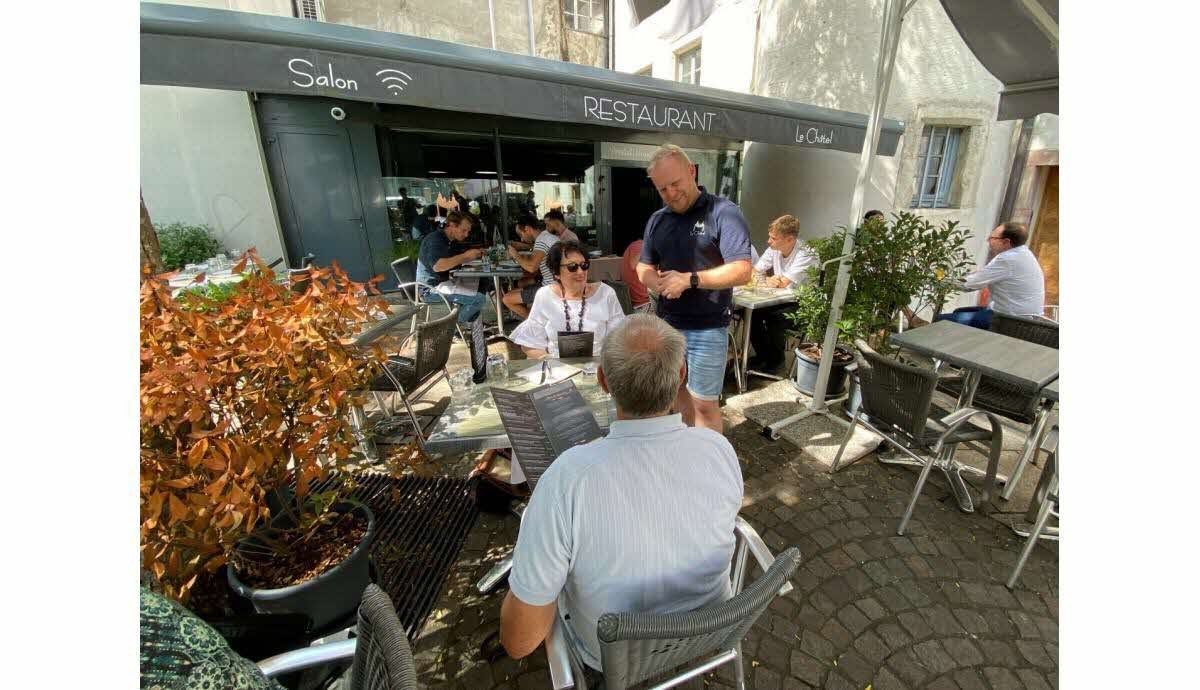
Where Montbéliard Meets the Table
Rue du Collège runs along the lower flanks of the old town, with the pale stone of Montbéliard's ducal château visible above the rooflines. The approach to Le Châtel carries the particular atmosphere of a provincial French city that has never needed to perform for tourists: the streets are narrow, the architecture is genuine, and the restaurants that have lasted here have done so because they cook for the town before they cook for any guide. Le Châtel sits on this street as part of that civic fabric, and walking toward it, you are moving through a neighbourhood that has fed working families and civic occasions alike for generations.
Montbéliard occupies an unusual position in the French culinary map. Historically part of the Duchy of Württemberg rather than France proper until 1793, the city carries Germanic inflections through its food culture, choucroute traditions, smoked meats, the prominence of pork, while sitting close enough to the Franche-Comté heartland to draw on that region's extraordinary dairy heritage. The Comté cheese aged in Fort Saint-Antoine, the Morbier with its ash vein, the Vacherin Mont d'Or that appears only in winter months: these are the larder of Le Châtel's surrounding countryside, and any serious kitchen in this city works with them.
Franche-Comté on the Plate: What the Region Produces
The Doubs department, which surrounds Montbéliard, produces particularly geographically specific ingredients in the country. Comté, the consumed AOC cheese in France by volume, is made in over 150 small fruitières across the Jura massif and aged to specifications that vary dramatically by affinage house. Montbéliard itself gives its name to the saucisse de Montbéliard, a smoked pork sausage with IGP protection, which distinguishes it from industrial imitations through its cold-smoke process over conifer wood. These are not decorative regional references; they are the building blocks of a cuisine that has production integrity written into its protected designations.
This kind of terroir density places Montbéliard in a different conversation from the spectacle-driven destination restaurants further south. Kitchens at Mirazur in Menton or Flocons de Sel in Megève have built global reputations partly on dramatising their regional ingredients for an international audience. A restaurant in Montbéliard operates closer to the source: less distance between producer and plate, less need to narrate provenance because the provenance is local knowledge. The same principle applies at places like Bras in Laguiole, where the Aubrac plateau functions as both context and content for the kitchen's approach.
The proximity to Alsace is equally consequential. Strasbourg sits roughly 120 kilometres north, and the wine traditions of Alsace, Riesling, Gewurztraminer, Pinot Gris in demi-sec and dry styles, provide the natural pairing logic for a cuisine built around pork fat, cream, and acid-cut preparations. Au Crocodile in Strasbourg works within a formally Alsatian register; Montbéliard cooking sits at the southern edge of that same food culture, inflected by Franc-Comtois dairy and the Jura's yellow wines.
The Regional Table in National Context
France's highest-profile kitchens have increasingly converged on a model where regional sourcing is the premise of a tasting menu rather than the background of a carte. Alléno Paris au Pavillon Ledoyen and Assiette Champenoise in Reims operate at the formal end of this spectrum, with multi-course structures built around named producers and seasonal precision. Montbéliard's restaurant culture operates in a different register, closer to the brasserie bourgeoise tradition, where the same sourcing rigour appears in a more direct format, without the theatre of a multi-course sequence. The comparison is not about hierarchy but about form: regional integrity expressed through a direct carte has its own logic and its own difficulty.
Further afield, the Loire and Provence have been the French regions most associated with the farm-to-table editorial narrative. But the Franche-Comté case is in some ways more interesting, because its protected designations are older, stricter, and less susceptible to trend. The Comté wheel aged for 24 months in a specific cave carries a flavour profile that no other cheese exactly replicates, not because of chef intervention but because of microbial geography. Restaurants like Auberge de l'Ill in Illhaeusern and Georges Blanc in Vonnas have long worked within the framework of regional product specificity; Montbéliard continues that eastern-French tradition without the Michelin overhead those houses carry.
Paul Bocuse - L'Auberge du Pont de Collonges in Collonges-au-Mont-d'Or, Troisgros - Le Bois sans Feuilles in Ouches, and Auberge du Vieux Puits in Fontjoncouse each represent points on the spectrum from classical grandeur to intimate regional precision. The restaurant operates outside that tier, but the sourcing principles underlying those kitchens are the same principles that give Montbéliard's better restaurants their backbone.
Eating Well in Montbéliard: Planning Notes
The city is accessible by TGV from Paris Gare de Lyon via Belfort-Montbéliard TGV station, approximately two and a half hours by direct service, which makes it a viable day trip from the capital for those combining a meal with a visit to the château.
Restaurants like AM par Alexandre Mazzia in Marseille, Christopher Coutanceau in La Rochelle, and L'Oustau de Baumanière in Les Baux draw international visitors to their respective regions. Montbéliard draws a different traveller: one interested in how French regional cooking sustains itself outside the attention economy, where the produce speaks without amplification. For a transatlantic comparison of what ingredient-driven cooking looks like in a formally ambitious register, Le Bernardin in New York City and Atomix in New York City represent the American end of the same disciplined sourcing conversation.
How It Stacks Up
Comparable venues nearby, for context on price, style, and recognition.
| Venue | Cuisine | Price | Awards | Notes |
|---|---|---|---|---|
| Le ChâtelThis venue — the venue you are viewing | French Seasonal Bistro | $$ | Not listed | Not listed |
| Le Saint-Martin | Traditional French Fine Dining | $$$ | Michelin Plate | centre historique |
| Caveau Heuhaus | Traditional Alsatian Winstub | $$ | Not listed | Eguisheim |
| La Cocotte de Grand-Mère | Homemade French Bistro | $$ | Not listed | Place de l'École |
| Le Fangle | Traditional Savoyard Mountain Cuisine | $$ | Not listed | Avoriaz |
| Le Signal 2108 | Bistronomic French with Regional Specialties | $$ | Not listed | Signal Mountain |
Continue exploring
More in Montbéliard
Restaurants in Montbéliard
Browse all →
Hotels in Montbéliard
Browse all →

At a Glance
- Elegant
- Cozy
- Modern
- Family
- Casual Hangout
- Special Occasion
- Terrace
- Local Sourcing
- Street Scene
Current opening hours
- Monday
- 12–2:30 PM, 7–11 PM
- Tuesday
- 12–2:30 PM, 7–11 PM
- Wednesday
- 12–2:30 PM, 7–11 PM
- Thursday
- 12–2:30 PM, 7–11 PM
- Friday
- 12–2:30 PM, 7–11 PM
- Saturday
- 12–3 PM, 7–11 PM
- Sunday
- Closed
Hours can change for holidays and private events. Last verified .
Cozy library atmosphere with bookshelves, elegant and refined setting, pleasant shaded terrace.