Google: 4.7 · 640 reviews
.png)
A Michelin Plate-recognised address in the 17th arrondissement, La Table du Caviste Bio sits at the intersection of organic wine culture and modern French cooking. The €€ price point makes it one of the more accessible entry points into Paris's natural-wine dining scene, and a Google rating of 4.7 across 617 reviews suggests the room delivers consistently. Expect a wine-forward format where the cellar informs the menu, not the other way around.
 Discover on Pearl
Pearl is the En Primeur Club membership app — saves, bookings, and concierge access live there. Same editors, same standards.
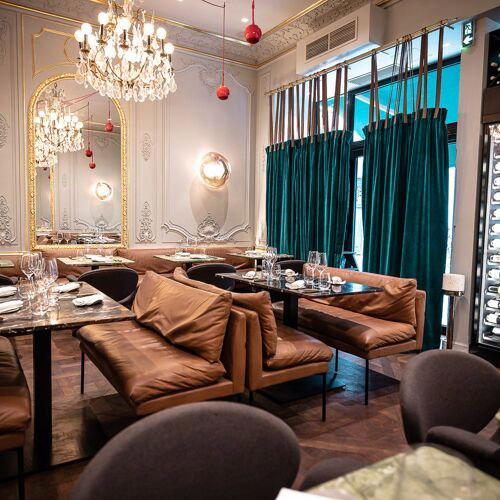
Where the Wine List Writes the Menu
Paris has always had restaurants that serve wine and wine bars that occasionally feed people. The more interesting category — and a growing one since the natural-wine movement took hold in the city's 11th and 10th arrondissements — is the address where the two disciplines genuinely inform each other. La Table du Caviste Bio, on Rue de Prony in the 17th, belongs to that category. The name signals the premise plainly: a wine merchant's table, grounded in organic and biodynamic producers. That framing matters because it changes the hierarchy in the room. The cellar is not a supporting actor here; it is the editorial argument around which everything else is organised.
The format echoes a broader Parisian shift away from the formal wine-list-as-afterthought model that still defines the €€€€ tier , venues such as Paul Bocuse - L'Auberge du Pont de Collonges or Auberge de l'Ill, where a classical cellar supplements a classical kitchen. At the other end of the price spectrum, the caviste-restaurant model stakes its identity on wine knowledge first, and lets the food follow the same organic logic. The result, when it works, produces menus that feel less like set pieces and more like a conversation between what the winemaker grew and what the cook found at the market that morning.
The 17th Arrondissement Context
Rue de Prony sits in the residential, relatively untheatrical part of the 17th, closer to Parc Monceau than to the tourist corridors of central Paris. Dining in this neighbourhood has traditionally served a local clientele of professionals and long-term residents who want somewhere reliable rather than somewhere photogenic. That audience is well-matched to a wine-focused format: the room does not need to perform. What it needs to do is stock well, rotate intelligently, and pair honestly , and a 4.7 rating from 617 Google reviewers, a meaningful sample for a neighbourhood address at the €€ price point, suggests it has earned that local trust over time.
For visitors who arrive in Paris with a list that begins at three Michelin stars and works downward, the 17th is often overlooked in favour of the 8th or the Left Bank. That's partly a function of proximity to monuments and partly habit. But the arrondissement has a scattered collection of serious tables operating below the radar of the major guides. La Table du Caviste Bio holds two consecutive Michelin Plates, awarded in both 2024 and 2025 , the guide's signal for good cooking that has not yet reached star level, or that is not seeking to. For a €€ address, that consistency is worth noting: Michelin does not distribute Plates automatically, and two consecutive years indicates a kitchen that has maintained its standard rather than spiking once.
Organic Wine as Curation Philosophy
The organic and biodynamic wine world in France has matured considerably from its countercultural early years. What once meant funky, low-intervention bottles from Jura or the Loire has broadened into a category that includes rigorous producers across Burgundy, the Rhône, Alsace, and Bordeaux. A caviste with a genuine commitment to the category now has to make active, considered choices: which growers, which vintages, which balance between natural-wine purism and wider organic certification. That curation work is what separates a themed wine list from a genuinely expert one.
The Bio designation in the name positions La Table du Caviste Bio within the more principled end of the organic spectrum, though without verified specifics from the cellar, the exact scope of the list , its depth by region, its coverage of small-grower versus domaine-scale producers , remains a question to investigate on arrival. What the format does imply is that the wine selection is not decorative. In a caviste model, the bottles on the list are typically available for retail purchase alongside dinner service, which means the inventory is live, rotated, and curated by someone who is buying actively rather than setting a list annually.
For comparison, the wine programs at three-star Paris addresses like Amâlia or the modern-cuisine format at Accents Table Bourse approach wine as a complement to a chef-driven tasting architecture. The caviste model inverts that: the wine vocabulary is the architecture, and the kitchen works in response. Neither approach is superior; they answer different questions for the diner.
Modern Cuisine at the €€ Level
La Table du Caviste Bio is categorised under modern cuisine, a classification that in Paris covers a wide range of ambitions and techniques. At €€, the expectation is not elaborate tasting menus but focused, well-executed plates that respect product quality , a reasonable fit for an address where organic sourcing in the cellar presumably extends to some logic about ingredients in the kitchen. The Michelin Plate recognition across two years aligns with this reading: cooking that is more than competent and clearly consistent, delivered at an accessible price that keeps the room democratic rather than ceremonial.
Paris's mid-range modern cuisine scene has strong competition. Anona and Auberge de Montfleury operate within a similar range of seriousness, and across the city, addresses like 114, Faubourg represent the upper end of accessible fine dining. La Table du Caviste Bio's differentiator is not complexity of technique but specificity of approach: a wine-first identity that gives the experience a coherence that purely food-led mid-range restaurants can struggle to match. The menu's purpose is to make the wine selection make sense, and in that narrow aim, it has a clarity that is harder to execute than it looks.
Planning a Visit
La Table du Caviste Bio is at 55 Rue de Prony, 75017 Paris, accessible from the Wagram or Malesherbes Métro stations on lines 2 and 3 respectively. At the €€ price range, the table is accessible for a weeknight dinner without the advance planning required at the city's starred addresses. Given the 4.7 rating and the niche appeal of an organic caviste format, booking ahead , particularly for weekend tables , is the sensible approach; walk-ins at a small neighbourhood address with an active following carry risk. Current hours, booking methods, and any seasonal menu details are leading confirmed directly with the venue. For a broader view of the Paris dining scene across price tiers and neighbourhoods, our full Paris restaurants guide maps the city's options in more detail.
Visitors oriented around wine specifically may also find value in our full Paris wineries guide, while those building a wider itinerary across the city can consult our full Paris hotels guide, our full Paris bars guide, and our full Paris experiences guide for complementary recommendations. For context on what France's serious restaurant culture looks like at higher price tiers and in other regions, Mirazur in Menton, Flocons de Sel in Megève, Troisgros in Ouches, and Bras in Laguiole each represent a different register of French culinary ambition. For modern cuisine beyond France, Frantzén in Stockholm and FZN by Björn Frantzén in Dubai are useful reference points for the category at its most technically ambitious.
Side-by-Side Snapshot
A quick context table based on similar venues in our dataset.
| Venue | Cuisine | Price | Awards |
|---|---|---|---|
| La Table du Caviste BioThis venue — the venue you are viewing | Modern Cuisine | €€ | Michelin Plate (2025); Michelin Plate (2024) |
| Alléno Paris au Pavillon Ledoyen | Creative | €€€€ | Michelin 3 Star |
| Kei | Contemporary French, Modern Cuisine | €€€€ | Michelin 3 Star |
| L'Ambroisie | French, Classic Cuisine | €€€€ | Michelin 3 Star |
| Le Cinq - Four Seasons Hôtel George V | French, Modern Cuisine | €€€€ | Michelin 3 Star |
| Plénitude | Contemporary French | €€€€ | Michelin 3 Star |
Continue exploring
More in Paris
Restaurants in Paris
Browse all →
Bars in Paris
Browse all →
Hotels in Paris
Browse all →
At a Glance
- Elegant
- Sophisticated
- Modern
- Intimate
- Date Night
- Special Occasion
- Business Dinner
- Wine Cellar
- Extensive Wine List
- Natural Wine
- Organic
Stylish modern dining room with chic and sober decor and impeccable service.