
Tabelog 100 #26
Our verdict
La Strada belongs to Tokyo’s serious soba tier: tiny room, reservation-led dinner, no menu, and a price band that separates it from casual noodle shops. Its Tabelog 100 Soba EAST 2025 selection and earlier Tabelog Award Bronze wins place it in a narrow category where buckwheat, sake, and format discipline matter more than decoration.

Pearl is the En Primeur Club membership app, where members save venues, book tables and use the concierge.
The menu
What to order
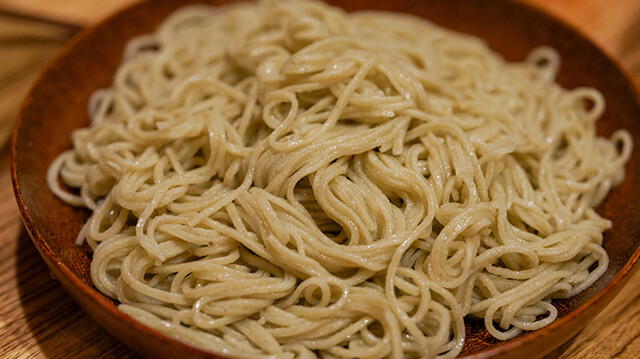
- Homemade soba (buckwheat noodles)
- Chef’s choice dinner course with soba and seasonal dishes
- Rich homemade tofu
- Seasonal simmered dishes with house dashi
In Tokyo, the approach is part of the sorting mechanism. La Strada is a room whose public identity is narrower than the city around it: the confirmed category is soba, and the useful way to read it is through focus rather than spectacle. The understatement fits Tokyo soba culture at its most severe. The point is not a quick bowl between trains but soba treated as a deliberate dining choice.
Tokyo runs many dining economies at once. Some meals are built for speed, breadth, and value, while peers such as COCHIN NIVAS, Raa Menya Shima, and Kashiwagi help show how varied the city’s restaurant map can be. Soba here works differently. La Strada sits in a JPY 8,000 to JPY 9,999 dinner band, placing it closer to specialist restaurants where restraint and attention define the meal than to everyday noodle counters. Its Tabelog Hyakumeiten recognition for soba in 2025 gives that positioning a public benchmark beyond ordinary local reputation.
A focused soba restaurant built around buckwheat rather than breadth
The defining idea is concentration. La Strada is listed as soba, but not in the broad, choose-every-component model many visitors associate with casual noodle meals. The important point is that the restaurant’s identity is built around buckwheat noodles rather than a wide-ranging Japanese menu. That frames soba as texture, structure, and craft, not just flavour. The meal’s argument comes through attention to one tradition.
That also explains the price tier. Many visitors know soba as fast, inexpensive, and functional. Tokyo also has specialist rooms where the craft sits closer to a considered dinner than casual noodle dining. La Strada belongs to that second camp. The appeal is not breadth or improvisation but focus. This is not a place to approach as a generic stop for every taste; it is for diners who want the category itself to carry the evening.
The category is not incidental. Soba has long associations with restraint, texture, and the flavour of buckwheat itself, and La Strada’s public listing places it squarely inside that world. Without inventing a course list or operational details, the structure reads through the confirmed facts: buckwheat anchors the restaurant, and the category matters more than volume. The limited public description is information, not mystique; it tells diners to accept the house’s specialist focus or choose another room.
Why Tokyo suits this kind of soba
Tokyo is practical for both high-visibility dining and quieter specialist rooms, and that matters for soba, a tradition that rewards concentration over spectacle. The city’s restaurant culture can support places whose appeal is not a grand setting but a narrow category pursued seriously. For La Strada, the relevant location fact is simple: it is in Tokyo, and it belongs to the capital’s deeper soba landscape.
La Strada sits outside any need for landmark-driven storytelling. That does not make it casual; it makes it a different commitment. A Tabelog score of 3.77 and Tabelog Hyakumeiten recognition for soba in 2025 indicate a specialist audience that understands the category. For travellers mapping Tokyo by cuisine rather than landmark, the lesson is useful: soba depth is not confined to the city’s most obvious dining circuits.
The restaurant’s positioning changes the social contract. A specialist soba room cannot absorb expectations better suited to broad, flexible dining. Diners should plan around the confirmed budget, the category, and the fact that the restaurant is best understood as a focused soba destination. These are not charming inconveniences but the operating reality of Tokyo dining culture. The reward is focus, if the diner meets the format on its terms.
How to place it within a Tokyo dining itinerary
Read La Strada as a specialist soba dinner, not a broad Japanese restaurant. It pairs poorly with a day built around excess and well with an itinerary that studies one category at high resolution. Planning should be intentional because the confirmed budget places it in a defined dinner band rather than an inexpensive everyday bracket. Its Tokyo setting makes it easy to treat as one precise chapter in a larger city itinerary.
For a broader Tokyo dining map, contrast matters. A visitor could treat soba here as one chapter in a wider study of the city’s restaurants, then compare the experience with comparable venues such as COCHIN NIVAS, Raa Menya Shima, Kashiwagi, Cuisine Michel Troisgros, or Eau de Vie, each useful as a marker of how varied Tokyo dining can feel without forcing La Strada into the wrong category. The wider city context sits in Our full Tokyo restaurants guide, with parallel planning in Our full Tokyo hotels guide, Our full Tokyo bars guide, Our full Tokyo wineries guide, and Our full Tokyo experiences guide.
Japan’s dining culture is not confined to one kind of room, and useful comparisons can also come from unnamed dining rooms elsewhere in the country. For readers tracking Japanese drinking, rice, and noodle culture more broadly, broader examples can show how fragments of the same grammar travel, but La Strada should be judged first on its own confirmed terms: a Tokyo soba restaurant with a serious price band and public recognition in the category.
The editorial case is clear: this is for diners who want soba presented with consequence. The specialist category, JPY 8,000 to JPY 9,999 dinner positioning, Tabelog score of 3.77, and Tabelog Hyakumeiten recognition for soba in 2025 point in the same direction. Choose it to understand how far Tokyo can narrow a category without making it feel small.
Frequently asked questions
How much does it cost to eat at La Strada?
Pricing at La Strada is listed as JPY 8,000 - JPY 9,999.
How do I find La Strada?
Tokyo.
What are La Strada's hours?
Specific opening hours are not included in the provided venue facts.
What's the defining dish or idea at La Strada?
La Strada is built around soba. Its confirmed category is Soba (Buckwheat noodles), and it appears in the Tabelog Hyakumeiten recognition for soba in 2025.
Cuisine-First Comparison
Side-by-side context: comparable cuisine and price.
| Venue | Cuisine | Price | Awards | Notes |
|---|---|---|---|---|
| La StradaThis venue (the venue you are viewing) | Traditional Soba Counter in Nakano | $50–100 | Tabelog 100 #26 | Not listed |
| Tantantei | Classic Tokyo Shina Soba & Wonton Ramen | $10–20 | Tabelog 100 #84 | Hamadayama |
| Shio Ramen Shinka | Traditional Shio Ramen | $10–20 | Not listed | Machida |
| Mendokoro Honda | Modern Tokyo Ramen & Tsukemen | $10–20 | Tabelog 100 #12 | Akihabara |
| 梢 | Modern Japanese Kaiseki | Not listed | Not listed | Shinjuku |
| Itteki Hassenya Shinjuku honten | Japanese Udon Izakaya | $30–50 | Tabelog 100 #86 | Shinjuku |
Recognition history
Dated appearances from independent guides and award organizations, with the underlying list record or original source where available.
Tabelog 100 #26 · No. 26
Tabelog · Tabelog 100 - Soba - EAST - 2025
Continue exploring
More in Tokyo
Restaurants in Tokyo
All restaurants in Tokyo →



Bars in Tokyo
All bars in Tokyo →







Details
- Intimate
- Quiet
- Classic
- Cozy
- Solo
- After Work
- Casual Hangout
- Date Night
- Chefs Counter
- Standalone
- Sake Program
- Counter Dining
- Set Menu
- A La Carte
- Sake
- Beer
Current opening hours
- Monday
- Closed
- Tuesday
- Closed
- Wednesday
- 6–9 PM
- Thursday
- 6–9 PM
- Friday
- 6–9 PM
- Saturday
- 12–3 PM
- Sunday
- Closed
Hours can change for holidays and private events. Hours as of .
An intimate, reservation-oriented hideaway in a residential Nakano building, with just a small counter, no smoking, and a calm, quietly focused atmosphere centered on the chef preparing soba and side dishes in front of guests.