La Puerta Amarilla occupies a quiet side street in Madrid's Huertas neighbourhood, drawing a loyalist crowd that returns less for novelty than for consistency. The address sits within walking distance of the city's broader Barrio de las Letras dining corridor, placing it in a part of Madrid where neighbourhood character matters as much as what arrives on the plate.
Pearl is the En Primeur Club membership app — saves, bookings, and concierge access live there. Same editors, same standards.
- Address
- C. de Fúcar, 9, Centro, 28014 Madrid, Spain
- Phone
- +34911451168
- Website
- lapuertamarilla.es
- Directions
- Get directions
 Saves & bookings on Pearl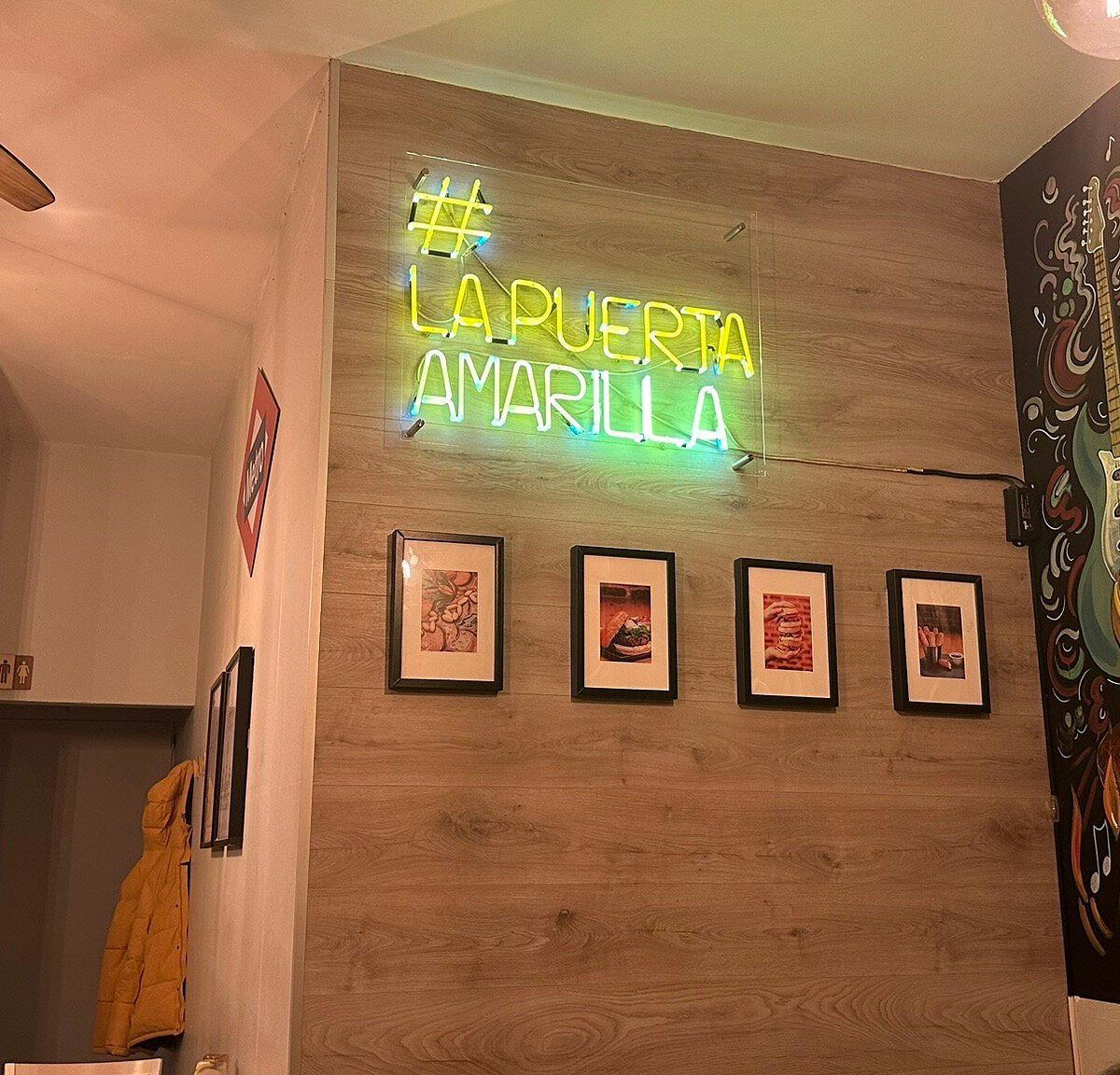
A Street in Huertas, and What It Reveals About Madrid Dining
Calle de Fúcar runs through Barrio de las Letras, one of central Madrid's more literarily charged neighbourhoods, where the streets are named for writers and the bars close late. The area has resisted the kind of concept-driven turnover that reshaped parts of Malasaña and Chueca over the past decade. Restaurants that survive here tend to do so not by reinventing themselves seasonally but by becoming fixtures, the kind of place where the staff recognise faces before orders are placed. La Puerta Amarilla, a restaurant in Madrid's Centro district, sits inside that pattern. The yellow door that gives the address its name is not a theatrical gesture but a practical one, a landmark on a block where similar-looking facades compete for attention.
In Madrid's dining map, Huertas occupies a middle register between the high-concept tasting-menu circuit and the rougher, more improvisational world of the city's taberna culture. That positioning matters for understanding what a neighbourhood regular expects when they return here. They are not arriving for the ceremony of a multi-course progression, the kind of experience you would find at DiverXO or Coque. Nor are they after the stripped-back spontaneity of a standing bar. The middle ground is harder to hold, and the venues that hold it reliably build the durable loyalty.
The Regulars' Logic
What keeps people returning to an address like this one, in a city with Madrid's density of options, is rarely a single dish. It is more often the accumulation of small consistencies: a table that feels claimed rather than assigned, a menu that shifts without becoming unrecognisable, a room that operates at a pace the diner controls rather than the kitchen. Spanish dining culture, particularly in Madrid, has always placed conversation at the centre of a meal rather than the plate. A restaurant that understands this does not rush its service or over-engineer its atmosphere. The regulars at places like this are not gastronomes tracking tasting menus across the city; they are people who have found a room where they can think clearly and eat well at the same time.
This is a different kind of loyalty from the kind generated by award recognition. Spain's highest-reaching kitchens, among them DSTAgE, Deessa, and Paco Roncero, attract diners who plan visits months in advance and often travel specifically for them. The neighbourhood restaurant builds its repeat custom differently, through proximity, reliability, and the particular comfort of knowing what you are walking into before you open the door.
Madrid's Neighbourhood Restaurant Tier
Spain's national dining conversation often centres on its headline addresses: El Celler de Can Roca in Girona, Arzak in San Sebastián, Mugaritz in Errenteria, Azurmendi in Larrabetzu, Martin Berasategui in Lasarte-Oria, and coastal kitchens like Aponiente in El Puerto de Santa María and Quique Dacosta in Dénia. These are destination restaurants in the fullest sense, planned around rather than stumbled upon. The same is broadly true of Barcelona's ambitious kitchens, including Cocina Hermanos Torres and Ricard Camarena in València, or the wine-and-culture proposition of Atrio in Cáceres.
Madrid's neighbourhood tier exists at a remove from all of this. Centro and its surrounding districts support a dense population of mid-register restaurants whose primary function is not to attract culinary tourists but to feed their immediate community well, consistently, and at a price that sustains repeat visits. In a city where dinner rarely begins before nine and can extend past midnight without social comment, the restaurant that manages this function becomes genuinely embedded in the fabric of a neighbourhood rather than decorating it.
The Unwritten Menu
Regulars at any long-standing address develop what might be called an unwritten menu: the things they order without looking at the card, the timing they have learned to request, the preferences the staff have absorbed over multiple visits. This phenomenon is not exclusive to fine dining. It is, in fact, more common at the neighbourhood level, where the relationship between diner and room has had more time to settle into routine. At places in Huertas with this kind of repeat custom, the kitchen's job is partly to honour that accumulated understanding, to deliver what is expected while leaving enough room for the evening to feel alive rather than mechanical.
For visitors arriving without that accumulated knowledge, the practical approach is to pay attention to what the room is ordering rather than defaulting to a tourist-facing reading of the menu. Madrid's neighbourhood restaurants often have dishes that circulate among the regulars that never receive the promotional emphasis of a signature. The instinct to ask what the table across from you is eating is rarely wrong in this part of the city.
Planning a Visit
La Puerta Amarilla sits at Calle de Fúcar 9, in the Centro district, postcode 28014. The neighbourhood is walkable from the major central Metro stops and well-served by night transport, which matters in a city where the later hours of a meal are often the important. The restaurant is recommended for reservations and follows regular hours: Mon to Sun, 1 to 4 PM and 8 to 11 PM.
The technical ambition of a kitchen like Le Bernardin in New York City or the precision of Atomix in New York City illustrates the distance between the neighbourhood tier and the global flagship tier, a distance that is not a judgment of quality but a description of purpose. What Madrid's neighbourhood restaurants do, at their steadiest, is something those destination addresses are structurally unable to replicate: they become part of a local life rather than an interruption of it.
Price Lens
Comparable venues nearby, for context on price, style, and recognition.
| Venue | Cuisine | Price | Notes |
|---|---|---|---|
| La Puerta AmarillaThis venue — the venue you are viewing | Not listed | $$ | Not listed |
| Alfredo's Barbacoa | Recoletos, American Barbecue & Burgers | $$ | Not listed |
| Steakburger | Las Tablas, American Steakhouse Burgers | $$ | Not listed |
| Distrito Burger | Not listed | $$ | Palos de Moguer, American Gourmet Burgers |
| No Va Mas | Vallehermoso, Burgers & Steakhouse | $$ | Not listed |
| SteakBurger Preciados | Not listed | $$ | Palacio, American Grilled Meats & Gourmet Burgers |
At a Glance
- Cozy
- Lively
- Casual Hangout
- Family
- Open Kitchen
Current opening hours
- Monday
- 1–4 PM, 8–11 PM
- Tuesday
- 1–4 PM, 8–11 PM
- Wednesday
- 1–4 PM, 8–11 PM
- Thursday
- 1–4 PM, 8–11 PM
- Friday
- 1–4 PM, 8–11 PM
- Saturday
- 1–4 PM, 8–11 PM
- Sunday
- 1–4 PM, 8–11 PM
Hours can change for holidays and private events. Last verified .
Relaxed and cozy with a good vibe and friendly service.