La Place Italienne in the 15th arrondissement sits at a particular intersection of Paris dining: the neighbourhood Italian that serves a local clientele with more consistency than fanfare. On Rue Eugène Gibez, it operates in a part of the city where Italian restaurants tend to outlast their trendier counterparts on the Right Bank, building regulars rather than reservations lists.
Pearl is the En Primeur Club membership app — saves, bookings, and concierge access live there. Same editors, same standards.
- Address
- 11 Rue Eugène Gibez, 75015 Paris, France
- Phone
- +33148281515
- Website
- laplaceitalienne.com
- Directions
- Get directions
 Saves & bookings on Pearl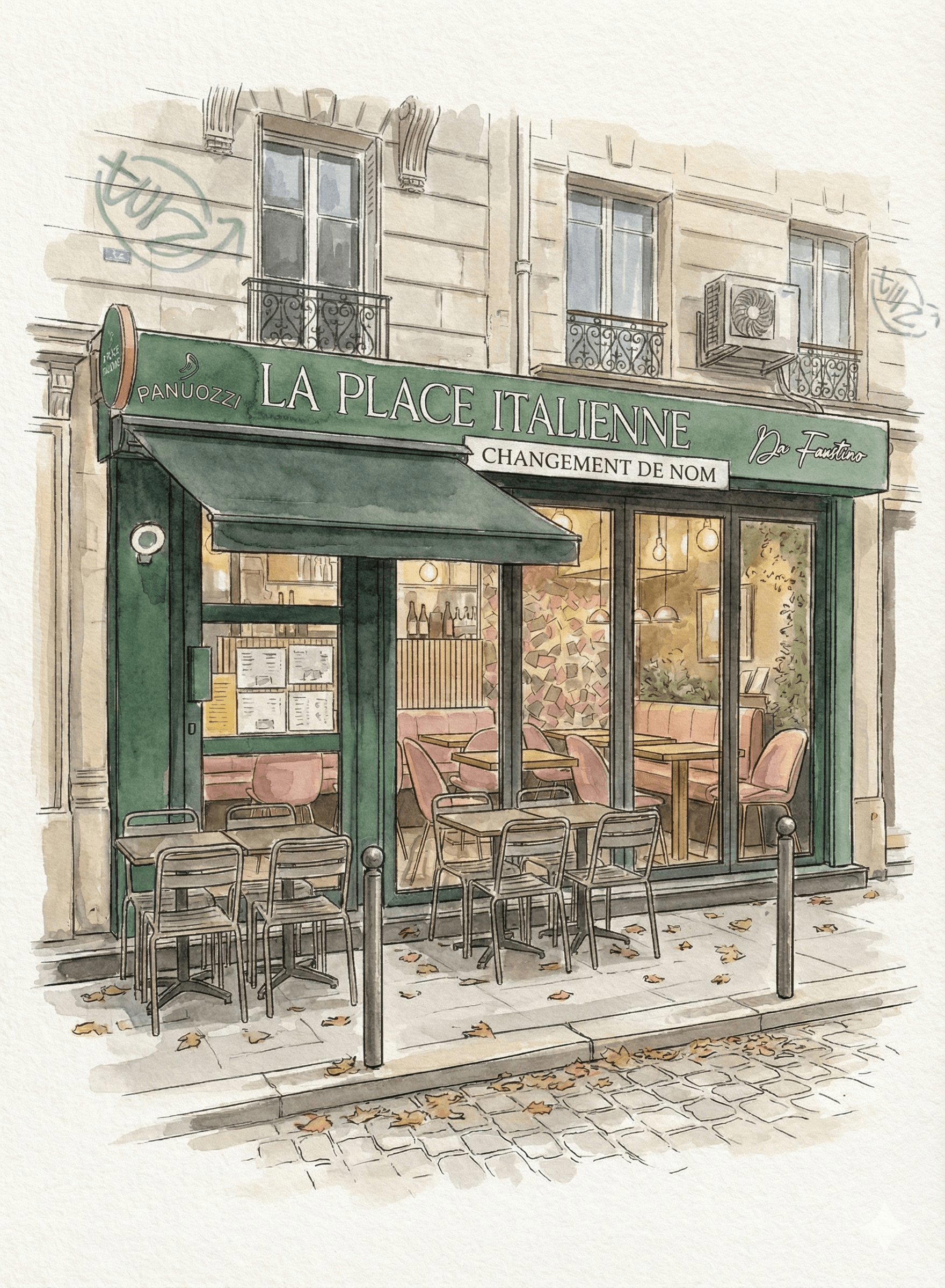
The 15th's Appetite for the Quotidian
Paris's 15th arrondissement has never chased the dining spotlight, and that relative indifference to trend cycles is precisely what gives it a particular character. While the city's high-end Italian offer has consolidated around a handful of addresses in the 8th and 1st — institutions trading on white tablecloths, cellar depth, and the kind of wine lists that align more closely with Le Cinq at the Four Seasons George V than with anything Neapolitan — the 15th operates on a different logic. Its restaurants survive by earning repeat business from a dense residential population, not by positioning against the Michelin circuit. Italian cooking in this context becomes less about provenance theatre and more about execution under everyday conditions: the pasta that arrives correctly al dente on a Tuesday, the sauce that doesn't drift between visits.
La Place Italienne on Rue Eugène Gibez sits within that neighbourhood dynamic. The address, mid-block on a quiet residential street in the southern 15th, signals its function before you read the menu. This is not a destination in the way that Paris's more decorated rooms position themselves. It is, instead, part of a longer Franco-Italian tradition of neighbourhood trattoria-style dining that has quietly persisted in Paris's outer arrondissements while the city's food press trains its attention elsewhere.
Italian Cooking in Paris and the Neighbourhood Question
The evolution of Italian dining in Paris follows a pattern worth understanding. Through the 1990s and into the 2000s, quality Italian in the city tended to cluster around a small number of upmarket addresses, with the broader category dominated by inconsistent pizzerias and pasta houses aimed at tourists. The shift came gradually, driven partly by French interest in regional Italian cuisine and partly by a wave of Italian chefs and restaurateurs who settled in Paris and opened more serious neighbourhood operations in the outer arrondissements. The 15th, with its large apartment blocks and stable population, became fertile ground for this kind of restaurant.
By contrast, the city's formal fine-dining circuit moved in a different direction altogether. The restaurants that attract critical attention, places like Arpège, Alléno Paris au Pavillon Ledoyen, and Kei, operate on tasting-menu formats, long booking windows, and price points that remove them from anything resembling casual neighbourhood use. The gap between that tier and the everyday Italian bistro is not just financial; it is structural. One requires planning, the other rewards spontaneity. La Place Italienne occupies the spontaneous end of this spectrum, serving a clientele that is less interested in narrative and more interested in reliability.
What the Address Tells You About the Format
Rue Eugène Gibez connects the Plaisance and Convention neighbourhoods in the 15th, running through a residential fabric of mid-century apartment buildings and local commerce. The dining offer on this stretch is functional rather than fashionable: boulangeries, brasseries, and a handful of ethnic restaurants that have held their positions across multiple decades. In this context, an Italian restaurant succeeds by doing a narrow range of things well and maintaining that standard across service. The format typical of this address type, a room of modest scale, a menu covering pasta, pizza, and grilled proteins, a wine list priced for everyday use, differs fundamentally from the Italian fine-dining approach that characterises addresses like L'Ambroisie in the Marais.
The practical intelligence here is direct: this part of the 15th is served by the Convention metro station on line 12, making it accessible from central Paris in under twenty minutes. The neighbourhood rewards walking, the Parc Georges Brassens lies a short distance south, and the broader residential texture of the southern 15th offers a more authentic slice of everyday Parisian life than the more visited arrondissements. For visitors who want to understand how Paris actually eats rather than how it performs eating for an international audience, the outer 15th is instructive.
The French Italian Neighbourhood Restaurant and Its Evolution
The Franco-Italian neighbourhood restaurant as a category has undergone quiet reinvention over the past fifteen years. Where earlier iterations prioritised volume, large rooms, quick turnover, menus calibrated for maximum breadth, the more recent evolution has moved toward smaller formats with tighter menus and better sourcing. This shift mirrors a broader movement in Paris neighbourhood dining away from the generalist brasserie model and toward more focused propositions. The leading regional French kitchens have followed a similar trajectory: consider how addresses like Flocons de Sel in Megève or Bras in Laguiole built reputations over decades by committing to a specific culinary logic rather than chasing breadth.
Neighbourhood Italian in Paris hasn't reached those altitudes, nor does it try to. What it has absorbed from that broader shift is the idea that a focused menu executed with care outperforms an expansive one executed with indifference. What is clear from its position on Rue Eugène Gibez is that it serves a local market that will calibrate its loyalty accordingly.
Paris in Context: What the 15th Offers
For readers planning time in Paris with dining as a priority, the 15th works well as a counterpoint to the city's more formal restaurant circuit. The Michelin-weighted rooms, L'Ambroisie, Alléno, and the rest, are covered in depth elsewhere. The interest in places like La Place Italienne is different: it is anthropological as much as gastronomic. Understanding how a residential arrondissement feeds itself, what it expects from an Italian kitchen, and what longevity looks like in a market that doesn't forgive complacency, that is a legitimate form of dining intelligence. France's broader restaurant culture has always maintained this dual structure, from Paul Bocuse's Auberge du Pont de Collonges at one extreme to the village bistro at the other, with the neighbourhood trattoria fitting somewhere in the productive middle.
For a fuller view of where La Place Italienne sits within the wider Paris dining picture, see our full Paris restaurants guide, which covers the city's dining from its most decorated rooms through to its most useful neighbourhood addresses.
Planning Your Visit
La Place Italienne is located at 11 Rue Eugène Gibez in the 15th arrondissement. The Convention metro station (line 12) provides one direct public transport connection from central Paris. The 15th is not a tourist-dense arrondissement, which means reservations at neighbourhood-level restaurants in this area typically require less lead time than equivalent addresses in the Marais or Saint-Germain.
How La Place Italienne - Paris 15: Casual Paris Lunch or Dinner compares with similar nearby venues.
| Venue | Cuisine | Price |
|---|---|---|
| Biscotte | Modern Cuisine | €€ |
| L'Accolade | French, Modern Cuisine | €€ |
Continue exploring
More in Paris
Restaurants in Paris
Browse all →
Bars in Paris
Browse all →
Hotels in Paris
Browse all →
At a Glance
- Cozy
- Classic
- Rustic
- Casual Hangout
- Family
- Group Dining
- Open Kitchen
- Standalone
- Beer Program
Current opening hours
- Monday
- 11 AM–2:30 PM, 6–11 PM
- Tuesday
- 11 AM–2:30 PM, 6–11 PM
- Wednesday
- 11 AM–2:30 PM, 6–11 PM
- Thursday
- 11 AM–2:30 PM, 6–11 PM
- Friday
- 11 AM–2:30 PM, 6–11:30 PM
- Saturday
- 11 AM–2:30 PM, 6–11:30 PM
- Sunday
- 11 AM–2:30 PM, 6–11 PM
Hours can change for holidays and private events. Last verified .
Warm and welcoming atmosphere with a contemporary take on traditional Italian trattoria design, creating a convivial and authentic dining environment.