Our verdict
On Rue Marbeuf in the 8th arrondissement, La Maison de l'Aubrac occupies a specific tier in Paris dining: the serious steakhouse anchored to regional French identity rather than haute cuisine spectacle. The address positions it steps from the Champs-Élysées corridor, but the orientation is firmly toward the cattle country of the Aveyron. A reference point for anyone tracing the arc from French terroir to Parisian plate.

Pearl is the En Primeur Club membership app, where members save venues, book tables and use the concierge.
The menu
What to order
- French Beef Steak
- Dry-aged Ribeye
- Lasagna of Aubrac's beef
- Aligot
Rue Marbeuf and the 8th's Meat-Forward Counter-Current
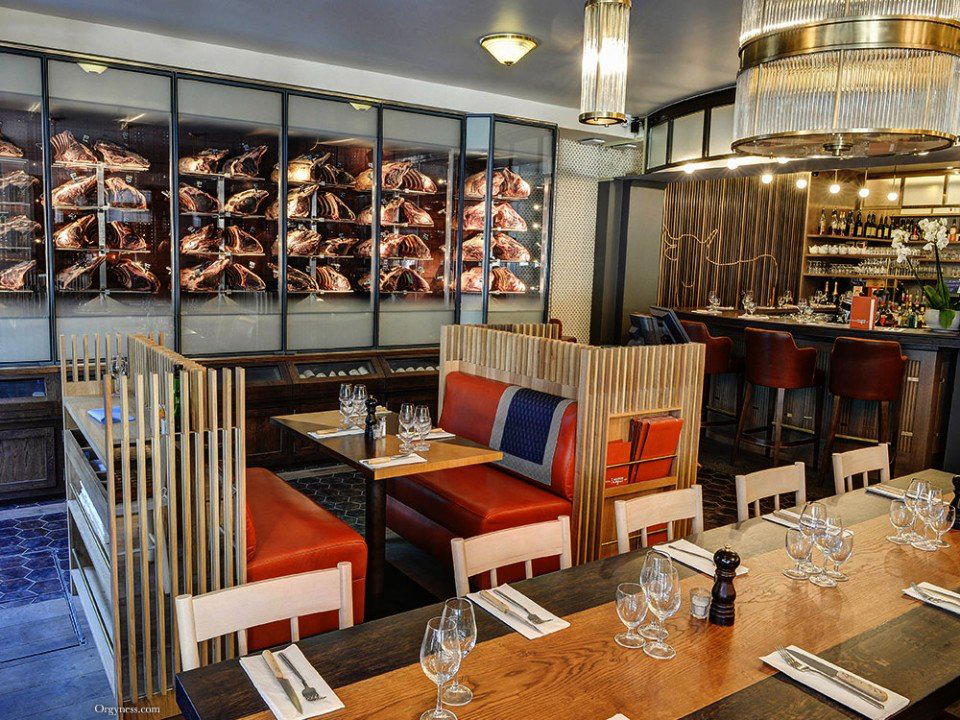
The 8th arrondissement is, on paper, the arrondissement of grand gestures: palace hotels, three-Michelin-star addresses like Le Cinq at the Four Seasons George V, and a dining culture that skews toward formal tasting menus and international clientele. Against that backdrop, La Maison de l'Aubrac at 37 Rue Marbeuf operates as a deliberate corrective. The room is built around beef, specifically, the Aubrac breed from the volcanic plateau of the Aveyron, served in a setting that reads as convivial brasserie rather than temple of gastronomy. Walking in from Rue Marbeuf, the sensory register shifts immediately: the smell of char and rendered fat, the sound of a room that does not quiet itself for ceremony, the visual weight of a space that treats its product as the main event without theatrical packaging.
This positioning matters in a city where the line between a serious restaurant and a dressed-up tourist trap in the 8th can be difficult to read on first approach. La Maison de l'Aubrac has been on this street long enough to accumulate a local regulars base alongside its visitor traffic, a distinction that shows in the pace and confidence of service rather than in any posted credential.
The Aubrac Breed as Editorial Argument
French regional beef culture has a more coherent identity than its international reputation sometimes suggests. The Aubrac breed, raised on the high basalt plateau shared by the Aveyron, Cantal, and Lozère departments, produces meat with a particular fat distribution and flavour profile shaped by altitude pasture and slower growth cycles. It occupies a different register from Charolais or Limousin, the two breeds that dominate French beef exports and supermarket shelves.
La Maison de l'Aubrac's entire editorial logic as a restaurant rests on making that distinction legible to a Paris diner. The approach parallels what houses like Bras in Laguiole have done for the Aubrac plateau's broader culinary identity: anchor the restaurant to a specific geography and let the product carry the argument. Where Bras pursues that argument through haute cuisine abstraction, La Maison de l'Aubrac pursues it through directness, the beef presented with minimal interference, the cooking focused on temperature and resting rather than transformation.
For context on how regional French identity plays out across different formats and price tiers, the contrast with institutions like Auberge de l'Ill in Illhaeusern or Troisgros in Ouches is instructive: those houses translate regional identity into multi-course architectural menus. La Maison de l'Aubrac does the opposite, compressing it into a single, confident product category.
The Wine Angle: What a Meat-Focused House Demands of Its Cellar
A restaurant built around a single dominant protein type creates a specific set of conditions for wine selection. The cellar at a serious steakhouse is not curated the way a multi-course tasting menu restaurant curates, it does not need to pivot across delicate fish, game, and dessert pairings. Instead, it can go deep in a narrower register: structured reds with enough tannic architecture to hold against fat and char, bottles that reward a table ordering a second glass without fanfare.
The natural reference points for a Paris beef house skew toward the southern Rhône and the southwest, Cahors, Madiran, Côtes du Rhône, and the appellations of the Languedoc that rarely appear on the lists of the more celebrated addresses nearby. These are wines that work at the table rather than wines that perform for the sommelier. That said, a Parisian address in the 8th, drawing an international clientele familiar with Bordeaux and Burgundy, requires both registers: something recognisable for the visitor who wants a Pomerol with their entrecôte, and something more pointed for the diner who knows that a Madiran from Alain Brumont at the right age is a more interesting partner for Aubrac fat than most classified Bordeaux.
This is a different curatorial philosophy from what you find at the starred addresses nearby. Alléno Paris au Pavillon Ledoyen and L'Ambroisie maintain cellars built to support extended tasting menus and sommeliers who function as a central part of the experience. The wine program at a maison de viande operates with less ceremony but arguably more precision in its core competency: finding the bottles that make a single great piece of beef taste better.
Where It Sits in the Paris Dining Field
Paris has several tiers of serious steak address. At the leading end, a hotel dining room like Le Cinq treats beef as one element in a broader French modernist menu. At the approachable end, a traditional brasserie serves steak-frites as a default rather than a statement. La Maison de l'Aubrac occupies the space between those poles: genuinely specialised, with a specific breed identity and a provenance argument, but accessible in format and free of the ritual that surrounds the starred addresses.
For visitors benchmarking against international peer cities, the closest analogue in New York's dining structure would be a dedicated single-breed house that sits above a steakhouse chain but below a white-tablecloth hotel restaurant, something in the territory that Le Bernardin occupies for fish, transposed to beef. The product focus is comparable; the ceremony is lower. See also Atomix for a sense of how a single strong culinary identity can carry a restaurant's entire program without needing to diversify across categories.
Across the broader French regional dining field, the Aubrac connection places La Maison de l'Aubrac in a loose orbit with houses that take plateau and mountain terrain seriously as flavour arguments: Flocons de Sel in Megève, Mirazur in Menton, and the southwestern producers who supply both the beef trade and the wine cellars of restaurants like this one. For the full Paris restaurant picture, see our Paris restaurants guide.
Planning a Visit
The address, 37 Rue Marbeuf, 75008, places La Maison de l'Aubrac within a short walk of the Franklin D. Roosevelt Métro stop (lines 1 and 9) and approximately equidistant from the Champs-Élysées and the quieter residential streets of the 8th that feed into it. The neighbourhood concentration of high-end dining in this arrondissement means competition for dinner tables is real, particularly Thursday through Saturday evenings.
| Venue | Category | Price Tier | Format | Booking Lead Time |
|---|---|---|---|---|
| La Maison de l'Aubrac | Regional beef / brasserie | €€-€€€ (estimated) | À la carte | Same week to 2 weeks |
| Le Cinq | French modern, hotel dining | €€€€ | Tasting menu | 4-8 weeks |
| L'Ambroisie | French classic | €€€€ | À la carte / set | 4-6 weeks |
| Kei | Contemporary French-Japanese | €€€€ | Set menus | 3-5 weeks |
| Arpège | Creative vegetable-forward | €€€€ | Tasting menu | 6-10 weeks |
For other regional French reference points beyond Paris, see AM par Alexandre Mazzia in Marseille, Assiette Champenoise in Reims, Au Crocodile in Strasbourg, Auberge du Vieux Puits in Fontjoncouse, and Paul Bocuse - L'Auberge du Pont de Collonges.
Frequently asked questions
Where do I go for La Maison de l'Aubrac?
La Maison de l'Aubrac is located at 37 Rue Marbeuf, 75008 Paris, France, Paris.
How does La Maison de l'Aubrac differ from other Paris steakhouses?
Most Paris steakhouses source from multiple breeds or international suppliers; La Maison de l'Aubrac is built around a single French regional breed, the Aubrac, giving the menu a specificity that positions it differently from broader grill-format competitors in the 8th. The address at 37 Rue Marbeuf places it within walking distance of the Franklin D. Roosevelt Métro (lines 1 and 9), away from the tourist-facing density of the Champs-Élysées strip, which shapes both the clientele and the room's register.
What do regulars order at La Maison de l'Aubrac?
The house identity is built around Aubrac beef, a breed raised on the high basalt plateaux of south-central France, so returning guests orient their order around whichever cut is driving the menu that day. The wine list is constructed to work with red meat as the dominant protein, meaning the pairing logic is unusually coherent for a Paris address at this price tier. Sides and accompaniments follow the beef rather than competing with it.
Is La Maison de l'Aubrac reservation-only?
The restaurant sits at 37 Rue Marbeuf in the 8th arrondissement, a neighbourhood where demand is consistent enough that booking ahead is advisable, particularly for dinner. Walk-in availability at the counter or bar area varies by service. Contacting the venue directly before arrival is the practical approach for any group larger than two.
City Peers
Comparable venues nearby, for context on price, style, and recognition.
| Venue | Cuisine | Price | Notes |
|---|---|---|---|
| La Maison de l'AubracThis venue (the venue you are viewing) | Traditional French Aubrac Steakhouse | $50–100 | Not listed |
| Arboré | Contemporary French Bistronomy | $50–100 | Madeleine |
| La Grande Épicerie de Paris - La Table | Classic French Bistro | $20–30 | 7e Arr. |
| Vin et Maree | French Seafood Brasserie | $50–100 | Louvre/Palais-Royal |
| La Ferrandaise | Traditional French Auvergne Bistro | $30–50 | Saint-Germain-des-Prés |
| Les Fables de La Fontaine | Modern French Seafood Fine Dining | $50–100 | 7th Arrondissement |