
Tabelog 100 #42
Our verdict
Kyoto Menya Takei Hankyuu umeda ten puts Osaka station dining into sharper focus: fast, counter-led tsukemen and ramen with serious local recognition rather than transit-hub compromise. Its repeated Tabelog Ramen selections from 2019 through 2025 place it in the city’s specialist noodle conversation, while the compact format keeps the experience closer to commuter ritual than destination dining theatre.

Pearl is the En Primeur Club membership app, where members save venues, book tables and use the concierge.
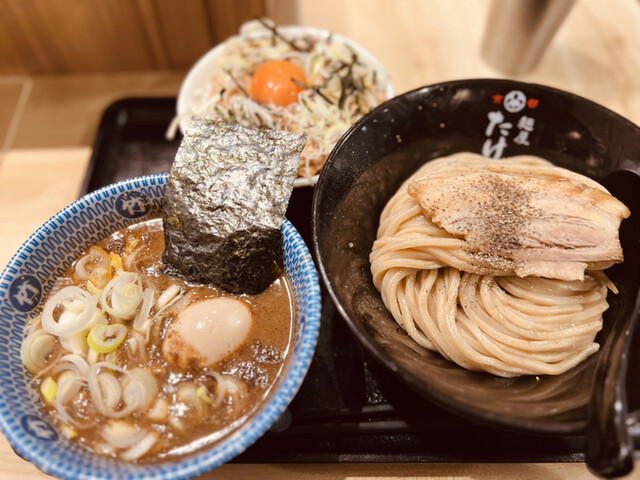
The menu
What to order
- Tsukemen (dipping noodles)
- Tokusei tsukemen with pork and seafood broth
- Shoyu ramen
- Ajitama soy-marinated egg topping
The approach is direct: commuter movement, bright everyday light, and a meal built for noodles rather than lingering. Osaka’s ramen culture has never depended only on tucked-away neighbourhood shops; some of its strongest everyday eating happens in busy urban corridors where speed, repetition, and consistency decide survival. Kyoto Menya Takei Hankyuu umeda ten belongs to that practical noodle lineage, with tsukemen and ramen treated as a focused category rather than a broad casual menu.
That matters because Osaka dining has changed. The old assumption that convenient restaurants trade ease for ambition has become less reliable, especially in the city’s busiest eating zones, where commuters, shoppers, and inbound travellers overlap all day. A noodle shop in Osaka now has to compete with specialist shops, bakeries, coffee counters, standing bars, and department-store dining within the same wider city rhythm. In that setting, recognition on Tabelog’s ramen Hyakumeiten list in 2025 is not decorative; it signals public standing in a category where repeat local use carries real weight.
Osaka ramen has moved from fallback meal to specialist format
Tsukemen is particularly well suited to a quick urban rhythm. Unlike long-form tasting formats, it rewards directness: noodles, dipping broth, pace, turnover. The form also asks more of a kitchen than ordinary convenience dining suggests, because the separation of noodle and broth leaves less room to hide imbalance. In Osaka, where casual eating can be technically disciplined without announcing itself, that format fits the city’s appetite for precision served quickly.
The narrow noodle focus reinforces the point. This is not a venue that needs to be understood through table conversation or extended drinking; it is best read through the bowl and the category. That places it closer to the city’s working lunch and post-commute habits than to the reservation-led restaurant circuit. Compared with nearby low-cost station options such as umugi Hankyu sanbangai ten or CAFE BAHNHOF Sanbangai ten, the appeal is narrower and more food-specific; compared with a higher-spend room such as nent, it sits in another category entirely. The useful comparison is not luxury versus casual, but whether a quick meal has enough specialist intent to justify choosing it over Osaka’s many easier defaults.
Osaka rewards that kind of decision-making. The city’s dining identity is often described through takoyaki, okonomiyaki, kushikatsu, and market eating, but its ramen and tsukemen scene has become a parallel map of everyday craft. In a city where visitor itineraries often compress into shopping, transfers, and quick meals, a serious noodle stop can function as a more accurate expression of the area than another polished dining room. The setting is practical, but the category is not secondary.
Tabelog recognition gives the shop its weight
The 2025 Tabelog ramen Hyakumeiten recognition is the clearest public marker here, alongside a Tabelog score of 3.70. For an inexpensive noodle format, that kind of listing matters because it places the shop inside a competitive field rather than treating it as a convenience choice. Ramen attention can be volatile because openings, social media heat, and regional preferences shift quickly; a current guide selection gives readers a useful signal without needing to inflate the experience.
The editorial angle is also geographic. Osaka’s noodle identity has become more precisely visible in public guides, and Kyoto Menya Takei Hankyuu umeda ten reads as a city-specific answer to a current food economy: quick, narrow, affordable, and judged against ramen peers rather than general casual restaurants. Its category is listed as tsukemen and ramen, which is enough to explain why the shop belongs in a premium guide even at a modest budget level.
There is no need to inflate the experience into theatre. The value is in compression. A tsukemen-and-ramen focus, a modest price band, and a practical meal structure are not limitations in this genre. They are the operating grammar. The reader choosing this stop should want the discipline of a short meal rather than the comforts of a long one.
How to fit it into an Osaka eating day
For travellers building an Osaka-based day, this is the sort of stop that pairs naturally with the city’s quick-service strengths rather than competing with dinner plans. The same itinerary logic can include bakeries, coffee counters, standing bars, or a more deliberate booking elsewhere in the city. For a broader city plan, use Our full Osaka restaurants guide alongside Our full Osaka hotels guide, Our full Osaka bars guide, Our full Osaka wineries guide, and Our full Osaka experiences guide.
The more interesting editorial lesson is that casual Japan should not be treated as a lower tier of seriousness. A focused noodle meal can sit in conversation with other specialist formats across the country without needing to imitate formal dining. The same logic now travels abroad through tightly defined Japanese casual formats, where the power comes from focus, repetition, and clarity rather than luxury signals.
Within Osaka, Kyoto Menya Takei Hankyuu umeda ten is at its strongest when judged on category fit. It is not trying to replace a long dinner, and it does not need to. It gives the city a credible ramen-and-tsukemen answer inside the flow of everyday eating, backed by current local recognition and a format that feels sharpened rather than broadened. That is the point: in a city where eating well often happens between destinations, the quick noodle stop can carry real editorial weight.
For another casual Osaka contrast, look to other dining in Osaka to see how international comfort formats sit beside the city’s noodle counters without replacing them.
Frequently asked questions
Does Kyoto Menya Takei Hankyuu umeda ten work for a family meal?
Kyoto Menya Takei Hankyuu umeda ten is best understood as a focused ramen and tsukemen stop in Osaka, with lunch and dinner budgets listed at JPY 1,000–1,999. It is better suited to a quick, contained noodle meal than a long sit-down occasion.
What kind of setting is Kyoto Menya Takei Hankyuu umeda ten?
It is a ramen and tsukemen venue in Osaka. The appeal is its narrow noodle focus, modest price band, and place within the city’s everyday casual dining rhythm.
Is Kyoto Menya Takei Hankyuu umeda ten expensive?
Pricing at Kyoto Menya Takei Hankyuu umeda ten is listed as JPY 1,000 - JPY 1,999 JPY 1,000 - JPY 1,999 View spending breakdown.
When is Kyoto Menya Takei Hankyuu umeda ten open?
Specific opening hours are not provided here; check the venue directly before planning around a visit.
At-a-Glance Comparison
Comparable venues at the same tier.
| Venue | Cuisine | Price | Awards | Notes |
|---|---|---|---|---|
| Kyoto Menya Takei Hankyuu umeda tenThis venue (the venue you are viewing) | Tsukemen & Ramen | $10–20 | Tabelog 100 #42 | Not listed |
| curry restaurant BRUNO HEP NAVIO ten | Japanese Curry House | $10–20 | Tabelog 100 #8 | Kita |
| Yakiniku Dote | Japanese Yakiniku | Not listed | Tabelog 100 #63 | Kita |
| Miyabi Tei | Japanese Teppanyaki | $30–50 | Tabelog 100 #70 | Kita |
| Shibaken | Premium branded-pork tonkatsu & curry | $30–50 | Tabelog 100 #3 | Miyakojima |
| Okonomiyaki Ajikuraya | Osaka okonomiyaki & teppanyaki | $30–50 | Tabelog 100 #26 | Tennōji |
Recognition history
Dated appearances from independent guides and award organizations, with the underlying list record or original source where available.
Tabelog 100 #42 · No. 42
Tabelog · Tabelog 100 - Ramen - OSAKA - 2025
Continue exploring
More in Osaka
Restaurants in Osaka
All restaurants in Osaka →




Bars in Osaka
All bars in Osaka →




Hotels in Osaka
All hotels in Osaka →



Wineries in Osaka
Browse all →
Details
- Lively
- Casual
- Cozy
- Solo
- After Work
- Casual Hangout
- Family
- Standalone
- Local Sourcing
- A La Carte
- Counter Dining
Current opening hours
- Monday
- 11 AM–10 PM
- Tuesday
- 11 AM–10 PM
- Wednesday
- 11 AM–10 PM
- Thursday
- 11 AM–10 PM
- Friday
- 11 AM–10 PM
- Saturday
- 11 AM–10 PM
- Sunday
- 11 AM–10 PM
Hours can change for holidays and private events. Hours as of .
Compact, counter-only ramen shop inside a busy train station with constant foot traffic, quick turnover, and a casual, energetic atmosphere focused on efficient solo and commuter dining rather than lingering.