KPOT Korean BBQ & Hot Pot
Our verdict
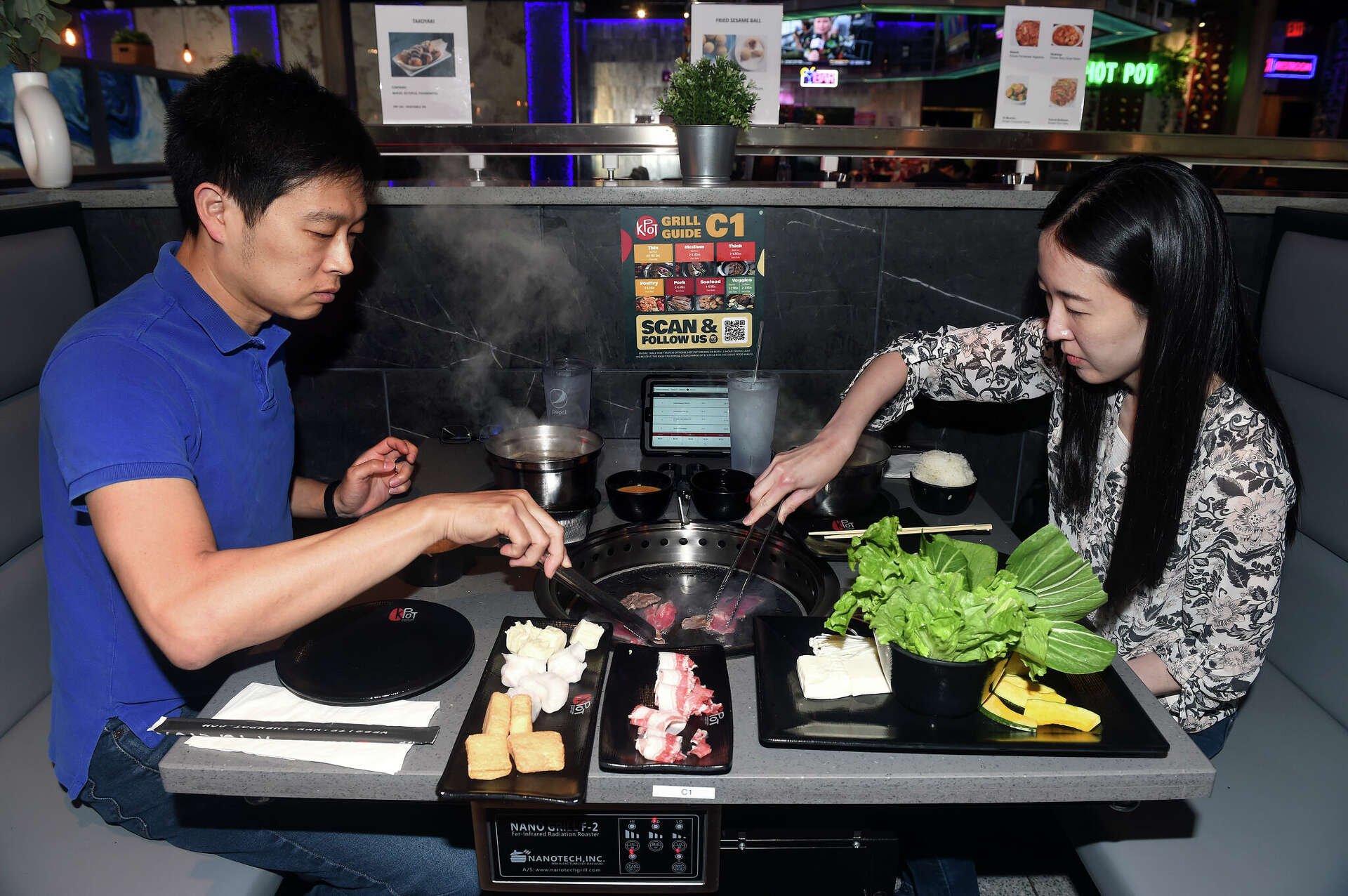
KPOT on San Antonio's I-10 corridor brings the all-you-can-eat Korean BBQ and hot pot format to a city more accustomed to Tex-Mex and brisket. The dual-concept setup places tabletop grills alongside simmering broth vessels, giving diners full control over heat, char, and pace. It sits at the more casual, high-volume end of the city's Asian dining spectrum.

Pearl is the En Primeur Club membership app — saves, bookings, and concierge access live there. Same editors, same standards.
- Address
- 12485 I-10, San Antonio, TX 78230
- Phone
- (210) 910-4494
- Hours
- Mon–Thu 11:30 AM–10 PMFri–Sat 11:30 AM–11 PMSun 11:30 AM–10 PM
- Website
- thekpot.com
- Directions
- Get directions
The menu
What to order
- Beef bulgogi
- Pork belly
- Marinated short-ribs
- Shrimp
- Salmon
Where Live-Fire Meets the Broth Bowl: San Antonio's Korean BBQ Scene
San Antonio's dining identity has long been anchored by smokehouses, taquerias, and Tex-Mex institutions. Venues like 2M Smokehouse and Mixtli define the city's more celebrated culinary registers. But a quieter shift has been underway along the I-10 corridor and the northwest side: the arrival of high-volume, participatory Asian dining formats that ask something different of the guest. Korean BBQ and hot pot, in particular, demand active engagement. You are the cook. The kitchen provides the raw material; the table is where judgment calls happen.
KPOT Korean BBQ & Hot Pot, located at 12485 I-10 in the 78230 zip code, represents the national expansion of this format into a city that, until recently, had limited exposure to it. The concept fuses two distinct Korean dining traditions under one roof: the charcoal-adjacent tabletop grill of Korean barbecue, where marinated and unmarinated proteins are cooked directly by diners, and the hot pot format, where a simmering flavored broth does the work at a slower, more contemplative pace. Combining both at a single table is a relatively modern commercial evolution, and KPOT has built a multi-location operation around it.
The Format and Why It Holds Up
Across American cities, Korean BBQ has followed a recognizable arc. Early adopters clustered in Koreatown enclaves in Los Angeles and New York, where the format was already established community practice. The subsequent decade brought it to suburban corridors and mixed-use retail strips, packaged for broader audiences without stripping the core mechanics. The all-you-can-eat pricing model, now common across national chains in this category, resolves the entry-barrier question: diners pay a flat fee and order from a set menu of proteins, vegetables, and broth bases, removing the anxiety of per-item pricing when exploring an unfamiliar format for the first time.
That accessibility is part of what has made the KPOT model expand across Sun Belt cities. San Antonio, with its military population, younger demographic base, and growing appetite for formats that function as social occasions rather than purely gastronomic ones, is a logical market. The I-10 location sits in a retail-dense corridor that draws from the entire northwest quadrant of the city, not just the immediate neighborhood.
Local Ingredients, Imported Technique
The editorial angle worth pressing here is what Korean BBQ and hot pot actually represent as culinary systems when transplanted into a Texas context. The technique is precise and codified: proteins are often pre-marinated in soy, sesame, garlic, and sugar combinations calibrated for high-heat, quick caramelization on a grill grate. The hot pot tradition draws on Chinese and Korean regional variants, with broths ranging from mild anchovy-kelp bases to intensely spiced tallow-forward preparations. Neither tradition originated in Texas, but Texas is not a passive host.
The state's cattle supply, in particular, creates an interesting intersection. Short rib cuts such as galbi, thinly sliced brisket, and rib-eye are standard Korean BBQ proteins that overlap directly with Texas's most culturally significant meat traditions. At higher-end expressions of Korean cuisine in the United States, venues like Atomix in New York City have demonstrated how Korean culinary logic applied to premium American proteins can produce results that operate at a different register entirely. KPOT operates at the accessible, volume end of this spectrum, but the underlying logic is the same: imported technique applied to familiar raw material.
San Antonio's own dining scene shows this intersection of technique and local product in other ways. Isidore approaches Texan ingredients through a fine-dining frame; 1Watson works a different register of that conversation. Korean BBQ does it through participation rather than presentation, which is a meaningful distinction. The diner's role shifts from passive recipient to active agent, and the quality of the outcome depends partly on how attentive they are to heat management and timing.
Positioning Within San Antonio's Dining Spectrum
Against the broader San Antonio restaurant map, KPOT occupies a specific lane. It is not competing with the tasting-menu ambition of Mixtli or the comfort-food authority of 410 Diner. The all-you-can-eat format positions it clearly in that tier.
Within the national context, Korean BBQ chains at this scale are a distinct category from the chef-driven Korean fine dining that has gained significant critical traction in recent years. Nationally, the most technically demanding end of Korean cuisine is represented at venues like Atomix, where the influence of Korean culinary tradition is channeled through a refined tasting format. The distance between that end of the spectrum and a volume-format chain is comparable to the distance between The French Laundry in Napa and a well-run French bistro. Both have legitimate value; they serve different purposes.
For context on what the highest technical registers of American restaurant cooking look like in 2024, the reference points run from Le Bernardin in New York City and Alinea in Chicago to farm-anchored projects like Blue Hill at Stone Barns in Tarrytown and Single Thread Farm in Healdsburg. KPOT does not operate in that conversation, nor does it need to. It serves a different reader need: reliable, social, interactive dining with a clear format and predictable pricing.
Planning Your Visit
The I-10 address in the 78230 area puts KPOT in the northwest corridor, accessible from the Medical Center district and the broader loop. For groups, the format rewards advance planning: the all-you-can-eat structure works well when the table agrees on pace and broth selections at the outset, since different broth bases accommodate different dietary preferences. For readers who want fine-dining benchmarks in San Antonio before or after a casual group meal, our full San Antonio restaurants guide covers the full spectrum, from Mediterranean-inflected midrange to the higher-register options on the River Walk and beyond.
Comparable all-you-can-eat Korean BBQ formats in major Texas cities tend to fill quickly on weekend evenings, particularly when warm-weather seasonality reduces outdoor dining competition. Visiting on a weekday or arriving at the start of service typically secures shorter waits. For readers who want to understand how global technique operating at a much higher price point and with farm-level sourcing integration works, venues like Providence in Los Angeles, Addison in San Diego, and Lazy Bear in San Francisco offer contrasting reference points in the West, while Emeril's in New Orleans and The Inn at Little Washington anchor the South and Mid-Atlantic ends of that conversation.
Frequently asked questions
What should I eat at KPOT Korean BBQ & Hot Pot?
What's the ideal way to book KPOT Korean BBQ & Hot Pot?
What makes KPOT Korean BBQ & Hot Pot worth seeking out?
Is KPOT Korean BBQ & Hot Pot allergy-friendly?
Is KPOT Korean BBQ & Hot Pot worth it?
Can you do Korean BBQ and hot pot at the same time at KPOT?
The Short List
Comparable venues nearby, for context on price, style, and recognition.
| Venue | Cuisine | Price | Awards | Notes |
|---|---|---|---|---|
| KPOT Korean BBQ & Hot PotThis venue — the venue you are viewing | Korean BBQ & Hot Pot | $30–50 | Not listed | Not listed |
| El Pastor Es Mi Señor | Mexico City-Style Taqueria | $10–20 | James Beard Award Semi Finalist | Northwest, Mexico City-Style Taqueria |
| La Malquerida | Authentic Mexican | $20–30 | Not listed | West Side, Mexican with Texas Twists |
| The Cove | Sustainable American Burgers & Tacos | $10–20 | Not listed | Alta Vista, Sustainable American Burgers & Tacos |
| Jasmin Thai Restaurant | Authentic Thai | $20–30 | Not listed | Northwest, Authentic Thai |
| Sichuan House | Authentic Sichuan Chinese | $20–30 | Diners, Drive-Ins and Dives Featured Restaurant | West Side, Authentic Sichuan Chinese |
Continue exploring
More in San Antonio
Restaurants in San Antonio
Browse all →
Bars in San Antonio
Browse all →

Hotels in San Antonio
Browse all →


Details
- Lively
- Energetic
- Modern
- Group Dining
- Celebration
- Family
- Date Night
- Casual Hangout
- Open Kitchen
- Craft Cocktails
- Beer Program
- Sake Program
- Family Style
- A La Carte
- Cocktails
- Soju
- Sake
- Beer
- Vegetarian Friendly
Current opening hours
- Monday
- 11:30 AM–10 PM
- Tuesday
- 11:30 AM–10 PM
- Wednesday
- 11:30 AM–10 PM
- Thursday
- 11:30 AM–10 PM
- Friday
- 11:30 AM–11 PM
- Saturday
- 11:30 AM–11 PM
- Sunday
- 11:30 AM–10 PM
Hours can change for holidays and private events. Last verified .
Lively and social atmosphere with good music levels that allow conversation; features cool TV channels and celebratory energy with birthday songs throughout the evening.