
Tabelog 100 #22
Our verdict
Osaka’s gyoza culture usually points toward speed, beer, and late-night repetition; Kitashinchi Fuka moves the form into a counter-led, course-driven register. Its Tabelog 100 Dumplings 2024 selection, eight-seat counter format, and Dojimahama basement setting place it in a smaller category: dumpling gastronomy treated with the discipline of modern Japanese dining.

Pearl is the En Primeur Club membership app, where members save venues, book tables and use the concierge.
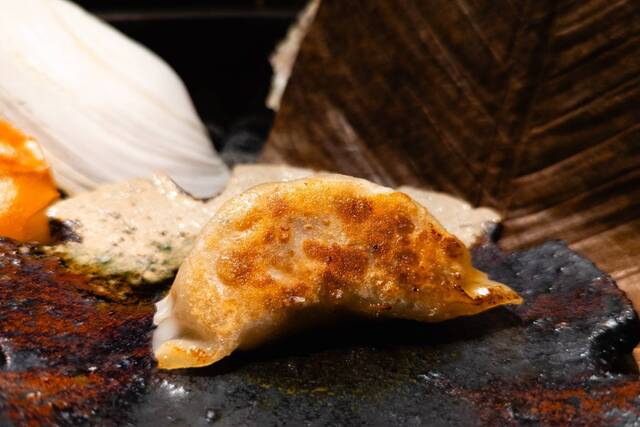
The menu
What to order
- Multi-course dumpling tasting menu
- Handmade xiaolongbao
- Original black and red sweet-and-sour pork
- Cod soft roe with shrimp ajillo
- Jamón Serrano soup with duck-stuffed cannelloni
- Wood-fired beef
Osaka’s premium dining circuit has a different charge from the city’s street-level dumpling shops. The mood is quieter, the audience more intentional, and a familiar food of repetition and speed is asked to carry more focus: wrapper, filling, heat, pacing, and service all have to land together.
That shift places Kitashinchi Fuka outside the city’s casual dumpling rooms. Osaka has long blurred class lines, from department-store counters to standing bars and late-night noodles. The newer premium tier asks whether a familiar form can hold attention without losing its direct appeal. Here, the answer is less novelty than control.
Gyoza treated as a focused format, not a side order
The useful frame is “Dumpling, Innovative,” the category attached to the restaurant’s public listing. It separates the cooking from casual grazing and luxury mimicry. The idea is dumpling as a complete culinary subject, with skin and filling treated as equal parts rather than one simply wrapping the other. In Osaka, where appetite often beats ceremony, that is a notable repositioning.
The Tabelog 100 Dumplings 2024 selection gives the room a concrete signal in a category where reputation can be anecdotal. Tabelog’s Hyakumeiten lists tend to reward category specialists rather than general glamour, so the recognition says this is being judged within Japan’s dumpling conversation, not simply as a polished Osaka dinner. The listed score of 4.01 reinforces its high-attention bracket for the genre.
The format is not just a menu note; it defines the meal’s logic. In a focused restaurant, the kitchen and service cannot hide behind spectacle. Timing, handoff, drinks, and clearing must function with precision. The style suits cuisine built on narrow margins: a dumpling is exposed if skin, filling, and finish fall out of sync. In a looser setting, that can read as inconsistency; here, it becomes the central point of attention.
Kitashinchi Fuka belongs to a recent Osaka pattern: specialist rooms using familiar Japanese categories as the base for more deliberate evenings. Yakitori Ichimatsu works a premium grammar through grilled chicken, while Shokudo Uchino uses Japanese dining as its frame; both show Osaka diners have room for formats that ask for attention rather than volume. Fuka’s distinction is applying that pressure to dumplings, a food many still associate with casual abundance.
The team dynamic is the point of the experience
Because no public chef biography is needed to understand the meal, the better reading is operational. A restaurant like this depends on a tight triangle: kitchen rhythm, front-of-house pacing, and drink service. That collaboration is what gives the experience shape. Dishes can be paced with intent, guests read quickly, and the evening stays closer to a focused workshop than a dining room built on layers of separation.
This matters in Osaka, whose hospitality culture has long prized controlled intimacy. The city is built for evening dining, client meals, and small rooms where the margin between warmth and stiffness is thin. A dumpling-focused restaurant here has to avoid two traps: turning gyoza into precious theater, or leaving the premium setting unjustified. The better version sits between them, using the format to sharpen the form rather than decorate it.
The comparison with casual Osaka gyoza is useful but limited. The city’s mass-affection side is portable, familiar, and woven into daily movement. Fuka belongs to the opposite end, where the diner pays for sequence, technique, and the accumulated attention of a small team. Both are Osaka, but they answer different appetites.
That spectrum makes the city compelling. A serious eating day might move through other Osaka dining rooms and end with a meal where a single category is pulled apart with care. Osaka’s range also includes many unnamed specialist kitchens and premium rooms, reminders that its dining conversation is not confined to one format.
Where it fits in an Osaka dining itinerary
This is a narrow-purpose dinner, and that is its strength. Diners looking for breadth across many Japanese forms may find more range elsewhere; diners interested in how far one everyday format can be pushed will understand the appeal quickly. The listed dinner budget of JPY 15,000 - JPY 19,999 reinforces an evening built around attention rather than drift.
Practically, the Osaka location pairs more easily with a drink-led second stop than another full meal. Dojima Samboa, in the same city, sits in a lower spend category and shows how Osaka can move from specialist dinner to classic bar culture within one evening. For a wider Osaka plan, treat this as one precise meal inside a larger map, not a catch-all introduction to the city.
Readers comparing categories across Osaka can place it beside other focused addresses on EP Club, including Ohata, Wagyuchugokusai Kumanohanare, Shokudo Uchino, and Yakitori Ichimatsu. Other Osaka dining rooms offer a broader contrast, showing how familiar forms can be translated into different service styles and levels of formality.
For city planning beyond one dinner, use Our full Osaka restaurants guide alongside Our full Osaka hotels guide, Our full Osaka bars guide, Our full Osaka wineries guide, and Our full Osaka experiences guide. The sharper reading of Kitashinchi Fuka is not that it makes gyoza luxurious by force; it shows how a focused Osaka restaurant can make a familiar form carry the weight of a serious dinner.
Frequently asked questions
What time does Kitashinchi Fuka open and close?
Published opening hours are not provided here. Check the venue’s official channels or call Kitashinchi Fuka for the latest schedule.
Is Kitashinchi Fuka more mid-range or high-end?
Pricing at Kitashinchi Fuka is listed as JPY 15,000 - JPY 19,999 for dinner.
What's the address for Kitashinchi Fuka?
Osaka.
What's the defining dish or idea at Kitashinchi Fuka?
The restaurant is listed as "Dumpling, Innovative" and was selected for Tabelog 100 Dumplings 2024. Its concept places dumplings in a more focused dining frame in Osaka, with dinner priced at JPY 15,000 - JPY 19,999.
Is Kitashinchi Fuka allergy-friendly?
Those details are not published here. Kitashinchi Fuka lists a phone number, +81-6-7653-6840, which is the clearest contact point for dietary questions. Check the venue's official channels for the latest details.
Is Kitashinchi Fuka suitable for children?
Those details are not published here. With a focused dinner format in Osaka, it is best to confirm suitability directly with the restaurant before booking.
The Quick Read
Comparable venues by price and recognition.
| Venue | Cuisine | Price | Awards | Notes |
|---|---|---|---|---|
| Kitashinchi FukaThis venue (the venue you are viewing) | Modern Chinese Dim Sum Tasting (Kitashinchi Counter) | $100–150 | Tabelog 100 #22 | Not listed |
| Ohata | Kansai-style Edomae Omakase | $150–200 | Tabelog Bronze #333 | Not listed |
| Shokudo Uchino | Modern Japanese Omakase | $100–150 | Michelin Plate | Japanese |
| Yakitori Ichimatsu | Michelin-starred Yakitori Chicken Kaiseki | $100–150 | 1 Michelin Star · Tabelog 100 #89 | JPY 15,000 - JPY 19,999 JPY 15,000 - JPY 19,999 |
| Dojima Samboa | Classic Japanese cocktail bar | $20–30 | Tabelog 100 #77 | JPY 3,000 - JPY 3,999 View spending breakdown |
| Wagyuchugokusai Kumanohanare | Chinese Wagyu Cuisine | Not listed | Michelin Plate · Tabelog 100 #82 | Not listed |
Recognition history
Dated appearances from independent guides and award organizations, with the underlying list record or original source where available.
Tabelog 100 #22 · No. 22
Tabelog · Tabelog 100 - Dumplings - 2024
Continue exploring
More in Osaka
Restaurants in Osaka
All restaurants in Osaka →




Bars in Osaka
All bars in Osaka →



Hotels in Osaka
All hotels in Osaka →



Wineries in Osaka
Browse all →
Details
- Intimate
- Elegant
- Cozy
- Modern
- Date Night
- Special Occasion
- After Work
- Solo
- Celebration
- Chefs Counter
- Design Destination
- Standalone
- Private Dining
- Tasting Menu
- Counter Dining
- Set Menu
Current opening hours
- Monday
- 6–11 PM
- Tuesday
- 6–11 PM
- Wednesday
- 6–11 PM
- Thursday
- 6–11 PM
- Friday
- 6–11 PM
- Saturday
- 6–11 PM
- Sunday
- Closed
Hours can change for holidays and private events. Hours as of .
A small, eight-seat counter space with warm lighting, refined but relaxed service, and a quietly luxurious Kitashinchi atmosphere that feels more like a chef’s studio than a typical dim sum restaurant.