
Kishida Ya is a Tsukishima counter izakaya with Tabelog 100 Izakaya EAST recognition in 2025 and a lineage that reaches back to 1900, before its 1966 shift into the tavern format it follows today. The appeal sits in Tokyo’s older, lower-waste drinking culture: compact seating, sake and shochu, take-out, cash-only payment, and a no-reservations rhythm that rewards patience rather than status.
Pearl is the En Primeur Club membership app — saves, bookings, and concierge access live there. Same editors, same standards.
- Address
- 3 Chome-15-12 Tsukishima, Chuo City, Tokyo 104-0052, Japan
- Phone
- +81 3-3531-1974
- Website
- tabelog.com
 Saves & bookings on Pearl
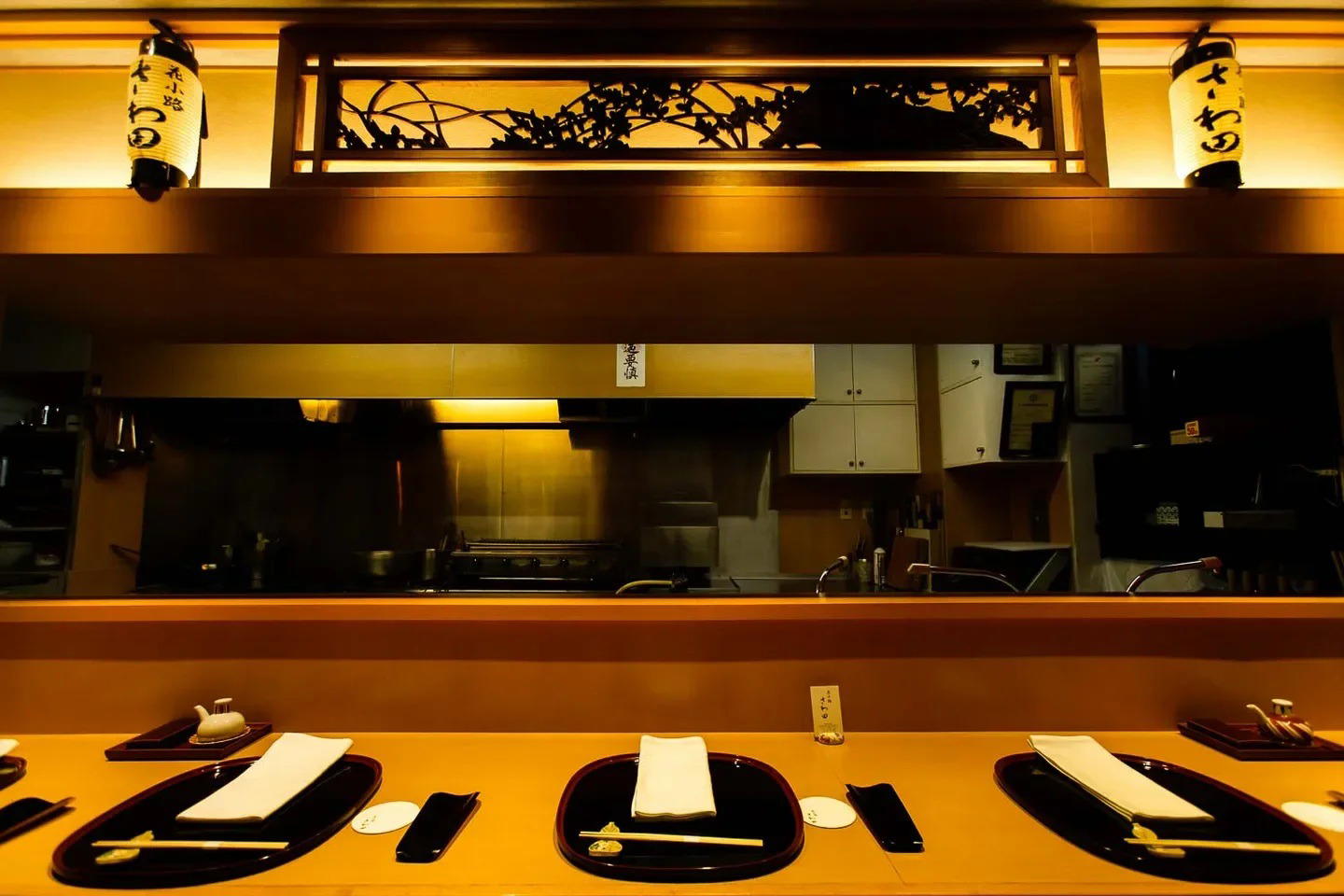
Tsukishima evenings differ from Ginza and Marunouchi’s polished dining corridors: streets narrow, pace slows, and izakaya tradition feels less like a category than a civic habit of small rooms, close counters, repeat customers, and food built for sake. Kishida Ya fits that older register: a 19-seat, counter-only tavern in a house-restaurant setting where scale is the argument.
Tokyo’s premium dining conversation often favors reservation systems, tasting-menu inflation, and chef-led theatre. The counter izakaya follows another logic: fewer seats and moving parts, no private rooms, no sprawling menu performance. That format can be environmentally modest without saying so. Smaller rooms reduce excess inventory pressure; drinking-led menus favor adaptable preparations; take-out from a compact kitchen extends production utility without a separate delivery machine. Kishida Ya’s reputation sits in that tradition, not in a contemporary sustainability slogan.
A counter izakaya shaped by restraint, not spectacle
Tokyo’s old tavern sustainability is rarely packaged for export. It appears in counter service, tight capacity, cash settlement, and a room run on rhythm rather than abundance. A 19-seat counter limits throughput and waste. Guests see the working shape of the evening, not a dining room engineered to absorb every request. In a city where premium restaurants can feel built for international demand, that matters.
Kishida Ya’s drink identity reinforces the point. Sake and shochu anchor the program, placing it in everyday Japanese drinking lineage rather than the global cocktail economy. Food is the practical partner to alcohol, conversation, and time at the counter, not an ornamental procession. The tavern form uses modest space well, rewarding dishes that can be paced, shared, repeated, or carried out, while making extravagance feel beside the point.
The award signal matters because this is not an obscure room surviving on nostalgia. Selection for Tabelog 100 Izakaya EAST in 2025 places it among eastern Japan izakaya with sustained public attention in a crowded field. Its Tabelog score of 3.73 is a useful local signal in Japan’s conservative, incremental scoring culture. Prior selections in 2021, 2022, and 2024 suggest continuity rather than a one-year spike.
That continuity has a long institutional arc. The business began in 1900 as a sweet red bean soup shop and became an izakaya in 1966. The detail is evidence of Tokyo’s adaptive food culture: premises and habits change use while neighborhood memory keeps them legible. In Tsukishima, where monjayaki dominates visitor shorthand, an old counter izakaya reveals broader casual, workday eating and drinking without hotel-lobby polish.
Where it sits in Tokyo's izakaya hierarchy
Tokyo’s izakaya field runs from casual chain rooms built for volume and price predictability to specialized counters where provenance, craft, and seat scarcity approach destination dining. Kishida Ya sits in a persuasive middle: recognized, small, historically anchored, and priced in the JPY 3,000 to JPY 3,999 dinner band rather than the luxury bracket.
That price position matters. Compared with Sakazuki at JPY 4,000 to JPY 4,999, Sakana ya Ajisen at JPY 6,000 to JPY 7,999, or Yakiniku Rin at JPY 10,000 to JPY 14,999, it is a lower-cost route into a serious Tokyo drinking room. KANE MASU belongs in the broader izakaya conversation, and Zaichi offers another Tokyo comparison, but the key distinction is format: a compact counter with no reservations behaves differently from a planned dinner appointment. It is less controllable and often more revealing.
That lack of control is not a flaw if approached correctly. Reservations are unavailable, so the experience belongs to the walk-in economy. This is Tokyo dining at its least concierge-friendly: visitors accept capacity and timing rather than impose a schedule. Guests needing a guaranteed seat, card payment, private room, or long group dinner should choose another format.
The environmental reading should stay grounded. Nothing needs inflating into a formal sustainability program. The stronger claim is that old izakaya mechanics often align with lower-waste behavior: compact inventory, limited seating, direct service, and a drink culture based on sake and shochu rather than resource-heavy spectacle. In a city of dining rooms competing through novelty, that operational restraint carries ethical weight.
How to plan a Tsukishima evening around it
Treat the meal as a neighborhood attempt, not a fixed itinerary anchor. The restaurant opens late afternoon and closes at night, with Monday, Sunday, and public holidays off. Its counter-only layout and no-reservations policy favor small parties. Payment is cash-only; credit cards, electronic money, and QR code payments are not accepted. The room is non-smoking, private rooms are unavailable, and parking is not provided, though paid lots exist nearby.
Location shapes the evening. The address is in Tsukishima, Chuo City, with Kachidoki and Tsukishima stations both practical access points. Do not pair it with a rushed cross-town hop after a hotel tasting menu. It works better as part of an eastern Tokyo night: arrive early, allow for waiting, and keep a second neighborhood option in mind.
For broader planning, compare it against EP Club’s Tokyo coverage rather than treating it as a standalone trophy. The full city restaurant map sits at Our full Tokyo restaurants guide, with adjacent city context in Our full Tokyo hotels guide, Our full Tokyo bars guide, Our full Tokyo wineries guide, and Our full Tokyo experiences guide. For different casual registers inside Tokyo, useful contrasts include. 鮪と炭火焼き うお炭 秋葉原店, 12/10 Shinjuku ten, 124. KAGURAZAKA (Yakitori), 2D Cafe, and 3 Chome no Curry Ya San.
Outside Tokyo, compact formats and local eating cultures appear differently at -Grilled beef Sukiyaki- KAMAKURA TANUKIAN 鎌倉 たぬき庵 in Kamakura.cafe in Osaka.know in Kumamoto, (Shoku) Vietnam in Kawasaki, [Curry Senmon Ten] Maruyama Kyoju. in Sapporo, and [ki:] in Kyoto. For Japanese drinking culture abroad, Jōdo Saké Bar in Los Angeles and Onigiri Time in Pasadena show how the categories travel, though Tokyo’s older counter izakaya remains its own discipline.
The editorial case for the restaurant is not conventional luxury. It is concentration: a small counter, long local memory, repeat Tabelog 100 recognition, and a price band within the everyday drinking economy. In 2026 Tokyo, that combination feels sharper than another expensive room promising novelty. The value is watching an older format keep working.
Price Lens
Nearby venues at a similar price tier for orientation.
| Venue | Cuisine | Price | Notes |
|---|---|---|---|
| Kishida YaThis venue — the venue you are viewing | Chūō, Traditional Tokyo Izakaya | $$ | Not listed |
| Hana Goori Kakigori | Not listed | $$ | Roppongi, Japanese Kakigori (Shaved Ice) |
| TAKEUCHI Chiyoda kanda jinbou honten | Chiyoda, Japanese Curry | $$ | Not listed |
| 赤坂 島袋 | Minato, Japanese Robatayaki | Not listed | Not listed |
| Okonomiyaki Kiji Shinagawa ten | Not listed | $$ | Minato, Osaka-style okonomiyaki & teppan grill |
| Katsuretsu Yotsuya Takeda | Shinjuku, Japanese Yoshoku & Tonkatsu | $$ | Not listed |
Recognition history
Dated appearances from independent guides and award organizations, with the underlying list record or original source where available.
Tabelog 100 #99 · No. 99
Tabelog · Tabelog 100 - Izakaya - EAST - 2025








At a Glance
- Classic
- Cozy
- Well Known
- Intimate
- After Work
- Casual Hangout
- Solo
- Group Dining
- Standalone
- Historic Building
- Chefs Counter
- Sake Program
- Beer Program
Current opening hours
- Monday
- Closed
- Tuesday
- 4–9 PM
- Wednesday
- 4–9 PM
- Thursday
- 4–9 PM
- Friday
- 4–9 PM
- Saturday
- 4–9 PM
- Sunday
- Closed
Hours can change for holidays and private events. Last verified .
A tiny, classic neighborhood izakaya with just a 19-seat counter, creating a cozy, lively ‘hideout’ feel in a traditional house-like space, focused on relaxed drinking and hearty stews rather than formality.