
Tabelog 100 #9
Our verdict
KING LION Sri Lanka Restaurant & Bar brings Sri Lankan curry and dining-bar culture into Kawasaki’s Mizonokuchi orbit, a commuter district better known for everyday Japanese dining than South Asian depth. Its Tabelog 100 selection for Asian and ethnic cuisine in EAST 2024 gives the small restaurant a clear credential, while the format stays casual, spice-forward, and accessible.

Pearl is the En Primeur Club membership app, where members save venues, book tables and use the concierge.
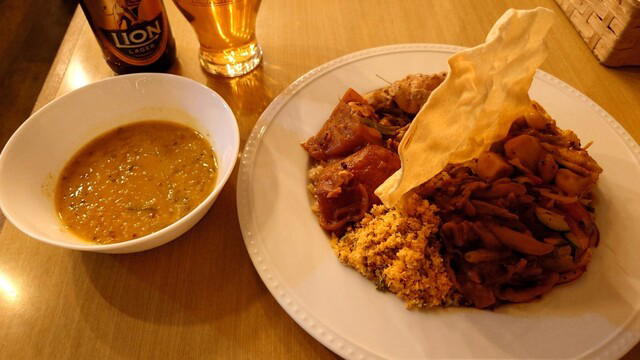
Approaching Kawasaki, the dining rhythm shifts from central Tokyo polish to local function: compact rooms, station traffic, weekday regulars, and restaurants built for repeat use rather than spectacle. Here, Sri Lankan cooking is framed less as a fashionable curry detour than as a daily-food tradition, where the appeal lies in mixing, contrast, and a plate that invites active eating rather than passive tasting.
Kawasaki’s strongest dining identity is not one cuisine but a patchwork of commuter-neighbourhood specialists, from casual spice rooms to more polished local tables. KING LION Sri Lanka Restaurant & Bar belongs to that tier. The point is specificity rather than luxury, and its Tabelog Hyakumeiten recognition in 2024 places it in a regional conversation beyond local curry cravings.
Sri Lankan curry in Kawasaki, read as a mixing culture rather than a single sauce
Japanese curry culture often prizes thickness, sweetness, and a tidy plate. Sri Lankan curry culture is often understood through contrast, heat, acidity, and multiple components combined by the diner. That distinction matters without turning the meal into anthropology. A Sri Lankan restaurant in Kawasaki must persuade diners who may arrive with Japanese curry expectations to think in layers: curry as relationships, not only a ladle over rice.
That is where KING LION’s recognition carries weight. Tabelog’s Hyakumeiten framework tends to reward restaurants that present a clear culinary identity within Japan’s dining grammar. The listed categories, Sri Lankan, curry, and dining bar, show its hybrid role: everyday meal, spice-driven specialist, and casual restaurant-bar format. That combination moves the experience beyond a simple lunch counter without making it formal.
The Kawasaki comparison set clarifies the niche. Match Bo Mizonokuchi ten and Tea House Mayur Miyazakidai ten sit in an everyday curry conversation, while Curry House Delhi also reflects the city’s appetite for accessible South Asian spice. Sushi Fukuhara works in an entirely different spending bracket, proving Kawasaki’s serious dining is not confined to one category. KING LION Sri Lanka Restaurant & Bar holds the middle ground: not a ceremonial counter, not a generic curry stop, but a compact ethnic-cuisine address with enough recognition to draw diners across Kawasaki.
The small-room advantage: spice, rhythm, and a dining-bar frame
Small restaurants can make regional cooking more legible because there is less noise around the plate. Here, scale matters in editorial terms rather than as a claim about exact capacity: the appeal is a close, casual format rather than a high-production dining room. For Sri Lankan food, that intimacy helps. The cuisine depends on spice rhythm and how separate elements meet; compact service keeps the emphasis on pace and immediacy.
The listed identity points to Sri Lankan cooking, curry, and a dining-bar frame. That trio explains part of the restaurant’s audience in Japan. It can feel intense without needing to be heavy, and it gives curry a more structured role than the generic category often suggests. The restaurant’s stated categories also help diners understand that the experience is not only about a single sauce, but about a broader casual dining vocabulary.
There is useful tension in the format. “Dining bar” in Japan can mean looseness: food with alcohol, flexible use, and a less formal relationship to courses. In a Sri Lankan context, that can fit a restaurant that wants to be more than a quick curry stop. The result is not a temple of purity, which is a strength. Diaspora restaurants often survive by translation; successful ones translate structure without flattening flavour.
For readers mapping Kawasaki, this kind of address explains the city better than a single prestige reservation. The area ranges across everyday specialists, casual counters, and more deliberate dining rooms. For a wider scan, use the broader Kawasaki dining landscape, then place this Sri Lankan room among the city’s daily-life specialists rather than treating it as a novelty.
Where it fits for travellers crossing Kanagawa and Tokyo
Kawasaki is useful precisely because it is not only a tourist dining stage. For travellers staying in or passing through the city, the appeal is a meal reflecting Japan’s mature appetite for regional Asian cooking outside the central-city spotlight. KING LION Sri Lanka Restaurant & Bar’s 2024 Tabelog Hyakumeiten recognition suggests that its relevance is not merely local convenience, but a stronger signal within its category.
It also rewards a different itinerary. Pair it with a Kawasaki day rather than forcing it into a Tokyo-only eating schedule. Visitors comparing categories can browse Kawasaki’s hotels, bars, wineries, and Our full Kawasaki experiences guide. The lesson is simple: Kawasaki dining is strongest when read by neighbourhood and purpose, not by central-city glamour.
Travellers building a broader Japan food route can compare how regional specificity appears in different formats, from traditional Japanese rooms and casual curry specialists to contemporary dining, café culture, and drinking-focused venues in other cities. Against that map, KING LION reads as a compact but serious expression of Sri Lankan food in Kawasaki: accessible, credentialed, and more culturally instructive than its casual frame first suggests.
Frequently asked questions
Where is KING LION Sri Lanka Restaurant & Bar located?
Kawasaki.
How much does it cost to eat at KING LION Sri Lanka Restaurant & Bar?
Pricing at KING LION Sri Lanka Restaurant & Bar is listed as Dinner: JPY 2,000 - JPY 2,999; Lunch: JPY 1,000 - JPY 1,999.
Do I need a reservation for KING LION Sri Lanka Restaurant & Bar?
For reservations or current availability, contact the restaurant directly in Kawasaki. As with many compact local restaurants, timing can matter during busy periods.
What's the defining dish or idea at KING LION Sri Lanka Restaurant & Bar?
The restaurant is listed as Sri Lankan, Curry, and Dining bar. The defining idea is Sri Lankan curry in a casual restaurant-bar setting rather than a standard Japanese curry shop.
What if I have allergies at KING LION Sri Lanka Restaurant & Bar?
Allergen information should be confirmed directly with the restaurant before ordering. If you have dietary restrictions, ask staff about ingredients and preparation on the day of your visit.
Price Lens
Nearby venues at a similar price tier for orientation.
| Venue | Cuisine | Price | Awards | Notes |
|---|---|---|---|---|
| KING LION Sri Lanka Restaurant & BarThis venue (the venue you are viewing) | Sri Lankan Restaurant & Bar | $20–30 | Tabelog 100 #9 | Not listed |
| Lilien Berg | Dessert Shop / European-Style Bakery Cafe | $10–20 | Tabelog 100 #89 | Asao-ku, Dessert Shop / European-Style Bakery Cafe |
| Etienne | Seasonal Japanese-French Patisserie | $10–20 | Tabelog 100 #80 | Shin-Yurigaoka, Seasonal Japanese-French Patisserie |
| Belmatine | Artisanal Bakery & Bread Shop | $1–10 | Tabelog 100 #13 | Nakahara-ku (Musashi-Kosugi Area), Artisanal Bakery & Bread Shop |
| カリフォルニア・ピザ・キッチン ラゾーナ川崎店 | California-Style Pizza | $20–30 | Not listed | Lazona Kawasaki, California-Style Pizza |
| Boulangerie Metier Pa-ku shiti musashi kosugi za ga-den | Not listed | $1–10 | Tabelog 100 #53 | Nakahara-ku (Musashi-Kosugi Area), Artisan Bakery & Bread Shop |
Recognition history
Dated appearances from independent guides and award organizations, with the underlying list record or original source where available.
Tabelog 100 #9 · No. 9
Tabelog · Tabelog 100 - Asian cuisine / Ethnic cuisine - EAST - 2024


Continue exploring
More in Kawasaki
Restaurants in Kawasaki
All restaurants in Kawasaki →

Bars in Kawasaki
Browse all →



Details
- Cozy
- Classic
- Family
- Casual Hangout
- Group Dining
- Solo
- Standalone
- Beer Program
- A La Carte
- Beer
- Vegetarian Friendly
Casual, welcoming, and dining-bar oriented, with a relaxed neighborhood feel rather than a formal or upscale atmosphere.