Kebaya Asian Brasserie
Kebaya Asian Brasserie sits in Lounge 2 at Amsterdam Schiphol, making it one of the few airport dining rooms in Northern Europe that draws on Asian culinary traditions at a credible level. For travellers transiting one of the continent's busiest hubs, it offers a clear alternative to the generic grab-and-go options that dominate terminal food courts. The kitchen positions itself within a brasserie format, structured, unhurried, rather than the fast-casual default of most airport food.

Pearl is the En Primeur Club membership app — saves, bookings, and concierge access live there. Same editors, same standards.
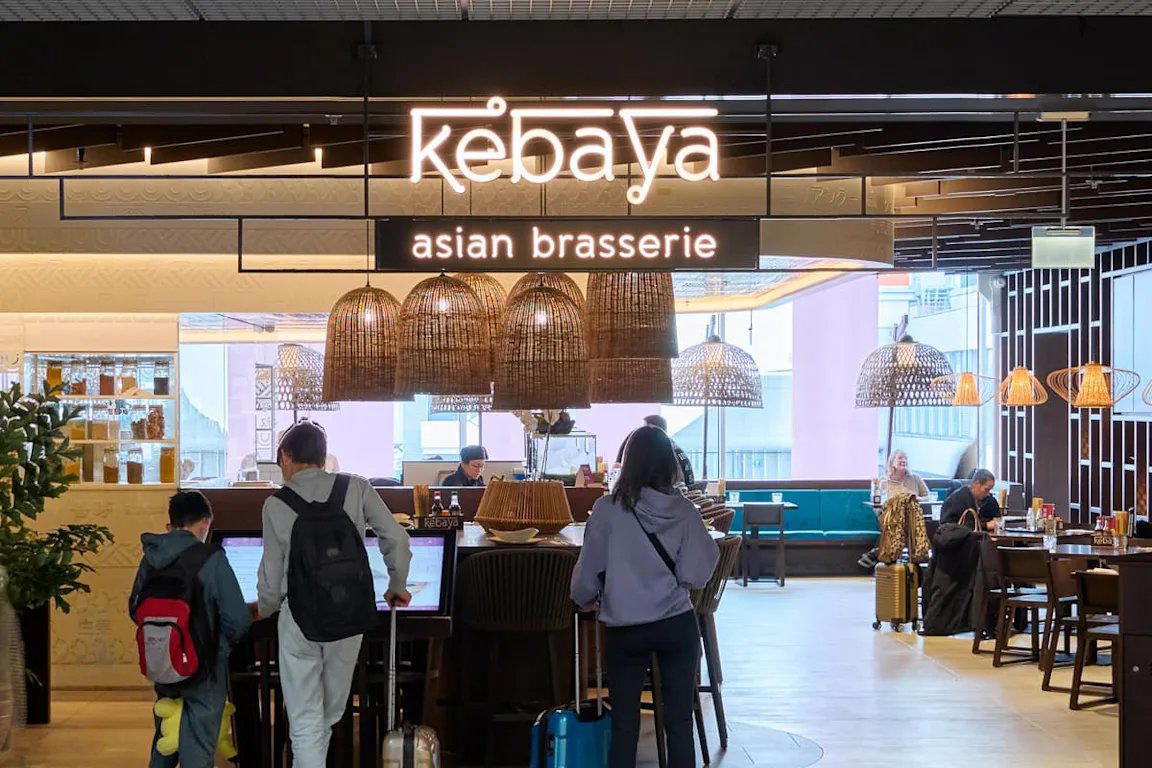
Asian Dining Inside One of Europe's Busiest Transit Hubs
Amsterdam Schiphol processes more than 70 million passengers a year, ranking it among the four largest airports in Europe by traffic volume. That scale creates a particular kind of dining problem: the sheer number of travellers and the short dwell times tend to compress food offerings toward speed and lowest-common-denominator familiarity. Most terminals at Schiphol, like their equivalents in Frankfurt, Heathrow, or Charles de Gaulle, resolve this tension by filling gate areas with franchise outlets and simplified menus designed for throughput rather than quality. Kebaya Asian Brasserie, positioned in Lounge 2, represents a deliberate move against that pattern, a brasserie format, with its implication of sit-down service and a broader menu, in a context where speed is usually non-negotiable.
The brasserie category matters here because it signals something specific about pacing and sourcing expectations. A brasserie, whether in Paris, Amsterdam, or an airport terminal, traditionally implies dishes with some structural complexity, ingredients prepared with care rather than assembled from pre-positioned components. In an airport context, that distinction is harder to sustain, but the naming choice at Kebaya sets an intention worth noting.
What the Asian Brasserie Format Means for Ingredient Logic
Asian brasserie dining in European airports sits at an interesting intersection. The category covers a wide geographic range, Southeast Asian, East Asian, and South Asian traditions all fall under that umbrella, and the sourcing decisions a kitchen makes within that range determine whether the result reads as authentic or merely referential. The strongest examples in this format, including operations at airports in Singapore and Hong Kong, tend to anchor their menus in a specific regional tradition rather than offering a pan-Asian survey, because doing so allows the kitchen to build consistent supply relationships with specialist producers.
At Schiphol specifically, the Dutch context matters. The Netherlands has one of the densest concentrations of Indonesian, Surinamese, and Chinese communities in Western Europe, a direct legacy of colonial trade networks and 20th-century migration. That means the Amsterdam metro region has genuine specialist suppliers for ingredients that would be harder to source consistently in, say, Munich or Stockholm. A kitchen operating inside Schiphol has geographic access to those supply chains in a way that airports in other Northern European cities do not.
This regional context places Schiphol's Asian dining options in a different category from the airport-Asian food common in Northern European hubs that lack the same community-driven supplier depth. It is the same logic that explains why the highest-scoring Asian restaurants in the Netherlands cluster around cities with established migrant communities, where generations of demand have built the supply infrastructure that serious kitchens depend on.
Where Kebaya Sits in the Dutch Restaurant Scene
To frame Kebaya's position accurately, it helps to understand the broader Dutch fine-dining structure it sits outside of. The Netherlands' most decorated kitchens operate at a different tier entirely: De Librije in Zwolle and 't Nonnetje in Harderwijk represent the country's €€€€ Modern and Creative ceiling, while operations like De Nieuwe Winkel in Nijmegen have built strong reputations around organic sourcing philosophies. Amsterdam's own Ciel Bleu operates at the summit of the city's hotel-dining tier. None of these belong to the airport dining category, but they establish the quality baseline that Dutch diners bring as a reference point, and against which any serious restaurant in the country will inevitably be measured.
Elsewhere in the Dutch scene, kitchens like Aan de Poel in Amstelveen, De Bokkedoorns in Overveen, and Inter Scaldes in Kruiningen have each carved distinct identities around product and place. Further afield, FG in Rotterdam and Brut172 in Reijmerstok anchor the southern end of the country's serious dining map, alongside De Treeswijkhoeve in Waalre, Tribeca in Heeze, and De Lindehof in Nuenen. Rural operations like De Lindenhof in Giethoorn, De Groene Lantaarn in Staphorst, and 't Amsterdammertje in Loenen aan de Vecht show that the country's appetite for considered dining extends well beyond its urban centres. Kebaya's airport setting places it in an entirely different competitive bracket from all of the above, but that context clarifies what a traveller is and isn't getting when they sit down in Lounge 2.
For a global reference point on what serious Asian dining looks like at the apex of its category, operations like Atomix in New York City, with its tasting menu format and deeply sourced Korean ingredients, or Le Bernardin's precision approach to product sourcing set the frame of what disciplined ingredient logic can achieve. Airport dining, by necessity, operates at a different scale and pace. The question for Kebaya, as for any airport restaurant attempting a serious food position, is how much of that discipline survives the operational constraints of a terminal environment.
Planning Your Visit: What to Know Before You Go
Kebaya Asian Brasserie is located in Lounge 2 at Amsterdam Schiphol Airport. Access to Lounge 2 is subject to the standard Schiphol terminal access rules, which means the restaurant is reachable only by passengers who have cleared security. Travellers intending to eat here should factor in time for security queues, which at Schiphol can extend to 30 minutes or more during peak departure windows in summer and around major Dutch public holidays. Kebaya Asian Brasserie is walk-in friendly. The restaurant is priced at about $35 per person and welcomes casual dress.
How It Stacks Up
Comparable venues nearby, for context on price, style, and recognition.
| Venue | Cuisine | Price | Awards | Notes |
|---|---|---|---|---|
| Kebaya Asian BrasserieThis venue — the venue you are viewing | Pan-Asian Fusion Brasserie | $$$ | Not listed | Not listed |
| Noeti | Oriental Fusion Fine Dining | $$$$ | Not listed | Oosterhout |
| Het Gerecht | Modern French with Global Influences | $$$ | Not listed | stadskern |
| Stiel Oriental | Modern Asian Small Plates | $$$ | Michelin Plate | Schagen |
| Brandsøn | Modern Seafood & International Fine Dining | $$$ | Not listed | Stokstraat Quarter |
| Restaurant Zaza's | International with French, Mediterranean & Asian Influences | $$$ | Not listed | Gerard Doubuurt |
Continue exploring
More in Schiphol
Hotels in Schiphol
Browse all →
At a Glance
- Lively
- Modern
- Trendy
- Energetic
- Casual Hangout
- After Work
- Open Kitchen
- Craft Cocktails
Lively and lively atmosphere inspired by contemporary Asian dining venues, with diverse seating including lounge areas, banquettes, communal tables, and bar seating.