Google: 4.5 · 709 reviews
.png)
Kaos occupies a vaulted brick space on Plaça de Sant Pere in Palamós, where a kitchen trained at El Celler de Can Roca, Disfrutar, and Enigma turns the Costa Brava's seasonal market into an à la carte that shifts with the catch and harvest. The Palamós red prawn appears in multiple preparations, and every rice dish is cooked to order. Michelin Plate recognition in 2025 places it in a credible mid-tier alongside the town's other €€ options.
 Discover on Pearl
A Vaulted Room and a Market-Driven Argument
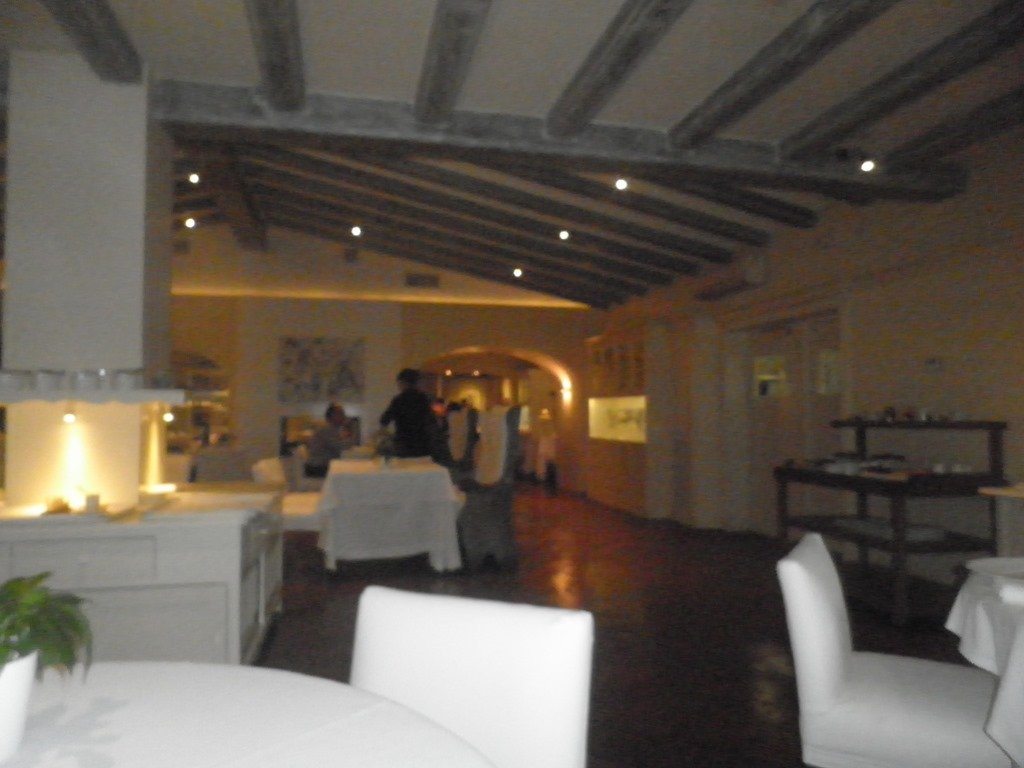
Below street level on Plaça de Sant Pere, the approach to Kaos already signals its intentions. You descend a staircase into a bar area defined by open-brick vaulted ceilings — the kind of architecture that Palamós's older buildings carry without effort — and then step into a modern dining room where the contemporary furnishings sit in deliberate contrast to the medieval stonework behind them. The physical layering is not accidental. It sets up a dining proposition that operates the same way: classical regional foundations, current technique applied on leading.
Farm-to-table as a restaurant category has become a broad tent in Spain, covering everything from rural farmhouses serving cured meats to high-technique kitchens treating local provenance as a design principle. Kaos belongs to the latter group. The kitchen takes its direction from what is available in the market on a given day, runs a varied à la carte that reads as current in format and sensibility, and supplements it with daily suggestions built around whatever the season is offering. In a fishing town like Palamós, that daily rotation is not a marketing device , it is the operational logic.
The Palamós Prawn and What It Reveals About Costa Brava Cooking
No ingredient defines Palamós's culinary identity more clearly than the gamba de Palamós, the red prawn pulled from the deep waters of the Cap de Creus submarine canyon. The prawn's reputation rests on a combination of factors: the cold, oxygenated water at depth, the short distance from sea to dock, and a fishing fleet that has maintained quality controls rigorous enough to support a protected designation. Chefs across the Costa Brava have built entire sections of their menus around it, and the conversations about how to present it , raw, briefly cooked, in technique-driven preparations , reflect a broader debate about when restraint serves an ingredient better than transformation.
At Kaos, that debate is answered by offering all three modes: carpaccio, cooked simply, and as the base of croquettes. Each preparation positions the prawn differently without asking the diner to choose a philosophy. The carpaccio honours the raw sweetness that the prawn's cold-water origin produces. The cooked version respects the texture that brief, precise heat achieves. The croquette form channels the ingredient into something the kitchen controls more directly, and where the surrounding bechamel and crust become part of the argument rather than a distraction from it. The fact that a €€ restaurant in a mid-sized fishing town offers three technically distinct presentations of its signature local ingredient says something about the competitive pressure Palamós's dining scene has built around this single product.
Rice Cooked to Order, and Why That Matters
Rice cookery in Catalonia sits in a specific tradition that is neither Valencian paella nor risotto, though it shares technical DNA with both. The Catalan coast has its own rice culture, built around sofregit bases, local seafood, and the discipline of timing. The key variable is always service pace: rice that is cooked ahead and held deteriorates in texture faster than almost any other preparation in a professional kitchen. Cooking each rice dish individually, as Kaos does, is a commitment that limits throughput and requires the kitchen to run rice to order rather than in batch. For a mid-tier restaurant operating a varied à la carte, that is a meaningful operational choice, not a default.
It also signals something about the kitchen's training references. The restaurant's couple-led team has worked in the dining rooms and kitchens of El Celler de Can Roca in Girona, Disfrutar, and Enigma , three of Spain's most technically demanding restaurants, each with distinct approaches to ingredient-led cooking. Training lineages of this kind show up in technique decisions rather than in name-dropping. The individual rice preparation is one of those decisions. It is the kind of discipline that a kitchen absorbs from working in environments where cutting corners on a dish has consequences.
Where Kaos Sits in Palamós's Dining Scene
Palamós is not a large town, but its restaurant density relative to its size reflects years of tourism investment and a local food culture that takes the prawn designation seriously. Within the €€ tier, the town runs several credible options with distinct identities. DVISI operates in the contemporary bracket. La Salinera works the traditional cuisine end of the spectrum. Entre dos Mons brings a Peruvian reference point that places it outside the regional tradition entirely, while Matsu Izakaya extends the town's range into Japanese contemporary. The spread is unusually wide for a town of this size.
Kaos occupies the farm-to-table position within that set, but with a training pedigree that differentiates it from casual seasonal cooking. Michelin Plate recognition in 2025 signals that the guide's inspectors found the kitchen executing to a consistent standard worth noting, even if the full star assessment places it below the town's highest tier. In the context of Spain's broader restaurant recognition landscape , which runs from three-star institutions like Arzak and Azurmendi through to the many Plate-level addresses that constitute the serious mid-range , a Plate at a €€ coastal address in a small Catalan fishing town represents reasonable value for the level of kitchen investment present. The same Plate designation applies to farm-to-table addresses elsewhere in Europe, including Au Gré du Vent in Seneffe and BOK Restaurant in Münster, which suggests a consistent Michelin framing for this kitchen style across geographies.
Google reviews stand at 4.6 across 557 ratings, a figure that reflects sustained quality across a volume of covers that removes the distortion of a small review sample. At this rating level and sample size, the consensus is reliable rather than exceptional, which tends to indicate consistent delivery rather than occasional brilliance.
Planning a Visit
Kaos is located at Plaça de Sant Pere, 14, in the centre of Palamós, making it walkable from the waterfront and from most of the town's accommodation. The €€ pricing sits at the mid-range of Palamós's dining options, and the à la carte format means the meal length is self-directed rather than fixed by a tasting menu sequence. Given the daily suggestions tied to market availability, the menu composition will differ meaningfully depending on when you visit , a spring visit will track different local ingredients than a summer or autumn one. The Palamós prawn season runs through the warmer months, which aligns with the town's peak visitor period, though the kitchen's treatment of the prawn across multiple preparations means a single visit can cover the range without requiring repeat trips. Reservations are advisable given the restaurant's recognition level and Palamós's summer tourist concentration; the Michelin Plate listing brings visitors from beyond the immediate area, and the dining room, while comfortable, is not a large space.
For broader planning in Palamós, see our full guides: restaurants, hotels, bars, wineries, and experiences.
Cuisine Lens
A fast peer set for context, pulled from similar venues in our database.
| Venue | Cuisine | Awards | Notes |
|---|---|---|---|
| Kaos | Farm to table | Kaos is run by a couple, both trained in leading restaurants such as El Celler d… | This venue |
| DVISI | Contemporary | Contemporary, €€ | |
| La Salinera | Traditional Cuisine | Traditional Cuisine, €€ | |
| Entre dos Mons | Peruvian | Peruvian, €€ | |
| Matsu Izakaya | Japanese Contemporary | Japanese Contemporary, €€ |
Continue exploring
More in Palamós
Restaurants in Palamós
Browse all →
Bars in Palamós
Browse all →
Hotels in Palamós
Browse all →
Wineries in Palamós
Browse all →
At a Glance
- Modern
- Elegant
- Cozy
- Date Night
- Special Occasion
- Open Kitchen
- Extensive Wine List
- Farm To Table
- Local Sourcing
Vaulted brick space with nice, non-pretentious dining room and very good atmosphere per guest reviews.