
Tabelog 100 #99
Our verdict
A Yurakucho sweets cafe built around the grammar of Japanese kanmi rather than pastry-shop spectacle: anmitsu, kakigori and take-out sit inside a compact, everyday format. Selection for Tabelog’s 2023 Tokyo Japanese sweets and sweets cafe 100 places it in a competitive city category where restraint, texture and tea-time utility matter more than ceremony.

Pearl is the En Primeur Club membership app, where members save venues, book tables and use the concierge.
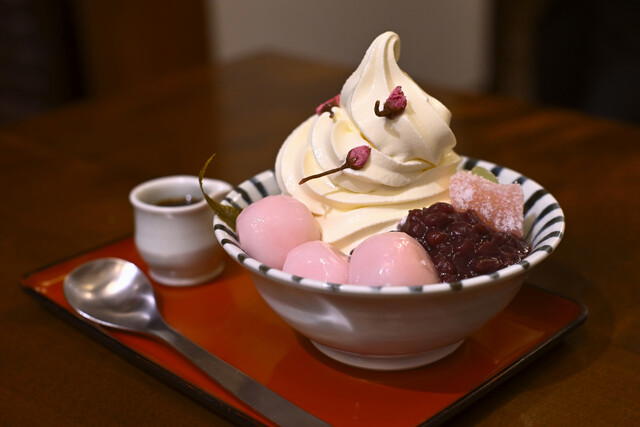
The menu
What to order
- Ohagi Tsubuan (sweet azuki rice ball)
- Ohagi Kinako
- Ohagi Goma
- Ohagi Sakura (seasonal)
- Anmitsu
- Chameshi Oden set
Tokyo’s compact dining culture runs on speed, small rituals and overlapping office workers, shoppers and theatre traffic. Here, Japanese sweets cafes do a different job from formal counters or larger dining rooms: they offer a pause without demanding an evening. Kanmi Okame Yuurakuchou ten fits that tradition, with a menu less chef’s manifesto than familiar forms: cafe-style Japanese sweets and kakigori built for repeat use.
The useful reading is structural. Tokyo’s kanmi menus often divide into lanes of chilled sweets, comforting cafe orders and seasonal refreshment. That explains why a sweets cafe matters in a city internationally known for many styles of dining. The discipline is proportion, temperature and texture, not luxury signals.
A kanmi menu built for pause, not performance
Japanese sweets cafes occupy the precise middle ground between confectioner, tea room and casual cafe. The category rewards clarity: traditional sweets elements, shaved ice and tea-friendly preparations arranged into combinations regulars understand before opening the menu. Kanmi Okame Yuurakuchou ten is listed in the cafe featuring Japanese sweets and kakigori category, a pairing that explains Tokyo’s dessert habits. Kakigori brings seasonality and heat relief; cafe sweets bring year-round structure.
That architecture differs from Western dessert service. A patisserie may lead with display-case drama; a kanmi shop leads with composition. Sweetness is one element among texture, temperature and balance. Pleasure comes from calibration, not excess. In Tokyo, that fits: the rhythm does not always favour a long dégustation at this hour. It favours a clean table, defined order and short reset between errands, shopping and trains.
The Tabelog 100 selection for Tokyo Japanese traditional sweets and Japanese sweets cafe in 2023 gives the address a useful trust signal without making it a trophy room. Tabelog’s Hyakumeiten lists are category-specific, placing the cafe among Tokyo peers in wagashi and sweets-cafe culture rather than the broader fine-dining hierarchy. A score of 3.73 points to sustained local attention in a category where regular use often matters more than international noise.
The comparison set sharpens the point. Wagashi Dokoro Oosumi Tamaya Ginza ten operates in the same sweets register, while Kanmi Okame Koutsuu kaikan ten signals a broader Okame presence in Tokyo. That cluster is part of the city’s food geography: sweets, coffee, curry, ramen and specialist counters sit close enough that a day’s eating can move by appetite rather than itinerary. High-ceremony restaurants such as 銀座 すきやばし次郎 本店 or yakitori rooms such as バードランド belong to another ritual; the kanmi cafe is the democratic counterweight.
Why Tokyo is the right setting for this kind of sweetness
Tokyo’s practical food culture rewards formats that understand movement. A sweets cafe is not an afterthought after dinner; it is an afternoon destination, meeting point or small recovery act between appointments. The format’s compactness matters because it can serve a precise need without turning every stop into a major meal.
The modest scale also shapes expectations. This is not framed as a sprawling salon for lingering groups. It belongs to Tokyo’s smaller urban dining grammar, where turnover, timing and table size influence the experience as much as the menu. The emphasis stays on casual cafe service and a sweets-focused pause rather than formal dining ceremony.
For travellers, the category offers a view of Tokyo that does not depend on scarcity. International conversation often overweights reservation counters and chef-led tasting menus. Those matter, but they are not the whole city. Kanmi culture shows how Tokyo handles sweetness in daily life: not as a final flourish after a meal, but as a stand-alone interval with its own rules. The form is accessible, not simplistic.
There is seasonal intelligence in the menu type. Kakigori has obvious summer logic, yet Japanese sweets cafes are not only warm-weather stops. The broader sweets-cafe format gives the category life beyond a single season. That duality explains why specialist sweets cafes stay relevant in Tokyo settings with constant foot traffic. They can absorb a hot afternoon, rainy errand day or quiet weekday meeting without changing identity.
How to place it within a Tokyo food day
Kanmi Okame Yuurakuchou ten works better as deliberate punctuation than headline meal. Pair it with a Tokyo afternoon built around shopping, culture or low-friction wandering. In a city where meal planning can become over-engineered, a kanmi stop restores proportion: no elaborate script, no chef biography to decode, no long-form performance. The value is choosing a category Tokyo does particularly well and letting it occupy its proper scale.
That makes it useful for broader Tokyo itineraries. A sweets cafe can sit between more substantial meals, especially if the day also includes ramen, curry, yakitori or seafood. For wider planning, EP Club’s Tokyo restaurant coverage ranges across other Tokyo dining rooms, casual cafes, curry specialists and specialist counters. The wider city index sits at Our full Tokyo restaurants guide, with parallel planning through Our full Tokyo hotels guide, Our full Tokyo bars guide, Our full Tokyo wineries guide and Our full Tokyo experiences guide.
Outside Tokyo, the same planning logic applies: use smaller specialist formats to break up destination-heavy eating. EP Club’s Japan and overseas coverage also looks at casual restaurants, cafes, curry rooms, sake bars and quick-service formats without needing every stop to be a marquee reservation.
The editorial case is simple: Tokyo’s sweets cafes deserve attention because they show how the city treats restraint as an everyday skill. Kanmi Okame Yuurakuchou ten is not competing with formal ceremony. It belongs to a quieter, highly functional tradition where menu categories, city rhythm and repeatable comfort do the work.
Booking and Cost Snapshot
Comparable venues by cuisine and category.
| Venue | Cuisine | Price | Awards | Notes |
|---|---|---|---|---|
| Kanmi Okame Yuurakuchou tenThis venue (the venue you are viewing) | Traditional Japanese sweets cafe (wagashi & kakigori) | $10–20 | Tabelog 100 #99 | Not listed |
| Soup Curry Kamui | Sapporo-style Japanese soup curry | $10–20 | Tabelog 100 #38 | Chiyoda, Sapporo-style Japanese soup curry |
| Mendokoro Honda Akihabara honten | Modern Tokyo Ramen & Tsukemen | $10–20 | Tabelog 100 #12 | Chiyoda, Modern Tokyo Ramen & Tsukemen |
| Echigoya Wakasa | Traditional Japanese Sweets | $1–10 | Tabelog 100 #34 | Sumida, Traditional Japanese Sweets |
| Tsuki to Kame | Japanese Curry | Not listed | Tabelog 100 #54 | Kōtō, Japanese Curry |
| Taiyaki Wakaba | Traditional Japanese taiyaki & wagashi shop | $1–10 | Tabelog 100 #1 | Shinjuku, Traditional Japanese taiyaki & wagashi shop |
Recognition history
Dated appearances from independent guides and award organizations, with the underlying list record or original source where available.
Tabelog 100 #99 · No. 99
Tabelog · Tabelog 100 - Japanese traditional sweets / Japanese sweets cafe - TOKYO - 2023
Continue exploring
More in Tokyo
Restaurants in Tokyo
All restaurants in Tokyo →

Bars in Tokyo
All bars in Tokyo →





Details
- Classic
- Cozy
- Quiet
- Solo
- Casual Hangout
- After Work
- Family
- Standalone
- Local Sourcing
- A La Carte
Current opening hours
- Monday
- Closed
- Tuesday
- 11 AM–8 PM
- Wednesday
- 11 AM–8 PM
- Thursday
- 11 AM–8 PM
- Friday
- 11 AM–8 PM
- Saturday
- 11 AM–8 PM
- Sunday
- 11 AM–8 PM
Hours can change for holidays and private events. Hours as of .
A small, non‑smoking Japanese sweets cafe with a classic, low‑key atmosphere; simple seating for under 30 guests and a relaxed, old‑fashioned kissaten-style feel suitable for quiet breaks near Yurakucho Station.