Our verdict
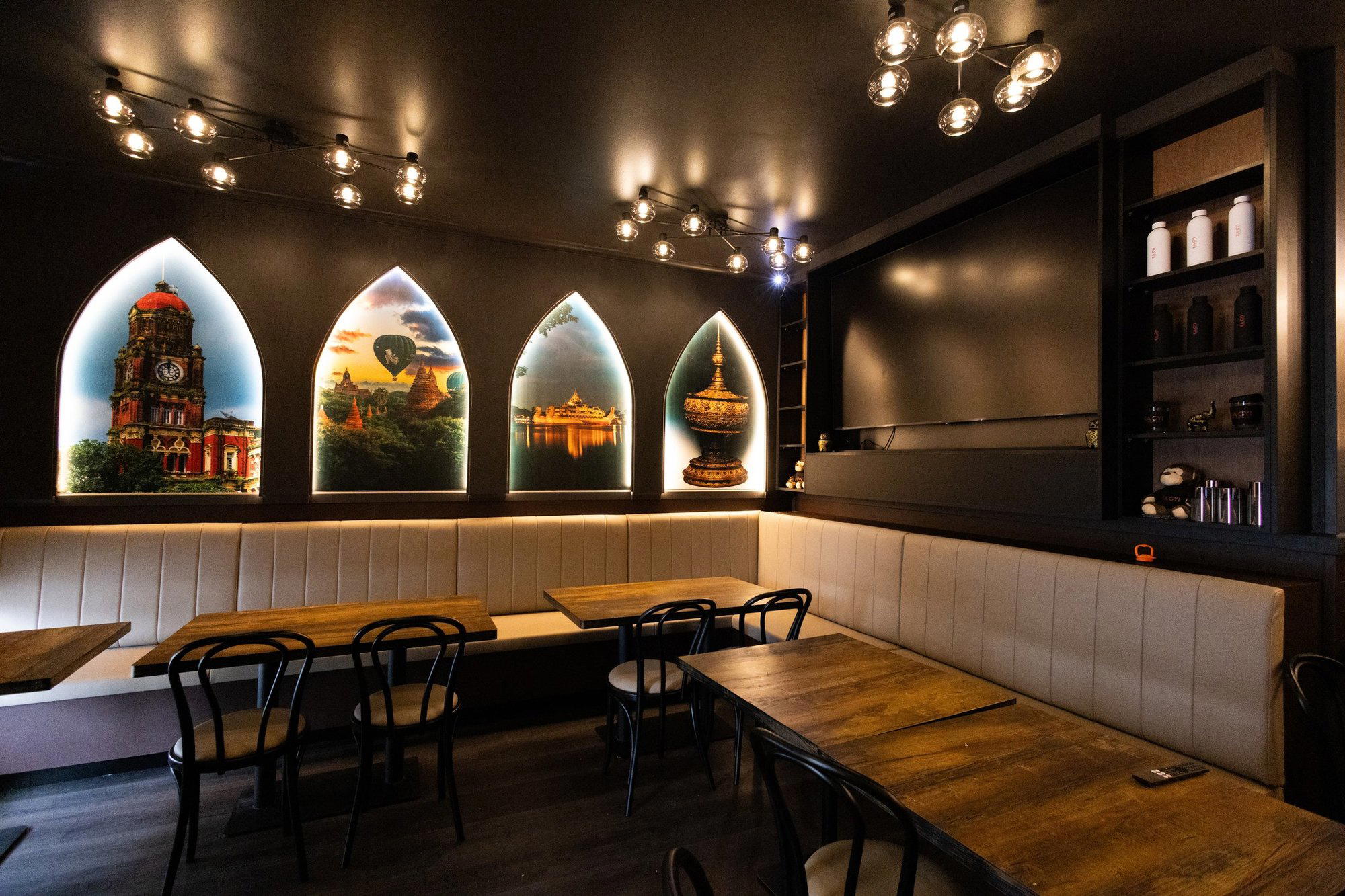
Ka Gyi brings Burmese and Burmese fusion cooking to Box Hill, Melbourne's most culturally concentrated dining suburb. The kitchen works within a tradition that remains underrepresented in Australian dining, where fermented tea leaf, golden turmeric broths, and fish paste-layered condiments carry the weight of a cuisine rarely given this kind of dedicated platform. For anyone tracking where Australian multicultural dining is actually moving, Box Hill is the argument — and Ka Gyi is part of that case.

Pearl is the En Primeur Club membership app — saves, bookings, and concierge access live there. Same editors, same standards.
- Address
- Box Hill, Australia
- Website
- kagyi.com.au
- Directions
- Get directions
The menu
What to order
- Egg noodles and tofu crackers with chicken curry
- Laphet Thoke
Box Hill and the Case for Burmese Cooking in Australia
Box Hill's main strip operates at a register most of Melbourne's inner suburbs cannot match for sheer density of culinary specificity. Where other precincts offer cuisine variety as a marketing concept, Box Hill delivers it as demographic fact: Vietnamese, Chinese, Korean, Malaysian, and Japanese kitchens sit within walking distance of one another, each serving communities with direct roots in those traditions rather than approximations pitched at tourists. It is into this context that Ka Gyi arrives as a Burmese and Burmese fusion kitchen — a cuisine that remains one of the more underrepresented traditions in Australian dining at any price point.
Burmese food has a structural logic that separates it from its Southeast Asian neighbours. Where Thai cooking leans into heat and acidity as dominant flavours, and Vietnamese cuisine builds around aromatic freshness, Burmese kitchens rely more heavily on fermented and umami-forward ingredients — dried shrimp paste (ngapi), fermented tea leaves (laphet), and fish sauce used at depth rather than as a finishing note. The result is cooking that can read as unfamiliar on first encounter but rewards attention. Box Hill, with its existing appetite for specificity and its population familiar with neighbouring cuisines, is as reasonable a home for this tradition as any suburb in Australia. For broader context on where Box Hill sits in Melbourne's dining geography, see our full Box Hill restaurants guide.
Where the Ingredients Lead
The editorial angle on Burmese cooking in Australia is not primarily about technique, it is about sourcing. The cuisine's identity is inseparable from a specific larder: fermented bean paste, tamarind, yellow split peas, dried fish, and the laphet leaf that is simultaneously an ingredient, a condiment, and a social institution in Myanmar itself. Getting these components to an Australian kitchen with sufficient quality and authenticity involves either importing from specialist distributors or identifying domestic substitutes that hold up under the preparation methods the cuisine demands. This is the tension every serious Burmese kitchen outside Myanmar faces, and it explains why the tradition is so rarely done with conviction beyond diaspora communities.
Mohinga, Myanmar's fish-based rice noodle broth, widely considered the country's national dish, requires a layered construction: banana stem, lemongrass, fish sauce, chickpea flour for body, and a slow fish stock that cannot be abbreviated. Any kitchen serving it honestly is making decisions about sourcing at every stage. Similarly, laphet thoke, the tea leaf salad that functions as something like a Burmese national symbol, depends on the quality of the fermented tea, an ingredient that does not have Australian domestic equivalents and must be sourced through the same import channels that supply Myanmar diaspora grocers. The proximity of Box Hill's Asian grocery infrastructure to Ka Gyi's kitchen is not incidental; it is part of what makes the suburb a viable location for this kind of cooking at all.
Ka Gyi in the Box Hill Context
Box Hill's dining scene has historically been dominated by Chinese and Vietnamese operations. The suburb's Chinese precinct is well-documented, and restaurants like Wonton House, which focuses on Hong Kong-style wonton noodles and congee, represent the depth of Cantonese tradition available in the area. Korean dining has expanded more recently, with venues like Seoul Bakery adding salt bread, bingsu, and Korean sweets to the local offer. Against this backdrop, Ka Gyi's Burmese focus positions it as a distinct operator rather than a participant in an established local tradition, the category is largely its own in this suburb.
That distinction carries both opportunity and responsibility. The more instructive comparison is not Box Hill's other kitchens but the handful of Burmese restaurants operating across Melbourne and Sydney, most of which have maintained their foothold through strong ties to diaspora communities rather than through crossover dining appeal. Ka Gyi's fusion framing, positioning itself as Burmese fusion rather than strictly traditional, suggests an intent to work across both audiences.
Fusion as a Practical Decision
The Burmese fusion designation is worth examining as a strategic and culinary category rather than a vague marketing hedge. Fusion, when applied to cuisines with limited domestic ingredient supply, often reflects practical adaptation: local protein availability shapes the protein choices, familiar regional flavours are borrowed to bridge unfamiliar ones, and preparation techniques may shift to accommodate equipment or timing constraints. Melbourne's broader restaurant scene has worked through similar dynamics with other Southeast Asian and South Asian cuisines over the past two decades. The restaurants that emerge strongest from that process tend to be the ones that treat fusion as disciplined adaptation rather than licence to dilute. Venues like Attica in Melbourne and Brae in Birregurra have demonstrated, in different registers, that Australian kitchens are capable of serious culinary precision when the sourcing and intent are aligned. The question for any fusion kitchen, including Ka Gyi, is whether the adaptation adds something or simply reduces the original.
Planning a Visit
Box Hill is served by the Belgrave and Lilydale train lines from Flinders Street Station, making it direct to reach from the Melbourne CBD without a car. The suburb's dining strip is concentrated along Whitehorse Road and the Centro Box Hill precinct, which means most of the area's restaurants are within a short walk of Box Hill Central station. Given that the venue data does not confirm hours, pricing, or booking methods for Ka Gyi at this time, contacting the restaurant directly before visiting is the sensible approach, particularly for larger groups or specific dietary requirements, which can be significant considerations in Burmese cooking given the prevalence of fish paste and dried seafood in baseline preparations.
For travellers building a broader itinerary around Australian dining, the contrast between Box Hill's multicultural suburban registers and inner-city fine dining at venues like Rockpool in Sydney or neighbourhood-driven kitchens like Bar Carolina in South Yarra, Barry Cafe in Northcote, or Akasiro in Collingwood illustrates how wide the Australian dining spectrum actually runs. Other reference points for regional and multicultural kitchens operating in mid-sized Australian cities include Jaani Street Food in Ballarat, Kulcha Restaurant Wollongong, and Lenzerheide Restaurant in Adelaide, each operating in its own culinary category outside the major urban cores. For coastal and waterfront dining comparisons, Bayly's Bistro in Kirribilli, bills in Bondi Beach, and Johnny Bird in Crows Nest offer Sydney-side counterpoints. Internationally, Le Bernardin in New York City and Atomix in New York City represent how diaspora-rooted culinary traditions can be executed at the highest technical level when the conditions align, and Hungry Wolfs Italian Restaurant in Newcastle rounds out the regional picture.
Frequently asked questions
Is Ka Gyi one of the only Burmese restaurants in Melbourne's eastern suburbs?
Burmese cuisine remains significantly underrepresented in Melbourne compared to the city's Vietnamese, Chinese, and Thai offerings, making Ka Gyi's presence in Box Hill notable by sheer category scarcity. The suburb's dining scene has long been anchored by Chinese and Vietnamese operations, so a Burmese fusion kitchen occupies a distinct position in the local mix. For diners in Melbourne's eastern corridor, Ka Gyi represents one of the few accessible venues to engage with this cuisine without travelling to the inner city.
What should I eat at Ka Gyi?
Ka Gyi operates under a Burmese fusion designation, which in practice means dishes rooted in Burmese culinary tradition — expect fermented ingredient profiles, layered salads, and noodle-forward preparations — adapted to local Australian sourcing. The fusion framing signals that not every dish will read as strictly orthodox Burmese, which is common among diaspora kitchens working with what the local market provides. For first-time visitors to Burmese cooking, the salad courses are typically the clearest entry point into the cuisine's characteristic flavour logic.
How hard is it to get a table at Ka Gyi?
Ka Gyi sits in Box Hill's main dining strip, a precinct where Chinese and Vietnamese operations have historically driven the bulk of foot traffic. Burmese restaurants occupy a much smaller share of Australia's dining scene by volume, which means Ka Gyi draws a specific and often repeat clientele rather than casual walk-in crowds. Booking ahead for weekend visits is a reasonable precaution; weekday access is generally easier across Box Hill's strip.
Side-by-Side Snapshot
| Venue | Cuisine | Price | Awards | Notes |
|---|---|---|---|---|
| Ka GyiThis venue — the venue you are viewing | Burmese Fusion | Not listed | Not listed | Not listed |
| Attica | Modern Australian Indigenous Fine Dining | $300–500 | World's 50 Best #20 · La Liste Top Restaurants | Australian Modern |
| Brae | Modern Australian Seasonal Tasting Menu | $200–300 | World's 50 Best #44 · La Liste Top Restaurants | Modern Australian |
| Flower Drum | Fine Dining Cantonese | $50–100 | World's 50 Best #33 · Star Wine List | Cantonese |
| Rockpool | Modern Australian Steakhouse | $150–200 | World's 50 Best #49 · La Liste Top Restaurants | Australian Cuisine |
| Saint Peter | Modern Australian Seafood | $150–200 | World's 50 Best #66 · La Liste Top Restaurants | Australian Seafood |
Continue exploring
More in Box Hill
Restaurants in Box Hill
Browse all →
Bars in Box Hill
Browse all →
Hotels in Box Hill
Browse all →
Details
- Romantic
- Casual Hangout
- A La Carte
- Vegetarian Friendly