
Jikoryu Ramen Watamen is a compact counter-format ramen shop in Matsubara, outside central Osaka, selected for Tabelog Ramen OSAKA 100 in 2025 after repeated appearances on the ramen list. The appeal is not luxury; it is ingredient-control discipline, with ramen, tsukemen, and kara-age served in a narrow, low-capacity format that rewards diners willing to leave the city-center circuit.
Pearl is the En Primeur Club membership app — saves, bookings, and concierge access live there. Same editors, same standards.
- Address
- 大阪府松原市松ヶ丘3-6-15
- Website
- tabelog.com
 Saves & bookings on Pearl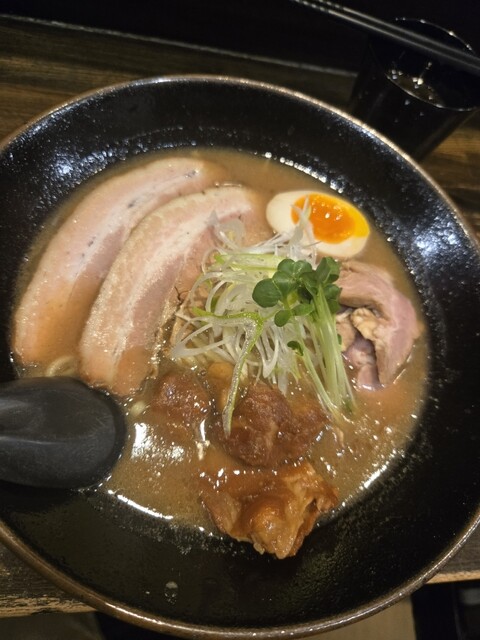
Approaching Matsubara for ramen changes the tempo of an Osaka meal. The city’s central stations sell speed, neon, and turnover; this part of Osaka asks for a deliberate detour. Inside a nine-seat counter room, attention narrows to the old ramen equation serious shops rarely escape: broth, noodles, timing, and the operational choices that decide whether a bowl tastes assembled or integrated.
That is the useful way to read Jikoryu Ramen Watamen. It is not part of the polished hotel-dining Osaka visitors often map through Nakanoshima, Umeda, and Shinsaibashi, nor the snack-heavy Dotonbori route where queues can be driven as much by photography as appetite. It belongs to another Osaka tradition: suburban, specialist, low-capacity, and built around repeat local attention. Its selection for Tabelog Ramen OSAKA 100 in 2025, after appearances across the ramen list from 2017 through 2024, places it in the city’s serious ramen conversation without changing the experience’s essential grammar.
Homemade noodles put the bowl in the specialist Osaka bracket
Osaka ramen has never had the single dominant regional identity of Hakata tonkotsu or Sapporo miso. Its strength is plurality: chicken-led bowls, seafood accents, shoyu clarity, thick tsukemen, and neighborhood shops refining one narrow lane for years. In that context, noodle production matters. A shop making its own noodles and soup controls texture, hydration, broth absorption, and serving rhythm rather than outsourcing one central variable.
Jikoryu Ramen Watamen’s listed categories, ramen, tsukemen, and kara-age, sketch a common Kansai comfort structure with a specialist tilt. Tsukemen asks more of noodle texture than standard soup ramen because noodles are dipped, often at a different temperature and against a thicker sauce. Kara-age is not a side-note in Osaka dining culture; fried chicken appears across izakaya, lunch counters, and ramen shops because it answers the city’s appetite for high-impact, low-ceremony eating. The point is not menu breadth, but a format that stays within a tight vocabulary and uses ingredient handling as its claim to seriousness.
Compared with Osaka’s lower-cost quick-service options such as Takara Ya and Kei Chan, the draw here is not convenience alone. Compared with higher-ticket counter restaurants such as TORILABO or Yakitori BLACK, it does not ask diners to treat the meal as a long-form evening. It sits in the affordable specialist tier, closer in spend to Inui, where judgment rests on execution rather than room theatre. That category is one of Osaka’s strengths: modest bills, narrow formats, and public scrutiny that can be unforgiving when a bowl loses precision.
A counter-only room changes how the meal works
Counter ramen is compressed choreography. With nine seats, every decision matters: how quickly bowls leave the kitchen, how long diners linger, how small groups fit into a room built more for concentration than conversation. Small ramen shops can feel more exacting than many tasting-menu rooms because there is nowhere to hide. Cooking, serving, and eating happen within the same field of attention.
The counter-only setup also explains why solo dining suits the format. Osaka is generous to groups, from kushikatsu counters to yakiniku tables, but ramen at this scale rewards one or two diners who can fold into the room’s rhythm. For travelers, it corrects the idea that Osaka dining begins and ends in the center. The city’s serious food culture extends along rail lines and residential districts, where repeat custom and online evaluation can matter more than international visibility.
That distinction matters for ingredient sourcing. Ramen is sometimes described through toppings, but the deeper sourcing question is production control: who makes the noodles, who builds the soup, and how tightly those components match. A shop foregrounding homemade noodles and soup competes on fundamentals. In a nine-seat room, those fundamentals are exposed. A diner notices noodle firmness, broth concentration, and whether the dipping format has enough structure to carry repeat bites. No garnish rescues weak architecture.
Where it fits in an Osaka eating itinerary
Jikoryu Ramen Watamen is best treated as a purposeful Matsubara ramen stop, not a casual add-on between central Osaka landmarks. The nearest station is Kawachi Matsubara, and the walk from the north exit is listed at about 20 minutes, so timing matters. Parking for three cars underscores its neighborhood orientation rather than tourist-strip positioning.
The planning profile is specific: reservations are unavailable, cards and electronic money are not accepted, and the room is non-smoking. Strollers are not allowed inside, so this is not the easiest choice for families with young children. For the right diner, those constraints are not flaws; they describe a small ramen counter operating on terms common to Japan’s serious noodle shops. The reward is a focused, inexpensive meal with a public recognition trail supporting the detour.
Travelers building a wider Osaka map should think in contrasts. Central bakery and casual stops such as .cafe, 52CHO-ME BAKERY, and 551 Horai (551蓬莱) show the city’s everyday eating at scale, while 99 Pizza Napoletana Gourmet and a canto (Italian) place Osaka in a more international register. For broader planning, use Our full Osaka restaurants guide alongside Our full Osaka hotels guide, Our full Osaka bars guide, Our full Osaka wineries guide, and Our full Osaka experiences guide.
Japan’s casual-specialist dining scene also rewards cross-city comparison. A diner who values narrow formats might also look at -Grilled beef Sukiyaki- KAMAKURA TANUKIAN 鎌倉 たぬき庵 in Kamakura. 鮪と炭火焼き うお炭 秋葉原店 in Tokyo.know in Kumamoto, (Shoku) Vietnam in Kawasaki, [Curry Senmon Ten] Maruyama Kyoju. in Sapporo, and [ki:] in Kyoto. Across the Pacific, Jōdo Saké Bar in Los Angeles and Onigiri Time in Pasadena show how Japanese formats translate abroad, though Matsubara’s ramen-counter discipline remains rooted in local mechanics of rail access, cash payment, and quick turnover.
Price and Positioning
Comparable venues to calibrate price, style, and recognition.
| Venue | Cuisine | Price | Notes |
|---|---|---|---|
| Jikoryu Ramen WatamenThis venue — the venue you are viewing | Not listed | $ | Not listed |
| Chuka Soba Kaminari Wantan | Not listed | $ | Sumiyoshi, Traditional Japanese ramen / chuka soba |
| Gyoza no Mise Momo | Abeno, Osaka gyoza counter | $ | Not listed |
| Fuse Hosomi Shoten | Fuse, Ramen & Tsukemen Shop | $ | Not listed |
| Niji no Hotoke | Not listed | $ | Tennōji, Osaka spice curry & Japanese-style Western curry |
| Udon Jojo | Higashinari, Casual Udon Noodle Shop | $ | Not listed |
Recognition history
Dated appearances from independent guides and award organizations, with the underlying list record or original source where available.
Tabelog 100 #39 · No. 39
Tabelog · Tabelog 100 - Ramen - OSAKA - 2025
Continue exploring
More in Osaka
Restaurants in Osaka
Browse all →




Bars in Osaka
Browse all →


Hotels in Osaka
Browse all →



Wineries in Osaka
Browse all →
At a Glance
- Lively
- Cozy
- Intimate
- Solo
- Casual Hangout
- Family
- After Work
- Late Night
- Chefs Counter
- Standalone
- Local Sourcing
Tiny, counter-only neighborhood ramen shop with a casual, energetic atmosphere and a focus on quick solo or friends’ meals rather than lingering.