
Niji no Hotoke puts Osaka curry in a compact Shitennoji frame: low-cost, highly edited, and serious enough to have earned repeated Tabelog Curry 100 recognition in western Japan. The appeal is not ceremony but discipline, with curry and yoshoku sharing a small-room format that suits solo diners as much as regulars moving through Tennoji.
Pearl is the En Primeur Club membership app — saves, bookings, and concierge access live there. Same editors, same standards.
- Address
- 大阪府大阪市天王寺区四天王寺1-12-23
- Website
- tabelog.com
 Saves & bookings on Pearl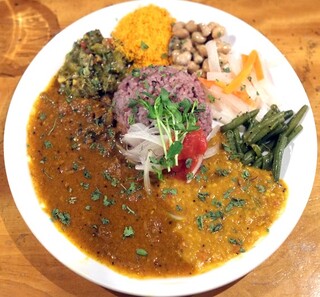
Approaching the Shitennoji side of Tennoji, Osaka’s curry culture feels far from Dotonbori neon. The rhythm is quieter: temple streets, lunch traffic, office workers, solitary diners, and small counters where the room works as hard as the kitchen. Niji no Hotoke belongs to the Osaka category where the experience is compact, low-priced, and more serious than the tariff suggests: curry, yoshoku, a small room, and service built on quick trust rather than performance.
Osaka curry has its own grammar, borrowing from Japanese home cooking, kissaten-style plates, spice-shop experimentation, and yoshoku’s Western-in-Japanese-translation comfort, then compressing them into meals often cheaper than a hotel-bar cocktail. That affordability is central. Niji no Hotoke’s repeated selection for Tabelog Curry 100 in western Japan, including 2024, places it in a competitive field where consistency matters more than luxury signals, and where a narrow format must feel personal without drifting into chef mythology.
Osaka curry, treated as a serious small-room genre
The useful comparison here is not only with other curry shops. Shitennoji Hayauchi shows how a soba room builds authority through restraint; Sushidokoro Amano represents the opposite end of the Osaka dining economy, where sushi technique and spending expectations create a formal bracket. Between them sits the curry-yoshoku counter: informal, exacting, and dependent on kitchen pace and front-of-house judgment. Niji no Hotoke’s 19-seat scale keeps the room legible. Plates move fast enough for everyday dining, but not so anonymously that the meal feels transactional.
The service format explains why the restaurant fits Osaka. Counter seating in Japan is not just space-saving; it makes production, pacing, and hospitality visible. In curry rooms, the exchange is especially direct. The kitchen must balance heat, rice, sauce, garnishes, and timing while front of house reads solo diners, pairs, and repeat customers without slowing service. When coordination works, the meal feels edited rather than rushed. The team dynamic is the substance, even without named personalities.
The restaurant is a lens on Osaka’s less formal excellence. The city’s restaurant identity is often reduced to takoyaki, okonomiyaki, and late-night appetite, but its small specialist rooms are just as revealing. They show how value, focus, and repeatability become critical virtues. The Tabelog score of 3.71 is useful not as a universal verdict, but as a signal within Japan’s review culture, where sustained support for a modestly priced specialist carries weight. Curry 100 selections in 2019, 2020, 2022, 2023, and 2024 add the stronger pattern: this is not a single-season spike.
Why the Shitennoji address changes the meal
Tennoji has several dining personalities. Around Abeno and the station, the city turns vertical, commercial, and quick. Near Shitennoji, it tightens into older streets and smaller routines. That difference matters for curry. A central-station curry stop competes on convenience; a Shitennoji curry room must justify a detour through identity and repeat demand. The restaurant does so in a price-conscious lane while earning recognition in a category that attracts obsessive local comparison.
The yoshoku connection is important. Japanese curry is often misread as one dish rather than a family of styles shaped by military mess halls, school lunches, department-store dining, home roux, regional spice movements, and Western-style Japanese restaurants. Yoshoku gives the format a broader vocabulary: rice plates, sauces, cutlets, omelet-adjacent comfort, and plating logic that makes a modest meal feel complete. Without inventing a specific order, the category tells the reader how to approach the table: expect Japanese curry within Osaka comfort food, not a facsimile of Indian or Thai curry.
For travelers building a food day, this differs from booking a formal tasting menu. It pairs naturally with a Tennoji or Shitennoji itinerary, then leaves budget and appetite for another register later. Osaka rewards that sequencing. A morning bakery run at 52CHO-ME BAKERY, a casual city snack from 551 Horai (551蓬莱), or coffee at .cafe can sit in the same day as a structured dinner at a canto (Italian) or 99 Pizza Napoletana Gourmet. The point is contrast: Osaka is strongest when low-cost specialists and formal rooms share the itinerary.
How to place it in an Osaka itinerary
The restaurant is not for travelers seeking a long, choreographed meal. It is for the diner who understands that a 19-seat curry room can say as much about Osaka as a chef’s counter with a longer bill. Reservations are unavailable, shifting planning from securing a table to timing the visit sensibly. The restaurant operates in a practical, cash-conscious lane: credit cards and electronic money are not accepted, while PayPay is listed among QR payment options. Common enough in Japan, but worth expecting before arrival.
Its selection history gives the address a clear editorial reason to sit on a serious Osaka food map. Tabelog’s Curry 100 WEST is a specialist list, and the 2024 inclusion places the restaurant among western Japan’s recognized curry houses rather than generic casual restaurants. Curry at this level is not expensive dining made cheaper; it is its own craft category, judged on repeatability, sauce structure, rice handling, room flow, and local loyalty. The restaurant’s strength lies in that matrix.
Readers comparing Osaka options should use category, not glamour, as the filter. For soba, Shitennoji Hayauchi speaks to a separate tradition; for high-spend sushi, Sushidokoro Amano belongs to another bracket; for French, au soleil couchant changes the tempo entirely. The restaurant answers a narrower question: where does Osaka’s everyday curry culture become serious enough to merit a detour? For broader planning, use Our full Osaka restaurants guide alongside Our full Osaka hotels guide, Our full Osaka bars guide, Our full Osaka wineries guide, and Our full Osaka experiences guide. For a wider Japanese and Japanese-adjacent reading list, compare the format with [Curry Senmon Ten] Maruyama Kyoju. in Sapporo, [ki:] in Kyoto, -Grilled beef Sukiyaki- KAMAKURA TANUKIAN 鎌倉 たぬき庵 in Kamakura. 鮪と炭火焼き うお炭 秋葉原店 in Tokyo.know in Kumamoto, (Shoku) Vietnam in Kawasaki, Jōdo Saké Bar in Los Angeles, and Onigiri Time in Pasadena.
The Quick Read
Comparable venues for context, by category and price tier.
| Venue | Cuisine | Price | Notes |
|---|---|---|---|
| Niji no HotokeThis venue — the venue you are viewing | Not listed | $ | Not listed |
| Chitose Udon | Namba, Osaka Nikusui Udon | $ | Not listed |
| Buttah | Chūō, Japanese Curry | $ | Not listed |
| Honneri Kwashi Suiren isshin | Not listed | $ | Chūō, Japanese traditional sweets (wagashi) & cafe |
| Hyakka Koushin Shokudo | Not listed | $ | Chūō, Spice curry & small plates with natural wine |
| Sodaisho | Kita, Traditional Shoyu Ramen Shop | $ | Not listed |
Recognition history
Dated appearances from independent guides and award organizations, with the underlying list record or original source where available.
Tabelog 100 #48 · No. 48
Tabelog · Tabelog 100 - Curry - WEST - 2024
Continue exploring
More in Osaka
Restaurants in Osaka
Browse all →




Bars in Osaka
Browse all →

Hotels in Osaka
Browse all →



Wineries in Osaka
Browse all →
At a Glance
- Cozy
- Casual
- Solo
- Casual Hangout
- After Work
- Standalone
Small 19‑seat curry shop with counter seating and a relaxed, cozy atmosphere suited to solo diners and casual visits with friends.