
Jian Bo Shui Kueh has held a Michelin Plate since 2024, placing this single-dish hawker stall among Singapore's recognised street food operators. Located in the basement of Causeway Point in Woodlands, it serves steamed rice cake with preserved radish in the tradition that defines this quietly specific Teochew format. The price point sits at the bottom of the Singapore dining spectrum, making it one of the more accessible entries in the city's awarded food scene.
Pearl is the En Primeur Club membership app — saves, bookings, and concierge access live there. Same editors, same standards.
- Address
- 1 Woodlands Sq, B1-K32 Causeway Point, Singapore 738099
- Website
- jianboshuikueh.com
- Directions
- Get directions
 Saves & bookings on Pearl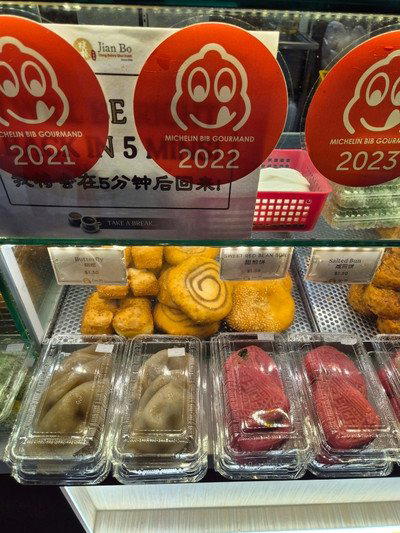
Steam, Radish, and the Logic of the Single-Dish Stall
Approach the basement food hall at Causeway Point in Woodlands and the sensory register is immediately hawker-specific: the close warmth of steam trays, the low hum of a busy queue, the faint sweetness of preserved vegetable cut through by something faintly savoury. Jian Bo Shui Kueh operates in a format that rewards no theatrics. The stall does one thing. The question the Michelin Guide answered in 2024, by awarding it a Plate, is whether it does that one thing with enough discipline to warrant recognition.
Shui kueh, the steamed rice cake topped with chai poh (preserved radish), is a Teochew hawker format that has operated in Singapore for generations. It demands almost nothing from the diner in terms of decision-making, and almost everything from the operator in terms of consistency. There is no menu to negotiate, no seasonal rotation to track, no pairing logic to consider. The stall's entire reputation rests on the quality of the rice cake, the calibration of the preserved radish, and the repetition of those two variables across every service. In a city where hawker culture has been nominated for UNESCO recognition, this is the format that most purely represents the argument for that nomination.
Where Woodlands Sits in Singapore's Hawker Geography
Singapore's recognised hawker stalls cluster heavily in the central and older residential districts: Tiong Bahru, Toa Payoh, Whampoa, the CBD fringes. The Woodlands corridor, in the far north near the causeway to Malaysia, sits outside that gravitational centre. A Michelin Plate at Causeway Point is, in that sense, a data point about where the guide's attention has expanded rather than where it has always been concentrated.
For visitors approaching from the city centre, Woodlands is a deliberate trip. The MRT ride from Orchard to Woodlands on the North-South Line runs approximately 40 minutes. That distance shapes the audience: the stall's primary constituency is the dense residential population of the north, not the hotel-district tourist circuit. This is relevant because it sets an expectation. The stall is not performing for an audience primed by a nearby hotel concierge recommendation. It is operating as a neighbourhood fixture that the Michelin Plate has brought to wider attention.
Compare this positioning with other recognised Singapore street food operators. Hill Street Tai Hwa Pork Noodle, which holds a Michelin Star, operates in the central Lavender area and draws queues from across the island. 545 Whampoa Prawn Noodles and Adam Rd Noo Cheng Big Prawn Noodle anchor their reputations in hawker centres with deep local roots. 91 Fried Kway Teow Mee and A Noodle Story represent different points on the spectrum between traditional form and modern interpretation. Jian Bo Shui Kueh sits closer to the traditional, high-repetition end of that range, in a location that serves the city's northern fringe rather than its culinary tourism core.
The Discipline of the Single-Format Stall
The editorial angle that matters here is not who runs the stall or what their background is. The angle is what the single-format hawker model demands as an operating discipline, and what Michelin recognition means when applied to it.
In most recognised restaurant formats, quality is distributed across multiple variables: a chef's brigade, a sommelier's selections, a front-of-house team managing pacing and atmosphere. The collaboration between kitchen and floor that defines fine dining service has no direct equivalent in a hawker stall. What replaces it is a different kind of team logic: the coordination between the person managing the steamer, the person applying the preserved radish topping, and whoever manages throughput during peak hours. At volume, these micro-roles matter. A rice cake left in the steamer thirty seconds too long loses its texture. Chai poh applied without consistent portioning changes the flavour balance. The stall's consistency, enough to earn Michelin acknowledgment, implies these roles are executed with the same attentiveness that fine dining operators apply to far more complex service choreography.
This is why the Michelin Plate, rather than being a lesser signal, is in some respects the more interesting one for a stall like this. A Star implies a certain vertical complexity. A Plate documents that the fundamentals are sound at a price point where margins are thin and volume is the only economic logic. Jian Bo Shui Kueh's price range sits at the single-dollar tier, placing it among Singapore's most affordable dining options and at the level of external recognition hawker food can achieve.
Southeast Asian Street Food in Context
The single-dish steamed format at Jian Bo Shui Kueh has parallels across the region. The rigour applied to one preparation, repeated at volume, is the same logic that drives 888 Hokkien Mee in George Town, Ah Boy Koay Teow Th'ng, and Air Itam Duck Rice in Penang, or A Pong Mae Sunee in Phuket and Anuwat in Phang Nga. In each case, the operator's identity is inseparable from the single dish they have chosen to well-suited. Air Itam Sister Curry Mee and Ali Nasi Lemak Daun Pisang in George Town operate under the same constraint. Even further afield, Banana Boy in Hong Kong represents a different expression of the same principle: format specificity as a quality signal rather than a limitation.
What Singapore does differently is institutionalise this format through the hawker centre system, and then layer external recognition onto it via the Michelin Guide's expanded street food coverage. That combination, low price point plus formal acknowledgment, is the condition that makes a stall like Jian Bo Shui Kueh legible to an international audience.
Planning Your Visit
The restaurant is located at 1 Woodlands Square, B1-K32, Causeway Point, Singapore 738099. The Woodlands MRT station on the North-South Line connects directly to the mall.
| Venue | Format | Price Tier | Recognition | Location |
|---|---|---|---|---|
| The restaurant | Single-dish hawker stall | $ | Michelin Plate 2024 | Woodlands, north Singapore |
| Hill Street Tai Hwa Pork Noodle | Hawker stall | $ | Michelin Star | Lavender, central Singapore |
| A Noodle Story | Hawker stall | $ | Michelin Plate | Central Singapore |
| Zén | Fine dining | $$$$ | Michelin 3 Stars | City centre |
| Burnt Ends | Modern barbecue restaurant | $$$ | Michelin 1 Star | Dempsey |
Recognition Snapshot
Comparable venues nearby, for context on price, style, and recognition.
| Venue | Cuisine | Price | Awards | Notes |
|---|---|---|---|---|
| Jian Bo Shui KuehThis venue — the venue you are viewing | Singaporean Chwee Kueh | $ | Michelin Plate | Not listed |
| Ya Kun Kaya Toast | Singaporean Kaya Toast | $ | Not listed | MARINA CENTRE |
| Nyonya Chendol | Traditional Nyonya Chendol | $ | Michelin Plate | YISHUN WEST |
| R&B Express | Singaporean Hawker BBQ | $ | Michelin Plate | NEWTON CIRCUS |
| J2 Famous Crispy Curry Puff | Crispy Curry Puffs | $ | Bib Gourmand | MAXWELL |
| Newton Food Centre | Singaporean Hawker | $ | Not listed | Newton |
Recognition history
Dated appearances from independent guides and award organizations, with the underlying list record or original source where available.
Michelin Plate
Michelin
Continue exploring
More in Singapore
Restaurants in Singapore
Browse all →
Bars in Singapore
Browse all →
At a Glance
- Classic
- Casual Hangout
- Standalone
Current opening hours
- Monday
- 7 AM–10 PM
- Tuesday
- 7 AM–10 PM
- Wednesday
- 7 AM–10 PM
- Thursday
- 7 AM–10 PM
- Friday
- 7 AM–10 PM
- Saturday
- 7 AM–10 PM
- Sunday
- 7 AM–10 PM
Hours can change for holidays and private events. Last verified .
Casual bustling hawker stall atmosphere in a lively wet market with long queues.