Our verdict
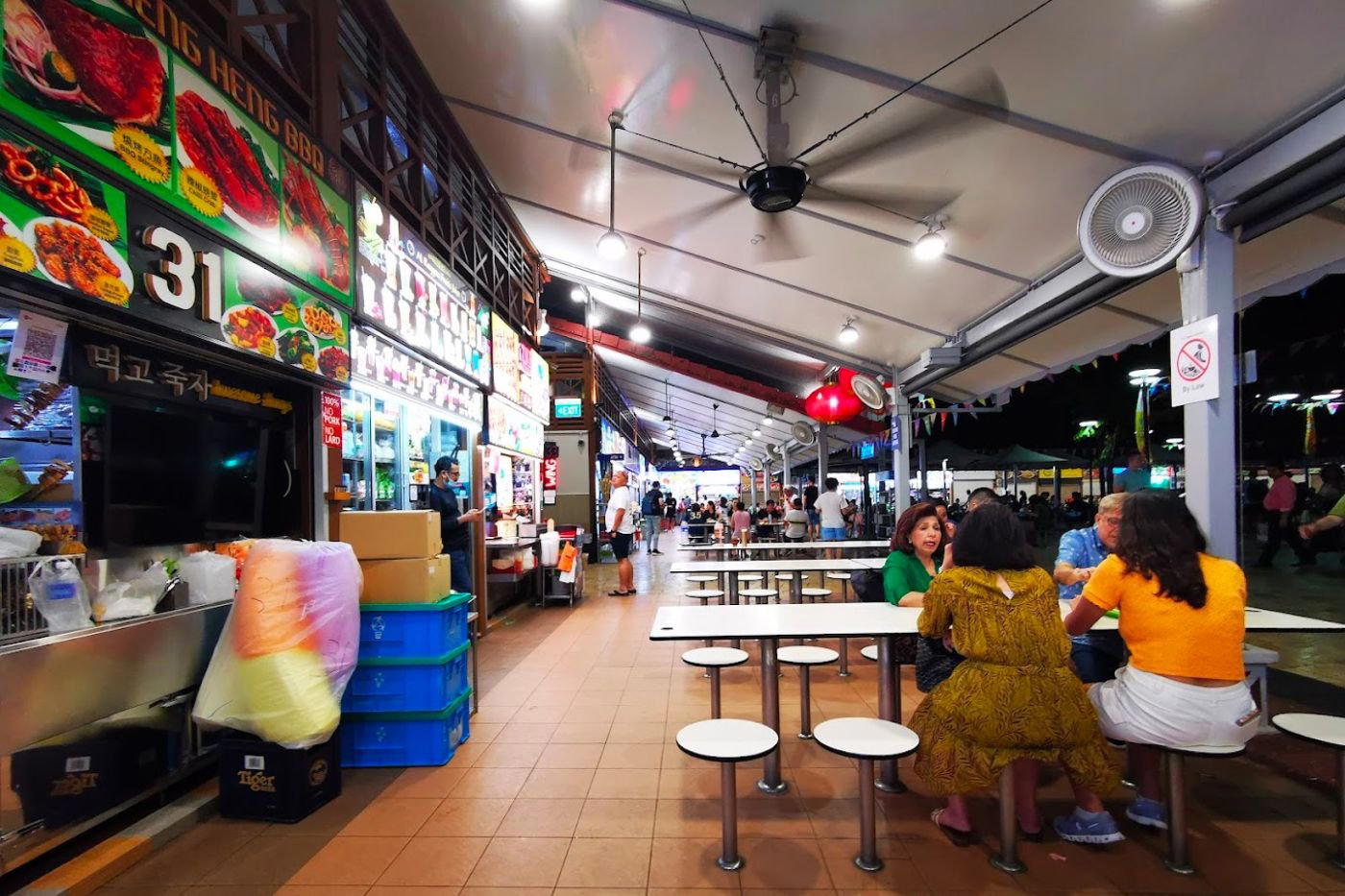
Newton Food Centre sits at the top of the Orchard Road hawker circuit, drawing a mix of office workers at lunch and tourists by night. The open-air format and rotating stall mix make it one of Singapore's most navigated food centres, but the experience shifts significantly between a midday visit and an evening session. Understanding that split is the key to getting value here.

Pearl is the En Primeur Club membership app, where members save venues, book tables and use the concierge.
The menu
What to order
- Satay
- Fried oyster omelette
- BBQ sambal stingray
- Chili crab
Two Centres in One: How Newton Divides by Daylight
Singapore's hawker centre tradition has never been monolithic. The same physical space can operate as a functional, price-driven lunch spot for nearby workers and as something closer to a theatrical outdoor dining experience after dark. Newton Food Centre, sitting just north of the Orchard Road corridor in the Novena-adjacent stretch of the island, makes this split more visible than almost any other open-air centre in the city. Arrive before 2pm and you find a working lunch environment: shorter queues, faster turnover, vendors focused on volume. Return at 8pm and the dynamic has shifted, with a denser tourist presence, more active stall touts, and a different pace entirely. Neither version is the "real" Newton, both are legitimate expressions of how a hawker centre adapts across a day.
The Lunch Register: Functional, Fast, and Better Value
Daytime hawker eating in Singapore runs on efficiency. The lunch crowd at a centre like Newton is largely transactional, workers from nearby offices, residents from the surrounding streets, and the occasional visitor who has done enough research to arrive before the tourist wave. At that hour, value is strongest. Portions run fuller relative to price, queues at the most-demanded stalls are shorter, and the ambient noise sits at a level where conversation is still manageable. The heat is a factor, Newton's open-air layout means midday sun reaches the perimeter stalls more directly than covered food courts nearby, but the trade-off is the ventilation that a fully enclosed centre cannot offer.
Hawker centres of Newton's generation, built in the 1970s and 1980s as part of Singapore's urban resettlement push that moved street vendors into organised spaces, were designed primarily around the lunchtime workflow. The infrastructure, communal tables, shared drink vendors, centralised refuse points, reflects that origin. Eating there at noon connects you to that founding logic in a way that an evening visit, now shaped heavily by external perception and tourism, does not.
The Evening Shift: Scale, Theatre, and the Tourist Premium
After 6pm, Newton's character changes in ways that matter practically. Stall touts become more active, which is worth knowing before you arrive, the expectation of negotiating your way to a table or being directed toward a stall by someone working on commission is part of the evening experience at this particular centre in a way it is not at Clarke Quay's satellite hawker operations or the more residential centres in Tiong Bahru or Bedok. This is not a criticism unique to Newton; it reflects a broader pattern in Singapore's hawker scene, where centres closest to tourist-dense corridors have evolved a different kind of service culture to capture that footfall.
The evening also brings a fuller stall count. Some vendors at Newton operate only from late afternoon onward, which means the dinner session offers a wider selection, particularly for seafood-forward dishes like chilli crab, barbecue stingray, and oyster omelette, which are associated with this centre's reputation more than the lunch menu. That reputation has a geographic logic: Newton's proximity to Orchard-area hotels made it an early stop on the Singapore hawker itinerary for visitors, and the stall mix evolved to reflect what that audience ordered. For someone whose primary interest is the seafood roster, evening is the right session. For someone more interested in the working-lunch economy of Singaporean hawker culture, the midday visit is more instructive.
What the Centre Is Known For
Newton's public identity rests most heavily on its cooked seafood and a handful of dish categories that appear across multiple stalls: satay, carrot cake (the local preparation, not the Western dessert), and various noodle formats. Across Singapore's hawker infrastructure, a system that UNESCO added to its Intangible Cultural Heritage list in 2020, recognising the centres as living social institutions rather than mere food courts, Newton sits in the mid-tier in terms of price positioning, above the neighbourhood coffee shop and below the air-conditioned food atrium. That middle ground means it draws a broader demographic range than either extreme.
For context on Singapore's full dining spectrum, the city's Michelin-starred restaurant tier, venues like Odette, Les Amis, and Zén, represents a completely separate conversation about cost and format. So does the modern tasting-menu tier occupied by venues such as Jaan by Kirk Westaway and Meta. Newton operates nowhere near those price brackets, which is precisely the point. It exists as the counterweight, the proof that Singapore's food culture does not require a reservation or a dress code to deliver something worth the trip. That contrast is part of what makes it useful as a reference point for anyone mapping the city's dining range. See our full Singapore restaurants guide for a broader cross-section of what the city offers across price tiers and cuisines.
Elsewhere in Singapore's hawker and casual dining geography, different centres and neighbourhoods each carry their own character. The 93 Kallang area operates with a distinctly local residential logic, while KTMW in Bedok and Fu He Delights in Rochor serve neighbourhood functions that Newton, with its tourist-facing orientation, no longer primarily performs. More polished casual options like Béni in Orchard or Imperial Treasure Fine Chinese Cuisine in Downtown Core serve a different expectation entirely. For a broader view of Singapore's casual dining mix, Asian Twist by 365 Food in Queenstown, Haidilao Hot Pot at Sun Plaza in Sembawang, Du Du Shou Shi in Jurong West, Little Italy Katong in Marine Parade, and Etna Restaurant in Outram each represent distinct corners of what the city's non-fine-dining tier looks like. And for international reference on what a deeply resourced kitchen culture can produce, Le Bernardin in New York and Atomix in New York illustrate how differently the same city can express itself across formats.
Planning Your Visit
Newton Food Centre is accessible by MRT via the Newton station on both the Downtown Line and North South Line, making it direct to reach from Orchard Road, the CBD, or Marina Bay without a taxi. No reservations are taken, walk-in is the only mode of entry, as it is across Singapore's hawker sector. Cash remains the standard tender at most stalls, though PayNow and some QR-based payment systems have expanded at higher-traffic vendors in recent years. Weekday lunches offer the leanest crowds and sharpest value; weekend evenings generate the longest waits and the most active tout presence. For vegetarian visitors, the stall mix includes options, but the centre's identity skews heavily toward meat and seafood, so availability is narrower than at centres with dedicated vegetarian-stall concentrations. Dress is entirely casual, and the open-air format means weather is a variable, the covered sections of the centre provide partial shelter during the short tropical rain events that are most common in the late afternoon.
Frequently asked questions
Is Newton Food Centre easy to reach without a taxi or private hire?
Newton Food Centre sits directly above Newton MRT station, which is served by both the Downtown Line and the North South Line, two of Singapore's most frequently used rail corridors. That dual-line access means the centre is reachable from Orchard Road, the CBD, and Marina Bay without transfers, making it one of the more transport-accessible hawker sites in the city.
What dish is Newton Food Centre famous for?
Cooked seafood carries the most weight in Newton's public identity, chilli crab, black pepper crab, and similar preparations appear across multiple stalls and draw the majority of evening visitors. Satay and carrot cake (chai tow kway) are the other two categories with genuine multi-stall representation, giving you meaningful options to compare within the centre itself.
Do they take walk-ins at Newton Food Centre?
Newton operates as an open hawker centre, so walk-ins are the only format, there is no reservation system, and no stall requires advance booking. Evening hours bring the highest footfall, particularly on weekends, so arriving before 7pm gives you first pick of seating and avoids the busiest stall queues.
What's the standout thing about Newton Food Centre?
The dual character of the centre is what separates it from most Singapore hawker sites: daytime operation runs as a functional, lower-priced neighbourhood lunch stop, while the evening shift shifts toward a larger-scale, tourist-aware atmosphere with active stall touts and cooked-to-order seafood. That contrast within one physical space is worth understanding before you plan your visit.
Can Newton Food Centre handle vegetarian requests?
Hawker centres in Singapore are not structured around dietary menus, and Newton is no exception, stalls operate independently and few advertise vegetarian options explicitly. Carrot cake (fried radish cake) can be prepared without egg at some stalls if requested, and plain rice and vegetable dishes appear at certain cooked food counters, but the centre's identity is built around seafood and meat-centred dishes.
Does Newton Food Centre justify its prices?
During daytime hours, pricing at Newton tracks the standard hawker centre range and represents fair value by Singapore standards. The evening session is a different calculation: seafood is priced per weight or per piece, and some stalls apply a tourist premium that pushes the bill noticeably higher than comparable dishes elsewhere in the city. Knowing what to order and confirming prices before the stall begins cooking is the standard advice for managing costs at the seafood counters.
Should I go to Newton Food Centre on a weekday or weekend?
Weekday lunch visits deliver the most straightforward experience, shorter queues, lower prices, and a crowd that is mostly local office workers rather than tourists. Weekend evenings are the most atmospheric but also the most congested, with higher demand at the seafood stalls and more active touting. If your priority is eating well rather than the evening atmosphere, a weekday evening sits between the two extremes.
Cuisine and Credentials
| Venue | Cuisine | Price | Awards | Notes |
|---|---|---|---|---|
| Newton Food CentreThis venue (the venue you are viewing) | Singaporean Hawker | $10–20 | Not listed | Not listed |
| Zén | Neo-Nordic with Japanese Influences | $500+ | 3 Michelin Stars · Michelin Guide 3 Stars | European Contemporary |
| Jaan by Kirk Westaway | Modern British Fine Dining | $200–300 | 2 Michelin Stars · Michelin Guide 2 Stars | British Contemporary |
| Born | Contemporary Fusion Fine Dining | $200–300 | 1 Michelin Star · Michelin Guide 1 Star | Creative Cuisine, Innovative |
| Burnt Ends | Modern Australian Barbecue | $100–150 | 1 Michelin Star · Michelin Guide 1 Star | Australian Barbecue, Barbecue |
| Iggy's | Modern European with Japanese Influence | $150–200 | 1 Michelin Star · Michelin Guide 1 Star | Modern European, European Contemporary |
Continue exploring
More in Singapore
Restaurants in Singapore
All restaurants in Singapore →
Bars in Singapore
All bars in Singapore →
Details
- Lively
- Well Known
- Casual Hangout
- Group Dining
- Late Night
- Open Kitchen
- A La Carte
- Vegetarian Friendly
- Vegan Options
Busy open-air atmosphere with lively street food energy under hawker centre lighting.