Jahunger

Uyghur cooking from China's Xinjiang region arrives in Cambridge's Central Square at this family-owned restaurant, where hand-pulled noodles, lamb-forward plates, and house-made yogurt with honey reflect a culinary tradition shaped equally by Central Asian and Chinese influences. The original location opened in Providence in 2017; this larger Cambridge branch followed in 2024, bringing the same unpretentious approach to a new neighbourhood.
Pearl is the En Primeur Club membership app — saves, bookings, and concierge access live there. Same editors, same standards.
- Address
- 272 Brookline St, Cambridge, MA 02139
- Phone
- (617) 801-9725
- Website
- jahunger.com
- Directions
- Get directions
 Saves & bookings on Pearl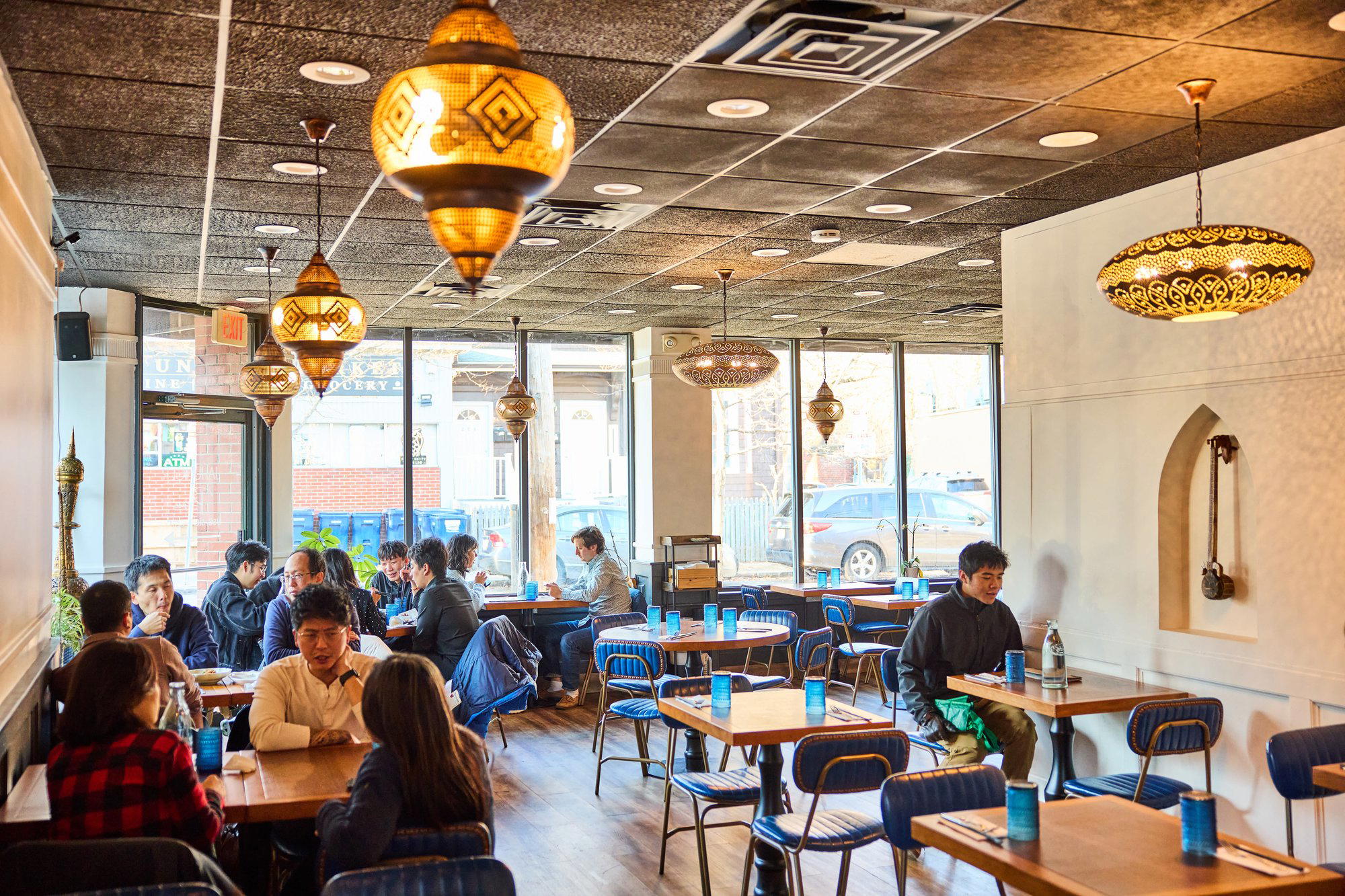
A Cuisine That Travels Its Own Road
Central Square in Cambridge has long absorbed restaurants that don't fit neatly into the categories most diners carry with them. That tendency serves Jahunger well. Uyghur cooking, the food of a Muslim-majority ethnic group from China's Xinjiang region, occupies a position at the intersection of Central Asian and Chinese culinary traditions, lamb and cumin on one side, hand-pulled noodles and Sichuan peppercorns on the other. It is a cuisine shaped by trade routes, geography, and religious practice in roughly equal measure, and it remains poorly represented across American cities. Cambridge, with its appetite for specificity and its student-and-academic dining culture, is a reasonable place for it to find a foothold.
The cuisine's Muslim roots mean pork is absent from the menu, replaced throughout by lamb in various preparations. Spice use is assertive but not one-dimensional: dried chilies, cumin, and coriander appear alongside the numbing tingle of Sichuan peppercorn, a reminder that Xinjiang borders multiple Central Asian countries and has historically been a meeting point for spice traditions from both east and west. The result is a flavor register that sits closer to a lamb-heavy Afghan or Uzbek table than to the regional Chinese cooking most diners in Boston and Cambridge encounter.
The Hand-Pulled Noodle as Anchor
In Uyghur restaurants across the diaspora, hand-pulled noodles function as the defining test of the kitchen's commitment. They are labor-intensive, technique-dependent, and immediately legible to anyone who has eaten them before: the texture is chewy and substantial in a way that dried or machine-cut pasta doesn't replicate. At Jahunger, two noodle preparations anchor the menu. Laghman noodles, the Central Asian preparation found across Uzbekistan, Kyrgyzstan, and into western China, arrive sauced with a braise-like mixture of lamb, peppers, and tomato. The second option pairs the same pulled noodle format with Sichuan peppercorns, tilting the dish toward the Chinese side of the kitchen's dual inheritance. Both preparations are described as carrying a nourishing quality that registers beyond simple satisfaction, a function of technique, fat, and the particular density of hand-worked dough.
The noodle work is the skill signal that positions Jahunger within a specific tier of Uyghur cooking. Pulling noodles to order requires someone in the kitchen with both practice and patience; it is not a process that scales without people. At a small, family-owned operation, that constraint is also a statement about how the kitchen is run.
How the Room Reads
Jahunger is a Uyghur hand-pulled noodles restaurant in Cambridge, Massachusetts, at 272 Brookline St. The Providence original was a smaller operation; the Cambridge branch was designed from the start to be bigger and brighter, a physical signal of some confidence in the concept's durability. Jahunger occupies a different register entirely: family-owned, unpretentious, and honest in a way that reads as a deliberate set of choices rather than a budget constraint.
That honesty extends to the service dynamic. In a restaurant where the food itself carries cultural specificity, front-of-house knowledge matters in a particular way. Staff who can explain the difference between Laghman and Jahunger-style noodles, or place the dumplings in their regional context, act as translators between the kitchen and a dining room that will include many first-time encounters with the cuisine. That interpretive function is part of what makes a small, specialist restaurant work, and it is distinct from the more formal sommelier-and-captain model you find at, say, Restaurant Twenty-Two or the tasting-menu precision of Darling.
What to Order and When
The structure of a meal at Jahunger follows a logic that rewards following through from start to finish. Dumplings with house-made chili oil open the meal and establish the kitchen's approach to both filling and heat. The chili oil is made in-house, which matters: it signals that the condiment work receives the same attention as the noodle work, rather than being sourced from a commercial bottle. The noodle dishes form the center of gravity. At the close, house-made yogurt with honey provides a cooling counterpoint to the accumulated spice of the preceding courses, a structural choice that echoes the role of yogurt across Central Asian and Middle Eastern table traditions.
The sequence is short and coherent. This is not a kitchen pursuing a lengthy tasting format or course-by-course elaboration; it is a restaurant that has identified four or five things it does well and organized the menu around them. Compared to the elaborate architectural presentations at Chicago's Alinea or the hyper-seasonal sourcing narratives at Single Thread Farm in Healdsburg, Jahunger represents the opposite end of the ambition spectrum: a focused, culturally specific kitchen with a clear identity and no apparent interest in expanding that brief.
Placed in Cambridge's Wider Dining Map
Cambridge's restaurant culture in 2024 covers a wider range than its academic reputation might suggest. At the formal end, Midsummer House holds two Michelin stars and Restaurant Twenty-Two holds one; Fallow Kin extends the New American conversation further. Jahunger occupies a different coordinate on that map entirely, one defined by cultural specificity rather than culinary ambition in the fine-dining sense. It belongs to a category of restaurants, found in every serious food city, that earn their place through the integrity of a single cuisine rather than through technique accumulation or tasting-menu architecture. In New York, Atomix approaches Korean cuisine from a high-concept angle; Jahunger represents the obverse, the same cultural specificity delivered through a direct and affordable format.
Planning Your Visit
Jahunger sits at 272 Brookline Street in Cambridge's Central Square area, accessible by the MBTA Red Line at Central Square station. As a family-run operation with a focused menu and a room described as bright and larger than the Providence original, it is the kind of restaurant that works equally for a quick weeknight meal or a more deliberate visit. Reservations are recommended, and the dress code is casual. The restaurant is open for lunch and dinner on weekends and dinner midweek.
Cuisine and Awards Snapshot
Comparable venues nearby, for context on price, style, and recognition.
| Venue | Cuisine | Price | Awards | Notes |
|---|---|---|---|---|
| JahungerThis venue — the venue you are viewing | Uyghur Hand-Pulled Noodles | $$ | Bib Gourmand | Not listed |
| Oleana | Turkish | Not listed | Michelin Plate | The Port |
| Sumiao Hunan Kitchen | Authentic Hunan Kitchen | $$ | Bib Gourmand | East Cambridge |
| Clover Food Lab | Dining | Not listed | Not listed | Cambridge |
| Alice | Modern Italian-Mediterranean Taverna | $$ | Not listed | Kendall Square |
| Sulmona | Warm Italian Pasta & Pizza | $$ | Not listed | The Port |
Recognition history
Dated appearances from independent guides and award organizations, with the underlying list record or original source where available.
Michelin Bib Gourmand
Michelin
Continue exploring
More in Cambridge
Restaurants in Cambridge
Browse all →
Bars in Cambridge
Browse all →

At a Glance
- Cozy
- Trendy
- Casual Hangout
- Group Dining
- Open Kitchen
- Beer Program
Current opening hours
- Monday
- Closed
- Tuesday
- 5–9:30 PM
- Wednesday
- 5–9:30 PM
- Thursday
- 5–9:30 PM
- Friday
- 5–9:30 PM
- Saturday
- 12–3 PM, 3:30–9:30 PM
- Sunday
- 12–3 PM, 3:30–8 PM
Hours can change for holidays and private events. Last verified .
Casual, cozy, and trendy atmosphere with an unassuming honesty that makes diners feel like they're in on a delicious secret.