J Korean
J Korean brings the hanjeongsik tradition to Los Angeles, a format built around the disciplined assembly of banchan rather than any single centrepiece dish. In a city where Korean dining ranges from casual barbecue halls to technically ambitious tasting counters, hanjeongsik occupies a quieter, more formal register. The result is a meal structured by variety, preparation, and the philosophy of accompaniment.
 Discover on Pearl
Pearl is the En Primeur Club membership app — saves, bookings, and concierge access live there. Same editors, same standards.
The Architecture of the Table
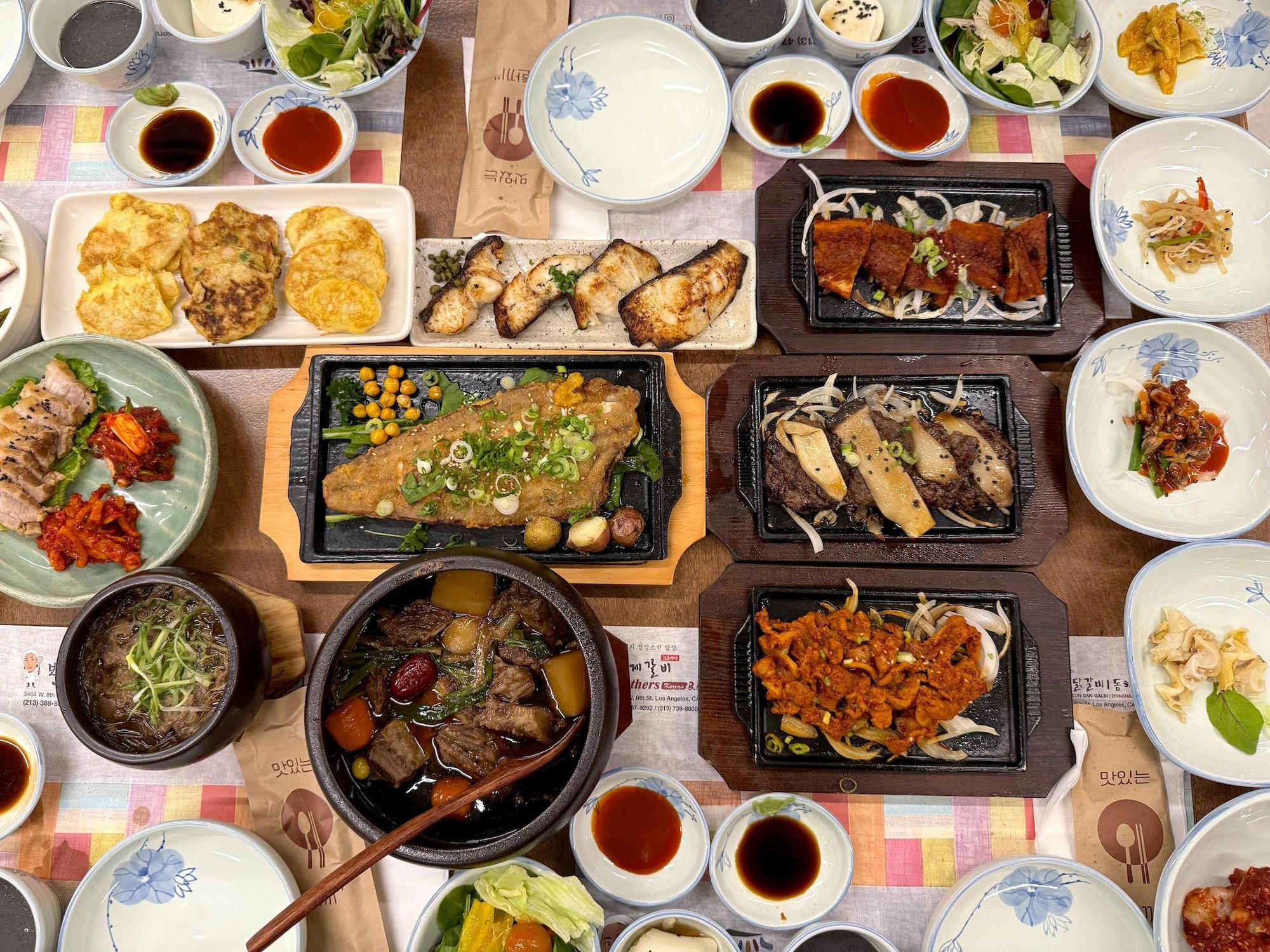
Before the main course arrives at a hanjeongsik meal, the table has already made its argument. Rows of small ceramic dishes spread across the surface, each one a discrete preparation, and the cumulative effect is one of the more considered statements a Korean kitchen can make. This is not incidental abundance. The banchan array in traditional hanjeongsik is calibrated by season, technique, and balance, with fermented vegetables sitting alongside fresh namul, braised proteins next to pickled roots, and preserved fish alongside clean, simply dressed greens. The meal's intelligence is expressed through that assembly before a single main dish is served.
J Korean works within this tradition in Los Angeles, a city where Korean dining has historically skewed toward the communal barbecue format that defines Koreatown's grid of charcoal grills and the fast-casual banchan counters across the Westside. Hanjeongsik, by contrast, is a more structured and lower-volume proposition, one that positions J Korean closer to the formal end of the city's Korean dining options than to its casual heart.
Where Hanjeongsik Sits in Los Angeles
Los Angeles has one of the largest Korean-American populations outside Korea, and Koreatown functions as one of the most self-contained and expansive Korean dining districts in the United States. That density has produced real specialisation: specific regional soups, dedicated jeon houses, sundubu shops that operate through the night. But the hanjeongsik format, a full-course Korean meal with its origins in royal court and aristocratic joseon-era dining, has a smaller footprint in the city than the grilled-meat category that most visitors encounter first.
That relative scarcity is worth noting because it shapes the context for J Korean. In New York, venues like Atomix have pushed Korean fine dining into the tasting-menu tier and established a competitive frame that draws direct comparisons with French and Japanese fine dining. Los Angeles operates differently. The city's premium dining conversation tends to run through Providence for seafood-forward tasting menus, Kato for New Taiwanese precision, and Hayato for Japanese kaiseki, the format most structurally analogous to hanjeongsik in terms of its reliance on sequence, seasonal discipline, and the primacy of technique over spectacle. J Korean occupies a similar position within Korean dining tradition, where the organisational logic of the meal itself carries the critical weight.
Hanjeongsik, with its emphasis on the banchan table as the primary expression of a kitchen's range, sits in a different category from the single narrative arc of a tasting menu.
The Banchan Philosophy
The discipline of banchan preparation is what separates a serious hanjeongsik kitchen from a venue simply serving Korean food in a formal setting. Each side dish is its own production: doenjang-dressed spinach has a different logic from ganjang-braised burdock, and the fermentation timing on kimchi variants reflects decisions made weeks or months before service. A table presenting twelve to fifteen banchan simultaneously is a kitchen managing at least a dozen concurrent timelines, each with its own fermentation schedule, blanching window, or braising duration.
This multiplicity is the format's defining challenge and its defining appeal. Where kaiseki and the Western tasting menu ask a kitchen to control sequence and pacing, hanjeongsik asks it to control simultaneity. The diner's experience is not linear, it is panoramic, a table surveyed rather than a meal navigated course by course. The comparison to other structured Asian dining formats is instructive: kaiseki at Hayato orchestrates a single thread of ingredients through the seasons; hanjeongsik at a venue like J Korean works through the logic of ensemble, where the whole of the table matters more than any individual bowl.
For diners more familiar with the progression model, whether from meals at Somni or Blue Hill at Stone Barns in Tarrytown or Addison in San Diego, the shift in orientation takes a moment to register. The etiquette of the hanjeongsik table is one of exploration, not direction. You are not told what to eat next.
Los Angeles Context: Why This Format Is Underrepresented
The relative scarcity of formal hanjeongsik venues in Los Angeles is not a failure of appetite. It reflects the economics of the format: high labour cost per cover, a reliance on fermentation-based preparation that requires significant lead time, and a guest base that has historically associated Korean dining with the convivial, high-turnover barbecue model. Premium Korean restaurants have had to work against those assumptions, which is precisely the position that venues like Osteria Mozza never had to occupy in relation to Italian food, or that Bacchanalia in Atlanta and Emeril's in New Orleans faced in their respective regional contexts.
That is changing. Recognition of Korean fine dining at the national level, including Michelin attention in New York and growing editorial coverage of Korean culinary traditions beyond fermented cabbage shorthand, has created a more receptive frame for hanjeongsik as a serious dining format rather than a novelty. J Korean operates in that opening. For a full picture of where it sits within the city's broader premium dining circuit, the citywide dining landscape offers useful context.
Internationally, the premium Korean format has found a wider audience at venues like Atomix in New York. J Korean is one of the Los Angeles restaurants making that case locally. J Korean is one of the venues making that argument in Los Angeles.
Comparisons to venues like The Inn at Little Washington may seem lateral, but they share one relevant feature: a format with deep historical roots can carry itself in the premium tier without compromise. That confidence is what hanjeongsik brings to the table, quite literally.
Know Before You Go
Cuisine: Korean, hanjeongsik (multi-course with banchan)
City: Los Angeles, California
Format: Formal sit-down; structured around the banchan table
Price tier: $$
Reservations: Walk-ins are welcome
Dress code: Casual
Just the Basics
Comparable venues nearby, for context on price, style, and recognition.
| Venue | Cuisine | Price | Notes |
|---|---|---|---|
| J KoreanThis venue — the venue you are viewing | Koreatown, Korean BBQ | $$ | |
| California Market | Wilshire Center, Korean Gimbap & Udon | $$ | |
| Chimmelier | $$ | Westlake, Korean Fried Chicken & Street Food | |
| Beverly Soon Tofu | $$ | Koreatown, Traditional Korean Soondubu Jjigae | |
| Perilla L.A. | $$ | Chinatown, Korean Banchan & Seasonal Sides | |
| Master Ha | Harvard Heights, Korean Seafood | $$ |
Continue exploring
More in Los Angeles
Restaurants in Los Angeles
Browse all →
Bars in Los Angeles
Browse all →
Hotels in Los Angeles
Browse all →
Wineries in Los Angeles
Browse all →
At a Glance
- Lively
- Energetic
- Group Dining
- Casual Hangout
- Family
Casual and lively Korean dining atmosphere with communal table spreads designed for sharing and group dining.