Our verdict
On Parnell Street, where Dublin's South Asian dining corridor has quietly deepened over the past decade, Indian Tiffins works within the tiffin-carrier tradition — the layered, compartmentalised meal format that structures lunch and dinner across the Indian subcontinent. The format itself dictates the pacing, the portion logic, and the way a meal here unfolds, setting it apart from the standard curry-house template that still dominates much of the city.

Pearl is the En Primeur Club membership app — saves, bookings, and concierge access live there. Same editors, same standards.
- Address
- Upper, 138 Parnell St, Rotunda, Dublin 1, D01 W9E5, Ireland
- Phone
- +353899846414
- Hours
- Daily 8:30 AM–11:30 PM
- Website
- indiantiffins.ie
- Directions
- Get directions
- Booking
- Book on the venue's website
The menu
What to order
- Heavy Roast Dosa
- Idli and Vada
- Chicken 65 Biryani
- Hyderabadi Chicken Dum Biryani
Parnell Street and the Logic of the Tiffin Meal
Dublin's most concentrated stretch of South Asian restaurants runs along Parnell Street in Rotunda, and the dining culture there operates by different rules than the city's fine-dining corridor further south. Where restaurants like Chapter One by Mickael Viljanen or Patrick Guilbaud build meals around a single authored tasting progression, the South Asian tradition works through multiplicity: many small components arriving together, each calibrated against the others, with rice or bread as the structural anchor rather than the afterthought.
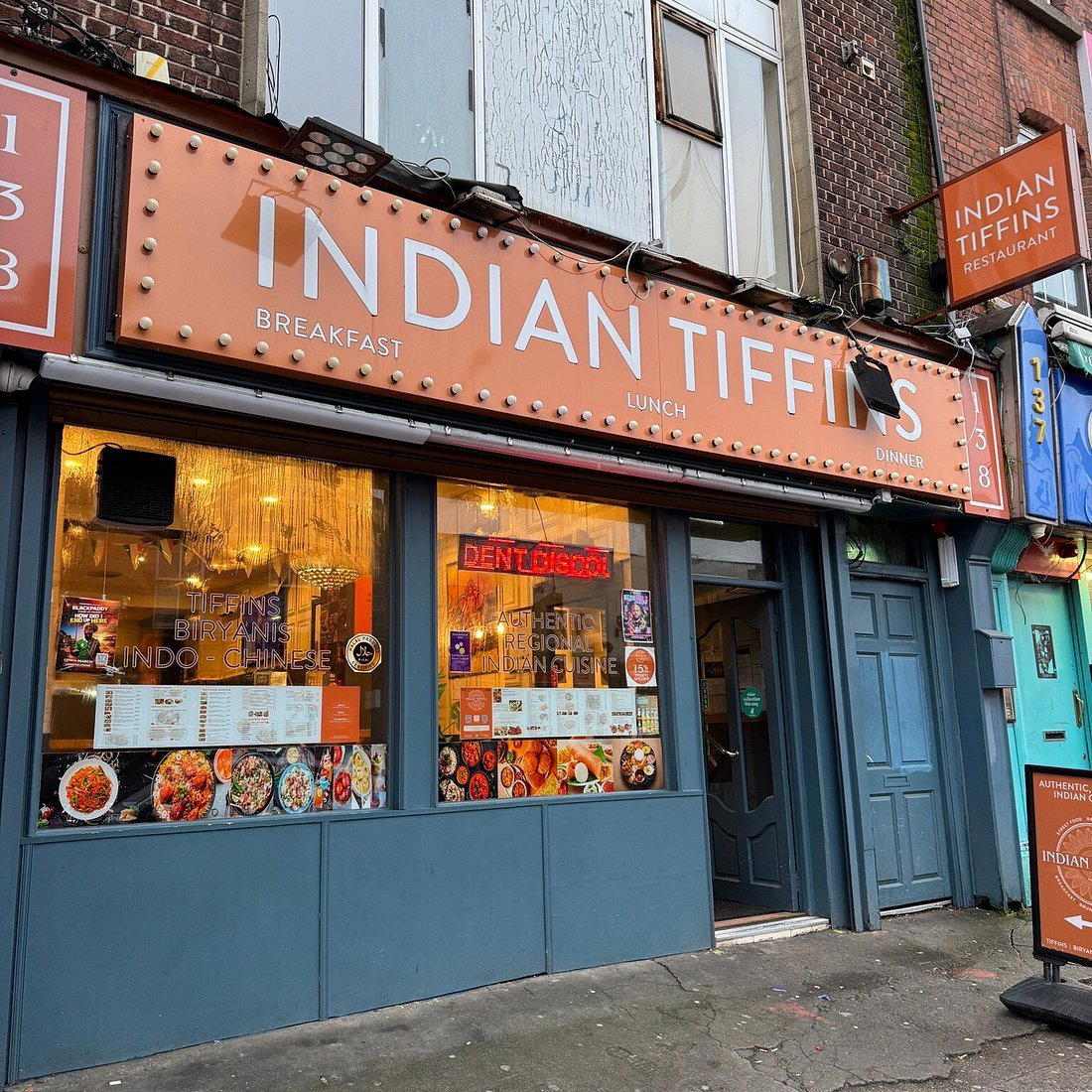
Indian Tiffins, at 138 Upper Parnell Street, draws its name and its organising principle from that tradition. The tiffin carrier — the stacked metal container used across India, Sri Lanka, and the wider subcontinent to transport home-cooked meals in compartmentalised tiers — is not a gimmick here. It is the logic of how the meal is composed and how it arrives. Understanding that format changes what you order, how you pace yourself, and what you should expect when the food reaches the table.
The Ritual Architecture of a Tiffin Meal
The tiffin format is a useful corrective to how Western diners are often taught to eat Indian food. The standard Dublin curry-house template, starter, one main, rice, naan, done, collapses a cuisine of extraordinary regional variation into a linear sequence that the food was never designed to follow. The tiffin tradition works differently. Components are portioned to complement rather than compete, with dal, vegetable preparations, chutneys, pickles, and a protein element arranged so that each mouthful is assembled by the diner, not pre-decided by the kitchen.
That assembly logic places Indian Tiffins in a different conversation from the broader Parnell Street field. Where much of the street defaults to the familiar ordering convention, a tiffin-led menu demands a different kind of attention from the guest. You are not moving through courses in sequence. You are managing a spread, working across flavours simultaneously, and using bread or rice as the binding agent that shifts the register between bites. For diners accustomed to the pacing structures of, say, Glovers Alley or Bastible, this requires a conscious gear change, and that is precisely the point.
Across the subcontinent, the tiffin meal carries social weight beyond nutrition. In Mumbai's dabbawalas system, tiffin carriers move through the city by a logistics network that has been studied by business schools for its near-zero error rate. In South Indian homes, a thali, the plate-based cousin of the tiffin, signals hospitality through abundance and balance rather than scarcity and refinement. The format at Indian Tiffins sits within that lineage, even if the Dublin context strips away some of the original ceremony.
Where Indian Tiffins Sits in Dublin's Wider Dining Picture
Dublin's restaurant scene has become more differentiated over the past several years. The Michelin footprint has expanded beyond the city centre's traditional fine-dining axis, and the conversation about Irish food now regularly includes venues like Liath in Blackrock, Aniar in Galway, and dede in Baltimore, restaurants working at the intersection of place, produce, and technique. That conversation is largely a European-cuisine conversation. The South Asian dining tier in Dublin has developed on a parallel track, with Parnell Street functioning as its informal centre of gravity.
Within that tier, Indian Tiffins occupies a specific position. The tiffin format is not common in Dublin, the majority of South Asian restaurants on and around Parnell Street operate on the curry-house or hybrid model. A venue that organises its menu around the compartmentalised tiffin tradition is working in a narrower lane, and that narrowness comes with both a more defined identity and a higher demand on the diner to engage on the format's own terms.
For context on how format-driven restaurants function at the higher end of the market, the Korean tasting counter at Atomix in New York City and the seafood-led precision of Le Bernardin both demonstrate how a strong structural logic, whether coursed omakase or classical French brigade, shapes not just what arrives at the table but how the diner participates in the meal. The tiffin tradition is a different register entirely, rooted in domesticity rather than haute technique, but the underlying principle holds: the format is the argument, and the food makes the case.
Parnell Street as a Dining Address
Rotunda, the district that contains Parnell Street, sits at the northern edge of Dublin 1, a short walk from O'Connell Street and the city's central axis. The area is less curated than the south city dining quarters around St. Stephen's Green or Merrion Square, where you find the fine-dining concentration represented by venues like D'Olier Street. That lack of curation is part of Parnell Street's character. The street functions as a working multicultural corridor, and its restaurants reflect that: the pricing is accessible, the atmosphere is unpretentious, and the cooking is aimed at regulars as much as visitors.
That context matters for calibrating expectations. A tiffin meal on Parnell Street is not competing with the tasting-menu register of Terre in Castlemartyr or Lady Helen in Thomastown. It is competing on different terms: authenticity of format, depth of spice work, and the quality of the dal and the bread. Those are the metrics that matter here, and they are not lesser for being different from what the city's fine-dining tier is measured against.
For visitors building a broader picture of eating well across Ireland, the full range extends significantly beyond Dublin. Bastion in Kinsale, Campagne in Kilkenny, Chestnut in Ballydehob, and Homestead Cottage in Doolin each represent distinct regional dining propositions. House in Ardmore sits within a coastal tradition that has little overlap with what Parnell Street offers. The breadth of that map is part of why Dublin's South Asian corridor deserves to be read as a distinct and valid strand within Irish food culture, not a footnote to the European-technique mainstream.
Our full Dublin restaurants guide covers the city's dining spread across price tiers, neighbourhoods, and cuisine types.
Know Before You Go
Frequently asked questions
What's the address for INDIAN TIFFINS?
INDIAN TIFFINS is located at Upper, 138 Parnell St, Rotunda, Dublin 1, D01 W9E5, Ireland, Dublin.
How does Indian Tiffins differ from other South Asian restaurants on Parnell Street, Dublin?
While Parnell Street in Dublin 1 holds the city's densest concentration of South Asian restaurants, most operate on a standard à la carte or set-menu curry-house model. Indian Tiffins structures its food around the tiffin tradition — a format rooted in Indian lunchtime culture that organises the meal into portioned components rather than individually ordered dishes, which changes both pacing and portion logic considerably.
What's the must-try dish at INDIAN TIFFINS?
The tiffin format itself is the main event at this Parnell Street address — a structured, compartmentalised meal drawn from South Asian lunch traditions rather than the standard Dublin curry-house template.
Is INDIAN TIFFINS reservation-only?
Given that Parnell Street operates at high lunch-trade volume, contacting the restaurant directly before visiting is advisable.
What's the defining dish or idea at INDIAN TIFFINS?
The defining idea is the tiffin meal format itself — a South Asian tradition of portioned, multi-component dishes served together rather than sequentially. On Parnell Street, where the surrounding dining culture is shaped by South Asian community-run kitchens, that approach sets Indian Tiffins apart from the conventional sit-down curry model that still dominates elsewhere in Dublin.
Can INDIAN TIFFINS accommodate dietary restrictions?
The tiffin format, by structure, includes vegetable-forward and pulse-based dishes as standard components, which tends to serve vegetarian diners well. For specific allergen or dietary requirements, contacting the restaurant at 138 Parnell Street, Dublin 1 directly before visiting is the practical step.
Is a meal at INDIAN TIFFINS worth the investment?
Parnell Street's South Asian restaurants are generally priced for regular local trade rather than occasion dining, and the tiffin format delivers volume and variety per sitting.
A Credentials Check
Comparable venues nearby, for context on price, style, and recognition.
| Venue | Cuisine | Price | Notes |
|---|---|---|---|
| INDIAN TIFFINSThis venue — the venue you are viewing | Authentic South Indian Tiffins & Biryanis | $10–20 | Not listed |
| Mehek Indian Restaurant | Authentic Indian with Irish Produce | $20–30 | Rathmines West E |
| Thali | Authentic Indian Thali | $20–30 | Rathmines West F |
| Indian Tiffins-Rathgar | Authentic Regional Indian Tiffins | $20–30 | Terenure A |
| Musashi Parnell Street | Japanese Sushi and Ramen | $20–30 | Rotunda B |
| Krewe North | Cajun Creole | Not listed | Rotunda B |