Hyatt Regency Sushi Bar
Hyatt Regency Sushi Bar serves Japanese sushi with Caribbean fusion at the Hyatt Regency waterfront in Port of Spain, with Temaki, Makimono, sake, and craft cocktails.
Pearl is the En Primeur Club membership app — saves, bookings, and concierge access live there. Same editors, same standards.
- Address
- #1 Wrightson Rd. (1 Wrightson Rd.), Port-of-Spain
- Directions
- Get directions
 Saves & bookings on Pearl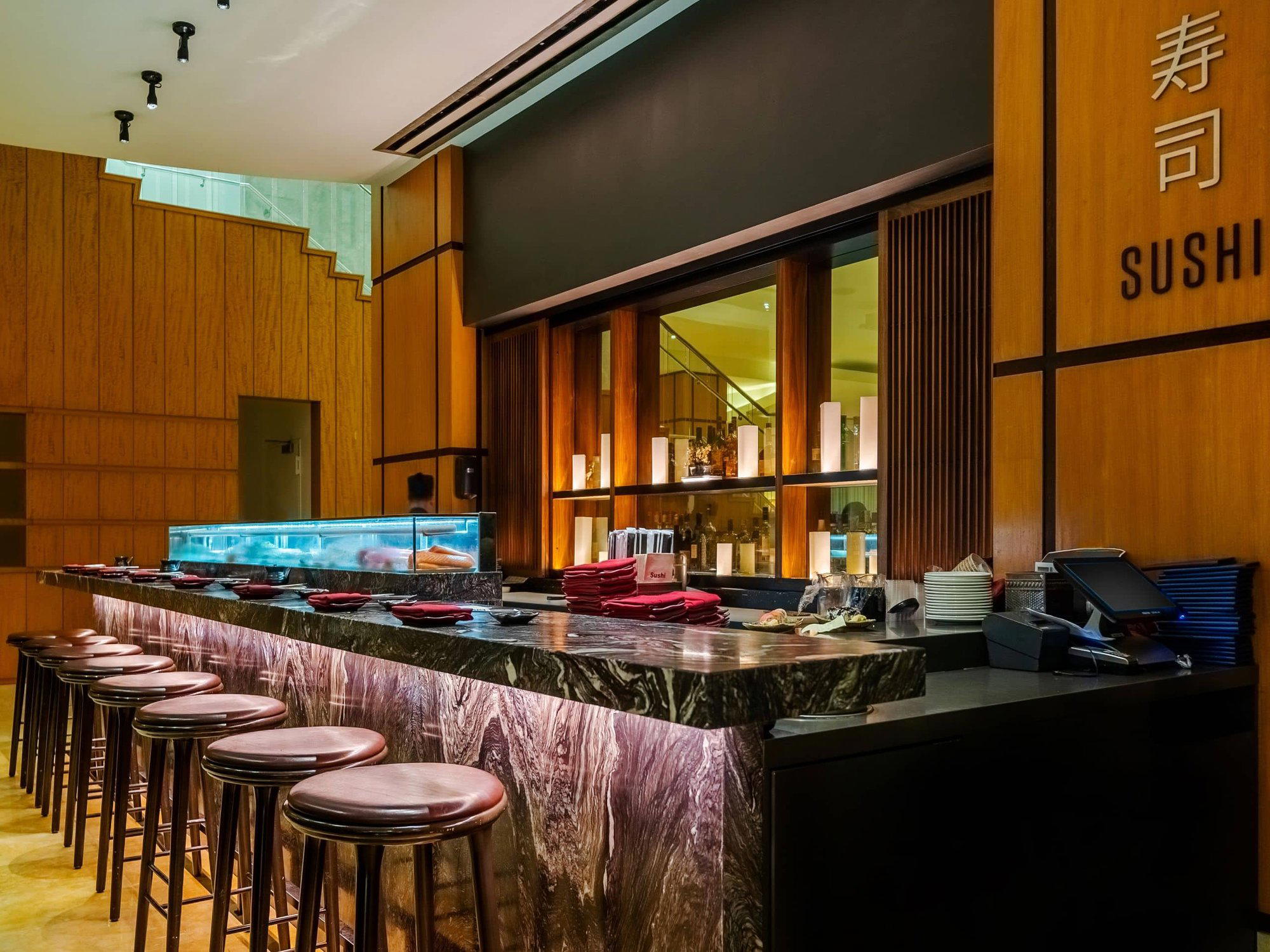
Sushi in a Port of Spain Context
Waterfront dining in Port of Spain carries a particular kind of tension: the Caribbean expectation of salt air and local colour colliding with whatever international format occupies the room. The Hyatt Regency Sushi Bar, situated inside the Hyatt Regency at 1 Wrightson Road, sits at that intersection. The building faces the Gulf of Paria, and the waterfront address places it physically apart from the denser commercial dining strips further inland, where spots like House of Chan and La Cantina anchor a more mixed-nationality crowd. Here, the hotel frame shapes expectations before you sit down: this is a format aimed squarely at business travellers and visiting professionals staying in the property, and it prices and presents itself accordingly.
How Japanese Technique Travels
Sushi bars that operate outside Japan's major cities face a consistent set of pressures. Without the dense supplier networks of Tokyo, Osaka, or even Hong Kong, sourcing the fish grades that define credibility at a counter becomes a logistical challenge rather than a given. At venues like 8 1/2 Otto e Mezzo Bombana in Hong Kong or Amber in Hong Kong, the solution is proximity to world-scale fish markets and deep-pocketed import logistics. In Port of Spain, neither condition holds at scale. The local fishing tradition is genuinely strong, Trinidad and Tobago sits in productive Atlantic and Caribbean waters, but the species profile is Caribbean rather than Pacific: kingfish, carite, snapper, and flying fish, not bluefin, yellowtail, or sea urchin from Hokkaido.
That gap creates an editorial question that applies to any sushi bar operating in a Caribbean or South American context: does the venue try to replicate a Japanese sourcing model at high cost and variable quality, or does it adapt its format to work with what the surrounding waters actually produce? How the Hyatt Regency Sushi Bar resolves that question shapes the entire value proposition for guests. The broader pattern in international hotel sushi programs is that adaptation tends to produce more coherent results than replication, but the adaptation requires genuine knowledge of both the Japanese technique and the local ingredient set.
Port of Spain's Dining Register
Port of Spain's restaurant scene is shaped by the country's food culture more than any single imported format. Trinidadian cuisine is one of the Caribbean's most compositionally complex, drawing on Indian, African, Chinese, Spanish, and Creole influences compressed into dishes that have developed genuine local identity over generations. The doubles tradition, represented across the city by operators including Sauce Doubles, S&S Doubles, and Dass Doubles Factory, and the roti shops visible at every price level, including Don's Roti Shop in Petit Valley, represent a food culture with deep roots and strong local authority. International formats, including Japanese, Italian, and American, occupy a secondary tier that caters primarily to the expatriate and hotel-staying demographic.
That demographic is real and consistent in Port of Spain, which functions as a business and energy-sector hub with steady international traffic. Venues like You And I and the cluster featured in the Yousef Gyros, Don's Roti Shop, and House of Chan roundup show the diversity of international formats that have found footing here, each anchored to a particular slice of the city's transient and local-professional appetite. A hotel sushi bar functions differently from all of these: it has a captive audience, a physical environment defined by the hotel's design standards, and a mandate to serve guests who may not want to leave the property after a long flight or a full day of meetings.
The Cultural Stakes of Sushi Outside Japan
Japanese cuisine has a particular claim on rigour that other international formats do not. The craft disciplines around nigiri, the temperature and seasoning of shari, the handling of fish at different stages of aging, are not decorative concerns. They are the actual content of the form. When sushi bars at hotel properties around the world fall short, it is usually not through lack of effort but through compressed supply chains and a guest base that cannot always distinguish between a technically sound plate and a facsimile. The venues that earn sustained credibility in non-Japanese markets, from Atomix in New York City representing the Korean-Japanese crossover model, to the classical French-adjacent seafood rigour at Le Bernardin in New York City, do so by making a clear commitment to technique that extends beyond the menu description into the actual execution.
For a hotel sushi bar in Port of Spain, the credibility question is harder to answer from the outside, because the venue data available does not include chef credentials, sourcing details, or operational specifics. What the address and hotel context do confirm is the format's positioning: this is a mid-to-upscale hotel food and beverage offering in a city where international dining options at that register are limited. By comparison, cities with denser Japanese dining ecosystems, including the populations of expatriate Japanese business communities that tend to drive quality competition, have different floors for what counts as acceptable. Port of Spain does not have that competitive pressure, which can cut both ways.
Planning a Visit
The Hyatt Regency sits on Wrightson Road along the waterfront, accessible from the city centre on foot or by short taxi from most downtown locations. As a hotel restaurant, it is generally accessible to non-staying guests, though confirmation directly with the property on current operating hours and reservation requirements is the only reliable approach, given that hotel food and beverage programs adjust seasonally and around conference calendars. Port of Spain's international traffic peaks around Carnival season in late January and February, when the city runs at full capacity and hotel dining rooms fill quickly with both staying guests and outside visitors. Outside those periods, walk-in access at a hotel venue of this type is generally more direct. For travellers comparing this against other options in the city, the full Port of Spain restaurants guide maps the broader scene across price points and formats, including local specialists that reflect the city's actual culinary identity more directly than any hotel sushi program can.
For readers who track how hotel-group dining programs perform internationally, the contrast between a property like this and the major-market anchor venues in EP Club's wider coverage, including Alinea in Chicago, Alain Ducasse at Louis XV in Monte Carlo, or Alléno Paris au Pavillon Ledoyen, illustrates how wide the spectrum runs from neighbourhood street food to three-star institutional dining.
A Pricing-First Comparison
| Venue | Price |
|---|---|
| Hyatt Regency Sushi BarThis venue — the venue you are viewing | This venue |
Continue exploring
More in Port Of Spain

At a Glance
- Modern
- Elegant
- Date Night
- Business Dinner
- Hotel Restaurant
- Waterfront
- Sake Program
- Craft Cocktails
- Local Sourcing
- Waterfront
Sleek, minimalist setting with arresting views of the terrace and gulf.
Know Before You Go
- Getting there
- #1 Wrightson Rd. (1 Wrightson Rd.), Port-of-Spain