
Tabelog 100 #49
Our verdict
Tokyo’s hamburger culture has moved well beyond fast casual, with small counters treating the format as a serious dinner category. hide mode sits in that sharper tier in Hongo, backed by repeated Tabelog Hamburger 100 selections and a compact 13-seat room that folds bistro, dumpling, wine and sake cues into the burger conversation.

Pearl is the En Primeur Club membership app, where members save venues, book tables and use the concierge.
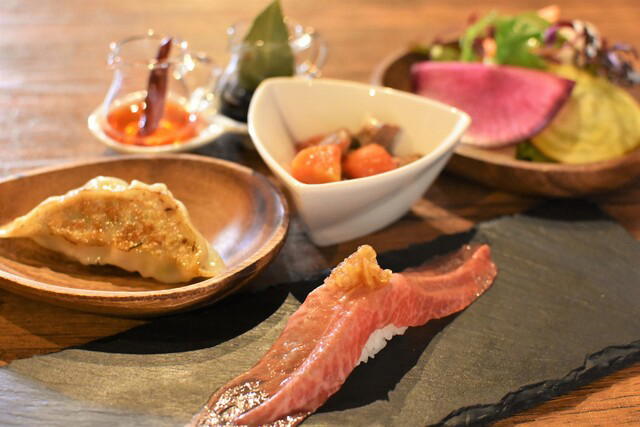
Tokyo does not need every worthwhile restaurant to announce itself with neon density or polished restaurant theater. Across the city, the rhythm can feel practical and everyday: storefronts, evening streets, and dining rooms that rely more on regular attention than spectacle. Here, Tokyo’s hamburger scene reads less as American nostalgia or diner cosplay than as Japan’s habit of importing a form and tightening it until every choice matters.
That frames hide mode. Recognition on the Tabelog Hamburger 100 list in 2026 places it among the burger-focused addresses Japanese diners treat as destination restaurants, not convenience stops. A Tabelog score of 3.70 gives the reputation numerical weight, but the stronger signal is category selection in a genre where Tokyo now has both specialist counters and hybrid restaurant formats.
Tokyo's serious burger tier has become a dinner category
Japan’s hamburger field splits into American-style shops built around size and familiarity, café burgers as casual lunch plates, and a narrower group where the burger becomes a composed restaurant dish. hide mode belongs to the last camp, with categories listed as hamburger, bistro and dumpling rather than single-purpose sandwich shop. That taxonomy explains the audience: diners choosing a focused, evening meal rather than a quick bite between stations.
The price band reinforces the position. At JPY 4,000 to JPY 4,999 for dinner, it sits above the casual burger norm while staying below heavier spend categories elsewhere in Tokyo. Citywide comparisons show the spread: other Tokyo dining rooms point toward izakaya, city-center dining, and specialist traditions. Within the comparisons set, Yakiniku Akira Hongou honten, Menya Suzuharu, Katsuzen, Soba Kiri Morino and canade show how varied Tokyo’s focused restaurants can be. This burger occupies the middle ground: not cheap, not ceremonious, but serious enough for a planned evening.
The restaurant’s public reputation is best read through the information that is actually listed: hamburger, bistro and dumpling categories, a dinner budget in the JPY 4,000 to JPY 4,999 range, and Tabelog Hamburger 100 recognition for 2026. Those signals show a venue positioned by category focus and diner attention rather than by a sprawling menu identity or ambience alone.
A hybrid listing, not a burger bar cliché
Category shapes the experience as much as price. hide mode is better approached as a Tokyo restaurant with a defined listing than as a casual counter built only around speed. That matters for planning, especially for diners treating the meal as part of an evening rather than a quick bite between appointments. Tokyo has many restaurants where focus is the main attraction; here the useful point is simple: the appeal rests on a clearly signaled format.
The category mix adds another clue to the hybrid identity. Listing hamburger alongside bistro and dumpling places the restaurant closer to a mixed-format dining room than a single-purpose burger stand. That pairing logic suits modern Tokyo, where genre boundaries blur easily: casual formats can carry scrutiny once reserved for sushi, soba, yakitori or tempura counters, and modest categories can become destinations when diners learn to read them carefully.
The location has a practical edge. hide mode is in Tokyo, but it is not framed here as a tourist landmark experience or a hotel-district default. That changes the pre-dinner rhythm: it is better treated as a planned stop within the city than as an improvised add-on. The restaurant rewards diners who care about category and reputation more than postcard scenery.
Recognition gives the burger format a sharper filter
Awards matter differently in casual categories. Michelin stars clarify the upper end of French, sushi and kaiseki; burger recognition works harder because the form is familiar. Tabelog’s Hamburger 100 list gives Tokyo diners a filter for a category crowded with personal preference. Selection does not make any burger universally persuasive, but it indicates attention from a dining public that ranks detail aggressively.
hide mode is therefore better understood within Tokyo’s broader specialist culture than as novelty. The city has long excelled at narrow formats: ramen shops built around a single broth direction, tonkatsu rooms with tightly controlled frying, yakitori counters organized by grill rhythm. A burger-focused restaurant can sit inside that mentality when the format is disciplined and the surrounding meal has enough structure to justify dinner pricing.
For travelers mapping Tokyo by category, this is not a replacement for sushi, soba or yakitori. It is a detour into how the city edits Western forms. For a broader read on the capital’s dining range, see Our full Tokyo restaurants guide, then compare how hospitality changes across Our full Tokyo hotels guide, Our full Tokyo bars guide, Our full Tokyo wineries guide and Our full Tokyo experiences guide. The same question runs through all of them: when does a familiar format become worth crossing town for?
The answer here rests on reputation, category mix and price band. The restaurant is focused, the category mix is specific, and the price band asks diners to treat the burger as a composed evening plate. That will appeal more to travelers interested in Tokyo’s specialist food culture than to anyone chasing spectacle. For wider context, compare the way other unnamed dining rooms in Japan and abroad turn narrow formats into serious destinations. The point is not that every casual form needs elevation, but that Tokyo is unusually good at making diners notice when one has been edited with intent.
The Short List
Comparable venues for orientation by cuisine and category.
| Venue | Cuisine | Price | Awards | Notes |
|---|---|---|---|---|
| hide modeThis venue (the venue you are viewing) | Creative French-Influenced Fusion | $30–50 | Tabelog 100 #49 | Not listed |
| canade | Seasonal Italian with Japanese Ingredients | $100–150 | Michelin Plate · Tabelog 100 #59 | Italian |
| Soba Kiri Morino | Traditional soba and tempura | $30–50 | Tabelog 100 #3 | JPY 8,000 - JPY 9,999 JPY 2,000 - JPY 2,999 |
| Yakiniku Akira Hongou honten | Japanese Yakiniku (BBQ Beef) | $50–100 | Tabelog 100 #10 | JPY 6,000 - JPY 7,999 JPY 2,000 - JPY 2,999 |
| Menya Suzuharu | Ramen / Tsukemen | $10–20 | Tabelog 100 #40 | JPY 1,000 - JPY 1,999 JPY 1,000 - JPY 1,999 |
Recognition history
Dated appearances from independent guides and award organizations, with the underlying list record or original source where available.
Tabelog 100 #49 · No. 49
Tabelog · Tabelog 100 - Hamburger - 2026
Continue exploring
More in Tokyo
Restaurants in Tokyo
All restaurants in Tokyo →



Bars in Tokyo
All bars in Tokyo →





Details
- Cozy
- Trendy
- Energetic
- Modern
- Casual Hangout
- Group Dining
- After Work
- Standalone
- Open Kitchen
- Beer Program
- Craft Cocktails
- A La Carte
- Counter Dining
- Wine
- Alcohol Pairings
A comfortable, lively space with the chef’s live energy and a casual creative-restaurant feel.