Our verdict
A Vietnamese restaurant on a quiet street just off Nice's central shopping axis, Hanoi Opera sits in a city where Southeast Asian kitchens occupy a distinct niche among French and Niçoise dining. The address on Rue Dalpozzo places it within easy reach of the old town and the Carré d'Or district. For those tracking where sourcing discipline meets unfamiliar cuisine in the south of France, it warrants attention.

Pearl is the En Primeur Club membership app — saves, bookings, and concierge access live there. Same editors, same standards.
- Address
- 1 bis Rue Dalpozzo, 06000 Nice, France
- Phone
- +33 4 89 14 68 82
- Hours
- Mon–Tue 11:30 AM–2:30 PM, 6–10:30 PMWed 6–10:30 PMThu–Sun 11:30 AM–2:30 PM, 6–10:30 PM
- Website
- hanoiopera.com
- Directions
- Get directions
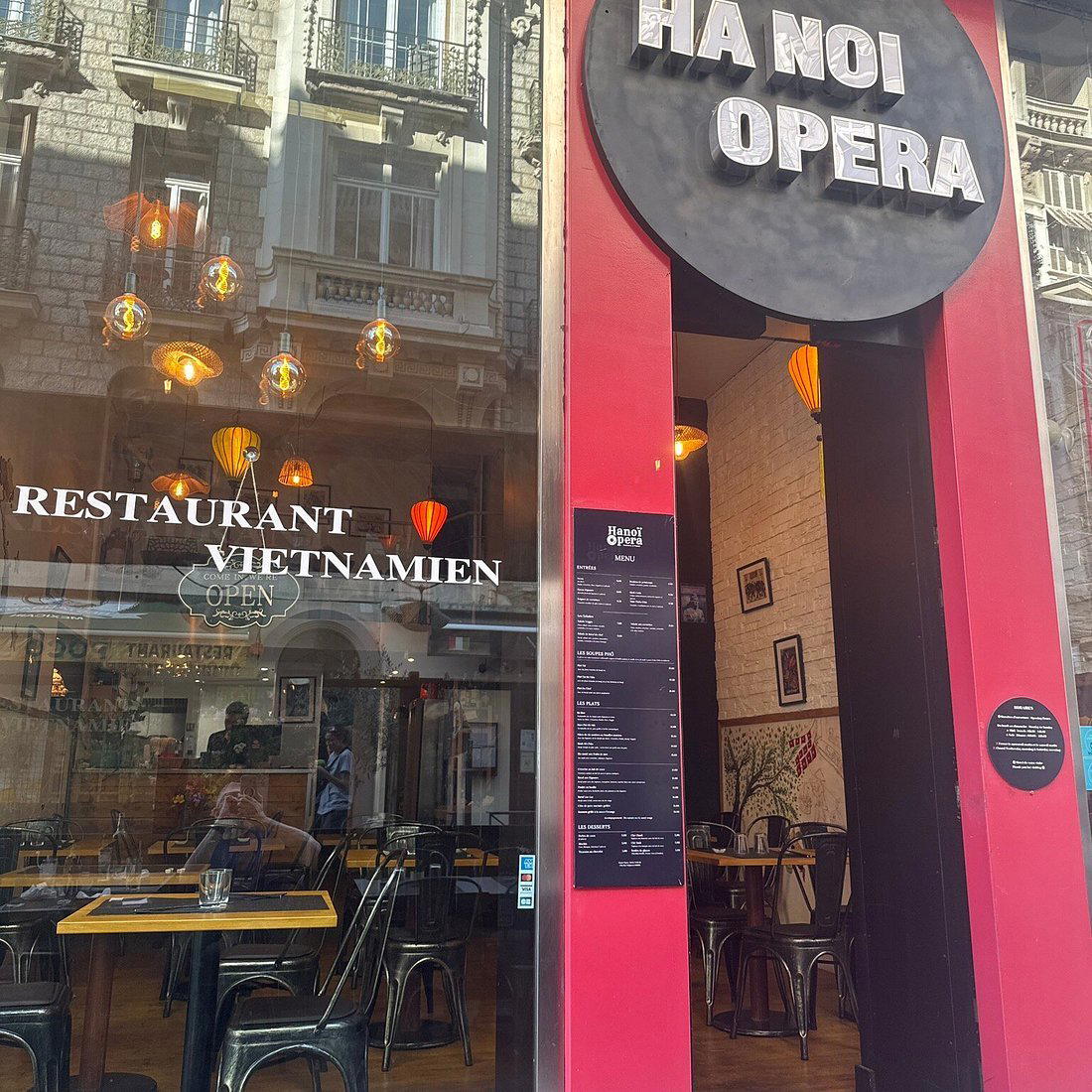
The menu
What to order
- Pho
- Bo Bun
- Vietnamese Crepes
- Nems
- Grilled Salmon with Orange Sauce
Vietnamese Cooking in the Context of Nice's Dining Scene
Nice is not a city short of culinary identity. The Niçoise tradition — socca, pissaladière, stockfish, and the particular olive oils of the arrière-pays — has shaped its restaurant culture for generations. The city's contemporary fine-dining tier, represented by addresses like Flaveur, L'Aromate, and Le Chantecler, sits firmly within a French and Mediterranean framework. Against that backdrop, a Vietnamese kitchen represents a genuinely distinct register, one that draws on a different set of sourcing logics, herb profiles, and cooking techniques.
Vietnamese cuisine, even in its Parisian form, has always been defined by what arrives at the table fresh and what was preserved or fermented in advance. The herb platters, the bone broths simmered for hours, the fish sauces aged in coastal provinces, these are not incidental details but structural ones. When a Vietnamese restaurant operates far from its original supply chains, the question of where ingredients come from becomes more pointed than it would be in, say, a Provençal kitchen drawing from markets twenty kilometres away.
Hanoi Opera, at 1 bis Rue Dalpozzo in the 06000 postal district, sits a short walk from Nice's Carré d'Or and the old town. The street is quiet relative to the main commercial arteries nearby, which gives the approach a degree of remove from the city's busier tourist circuits. That positioning places it in a tier of neighbourhood addresses that serve a mix of local regulars and visitors who have done their homework.
Sourcing Logic in a Transplanted Cuisine
The credibility of any Vietnamese kitchen operating outside Vietnam rests substantially on how it resolves the sourcing problem. The aromatics, lemongrass, galangal, Vietnamese coriander, perilla, do not grow in Provençal soil at the same intensity as they do in subtropical climates. The fish sauce, shrimp paste, and fermented condiments that anchor northern Vietnamese cooking are typically imported. The broths that define dishes like pho require time and the right cut of bones; shortcuts register immediately.
In France more broadly, the Vietnamese restaurant sector has bifurcated over the past two decades. One cohort has moved toward hybrid menus that accommodate French palate expectations, lighter sauces, reduced chilli, broader vegetable selections. Another has maintained fidelity to regional Vietnamese cooking, accepting a narrower audience in exchange for greater specificity. Northern Vietnamese cooking, associated with Hanoi, tends toward cleaner broths and subtler seasoning than the sweeter southern styles; a restaurant invoking the capital in its name signals something about which register it is working in.
For context on how sourcing ambition plays out at the highest level of French dining, it is instructive to look at addresses like Mirazur in Menton, where the kitchen's garden supplies a meaningful share of what arrives on the plate, or Bras in Laguiole, whose entire philosophy is anchored to the flora of the Aubrac plateau. Those are extreme cases, but they establish a useful benchmark: in serious kitchens, the sourcing question is answered before the cooking begins.
Nice's Broader Restaurant Architecture
Nice's dining scene has developed in a specific direction over the past decade. The city's proximity to the Italian border gives it an unusually broad pantry, Ligurian olive oils, Piedmontese truffles, and Cinque Terre anchovies all appear on local menus, and its Mediterranean position means seafood sourcing from local boats remains viable for kitchens willing to work with seasonal availability. Creative addresses like Les Agitateurs and ONICE have pushed that Mediterranean identity in more experimental directions.
Vietnamese cooking occupies a different position entirely: it imports its identity rather than drawing from local terroir. That is not a criticism. Some of the most consistent Vietnamese restaurants in France operate this way, treating ingredient sourcing as a logistics challenge to be solved through supplier relationships, rather than a geographical given. The test is whether the kitchen's supply chain is tight enough to deliver the flavour benchmarks that define the cuisine.
Across France's broader fine-dining constellation, from Alléno Paris au Pavillon Ledoyen to Flocons de Sel in Megève, the sourcing conversation has become central to how kitchens differentiate themselves. The same scrutiny applies, in a different register, to any restaurant making ingredient-specific claims. For addresses like Troisgros, Auberge de l'Ill, or Paul Bocuse, provenance is part of the institutional identity. For a Vietnamese kitchen in Nice, it is a quieter but no less real question.
Planning Your Visit
Hanoi Opera's address, 1 bis Rue Dalpozzo, 06000 Nice, puts it within comfortable walking distance of the Massena tram stop and the main pedestrian zone. The street sits between the Carré d'Or shopping district and the approaches to Vieux-Nice, making it accessible without being directly on the tourist path. For visitors cross-referencing this against other Nice dining options, the full Nice restaurants guide sets out the broader picture across cuisine types and price points.
This is particularly relevant for lunch service, which Vietnamese restaurants in France handle inconsistently, some operate full midday sittings, others concentrate on dinner. Booking ahead for dinner on weekends is advisable for any address in this part of Nice, where demand for non-French cuisine tends to concentrate on a smaller number of options.
For those building a wider Côte d'Azur itinerary that takes in serious dining, AM par Alexandre Mazzia in Marseille and Mirazur in Menton represent the regional ceiling in terms of award recognition. Further afield, Assiette Champenoise, Au Crocodile, Le Bernardin in New York, and Atomix offer useful reference points for how serious kitchens across different cuisine traditions approach sourcing and ingredient discipline.
Frequently asked questions
Where exactly is Hanoi Opera?
Hanoi Opera is located at 1 bis Rue Dalpozzo, 06000 Nice, France, Nice.
Is Hanoi Opera in Nice suitable for a solo diner visiting the French Riviera?
The restaurant's location at 1 bis Rue Dalpozzo, within walking distance of the Massena tram stop, makes it straightforward to reach from most central Nice hotels without a taxi. Vietnamese restaurants in the Hanoi-kitchen tradition, with their emphasis on individual bowl formats and counter-friendly service rhythms, tend to accommodate solo diners without friction.
What do regulars order at Hanoi Opera?
Hanoi Opera's kitchen is rooted in northern Vietnamese cooking, so the focus tends to fall on broth-based dishes and preparations where technique shows clearly rather than heavy saucing. Given the restaurant's position on Rue Dalpozzo, near the Massena commercial core, the clientele skews toward weekday lunch regulars and neighbourhood returnees rather than one-off tourists, which tends to shape a menu around repeatable, precise execution.
What's the best way to book Hanoi Opera?
A confirmed phone number and website are not currently listed for Hanoi Opera at 1 bis Rue Dalpozzo, Nice. Arriving in person to check availability or ask about reservation policy is a practical first step, particularly for dinner sittings when demand at well-regarded neighbourhood restaurants in Nice tends to run ahead of walk-in capacity.
What makes Hanoi Opera worth seeking out?
Nice has a clearly defined culinary identity built around Niçoise and Ligurian traditions, which means a Vietnamese kitchen operating here has to earn its place on its own terms rather than filling a gap in an underdeveloped scene. Hanoi Opera's address on Rue Dalpozzo puts it in a competitive, well-trafficked part of the city where the dining standard is high. A Vietnamese restaurant that holds its ground in that context, rather than in an isolated ethnic quarter, typically does so through sourcing discipline and cooking consistency.
Can Hanoi Opera handle vegetarian requests?
Traditional northern Vietnamese cooking includes a meaningful range of vegetable-forward preparations, including herb-heavy salads, tofu-based dishes, and broth options that can be constructed without meat. Contacting the restaurant directly before visiting, particularly for dietary requirements, is the reliable approach.
Fast Comparison
Comparable venues nearby, for context on price, style, and recognition.
| Venue | Cuisine | Price | Notes |
|---|---|---|---|
| Hanoi OperaThis venue — the venue you are viewing | Authentic Vietnamese | $20–30 | Not listed |
| Ramen Kumano | Authentic Japanese Ramen | $20–30 | Cœur de Nice |
| La Table de Mamane | Authentic Ethiopian | $20–30 | Cœur de Nice |
| Pinpin | Modern French Mediterranean | $20–30 | Nice Historique |
| Fjord | Scandinavian Cuisine | $20–30 | Nice Historique |
| Franchin | Classic French Bistro | $30–50 | Cœur de Nice |
Continue exploring
More in Nice
Restaurants in Nice
Browse all →
Bars in Nice
Browse all →
Hotels in Nice
Browse all →

Details
- Modern
- Cozy
- Quiet
- Family
- Casual Hangout
- Standalone
- Local Sourcing
- A La Carte
- Vegetarian Friendly
Current opening hours
- Monday
- 11:30 AM–2:30 PM, 6–10:30 PM
- Tuesday
- 11:30 AM–2:30 PM, 6–10:30 PM
- Wednesday
- 6–10:30 PM
- Thursday
- 11:30 AM–2:30 PM, 6–10:30 PM
- Friday
- 11:30 AM–2:30 PM, 6–10:30 PM
- Saturday
- 11:30 AM–2:30 PM, 6–10:30 PM
- Sunday
- 11:30 AM–2:30 PM, 6–10:30 PM
Hours can change for holidays and private events. Last verified .
Bright and open with high ceilings creating a comfortable atmosphere; modern interior with a somewhat sober aesthetic that prioritizes functionality over elaborate decoration.