Our verdict
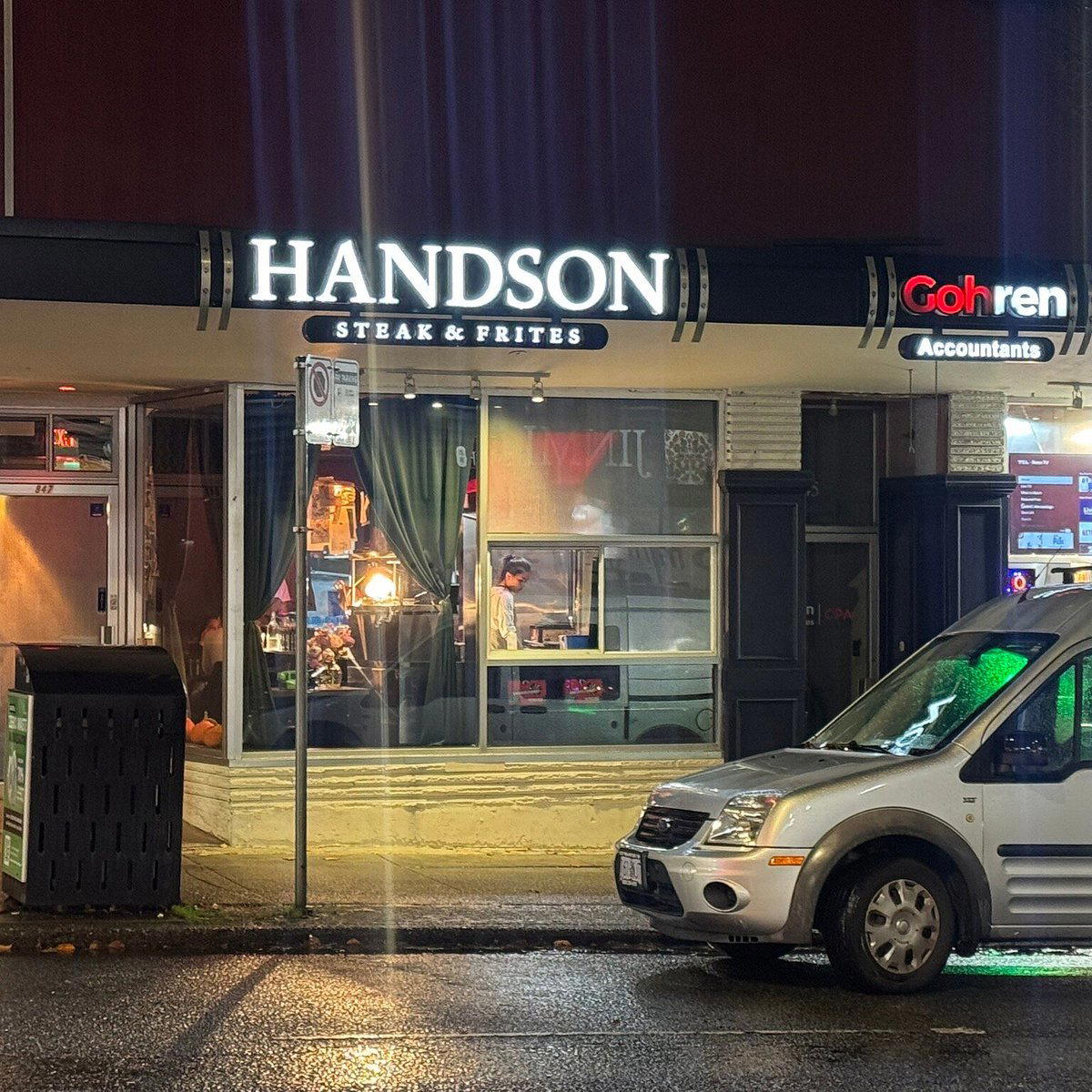
On Denman Street in Vancouver's West End, Handson Steak and Frites Restaurant occupies a neighbourhood corner where the French bistro format meets a local appetite for honest, protein-forward cooking. The steak-and-frites model, imported from the Parisian brasserie tradition, finds comfortable ground here, a short walk from English Bay and the dining corridor that runs toward Coal Harbour.

Pearl is the En Primeur Club membership app, where members save venues, book tables and use the concierge.
Denman Street and the Case for the Honest Steakhouse
There is a version of the steakhouse that prioritises spectacle: the private-reserve wagyu, the tableside theatre, the wine list priced for expense accounts. And then there is the bistro tradition, the entrecôte, the crisp frites, the glass of something Burgundian, where the measure of quality is restraint and repetition rather than maximalism. Handson Steak and Frites Restaurant at 847 Denman St sits in the second camp, occupying a stretch of Vancouver's West End that has historically supported neighbourhood dining over destination dining. The street runs south toward English Bay, and the foot traffic here skews local: residents of the dense West End grid, visitors from nearby Stanley Park, the kind of diner who returns to a place every few weeks rather than saving it for an occasion.
That context matters when reading the steak-and-frites format. In Vancouver's broader dining scene, the high-end contemporary tier, represented by the likes of AnnaLena and Barbara, both operating at the $$$$ price point with modern tasting-menu sensibilities, has claimed significant critical attention. Against that backdrop, a restaurant built around a single, well-executed plate makes a different kind of argument: that consistency and sourcing discipline, applied to one format, can produce something more honest than range for its own sake.
The French Bistro Format in a Pacific Context
Steak-and-frites as a concept traces back to the working brasseries of Paris and Brussels, where the entrecôte or bavette arrived pre-sliced with a compound butter and a mound of hand-cut frites, and the entire transaction was over in 45 minutes. The format travelled efficiently to North America, where it has been adopted at every price tier from mid-range neighbourhood spots to white-tablecloth rooms. What varies is sourcing fidelity and execution discipline, not the concept itself.
British Columbia is a province with genuine infrastructure for ethical meat sourcing. Ranches on Vancouver Island and in the Interior supply grass-fed beef to restaurants across the province, and the provincial traceability framework gives restaurants more tools to substantiate provenance claims than most North American jurisdictions. A steak-and-frites operation that commits to this supply chain occupies a different ethical position than one that sources from commodity feedlots and offers no transparency, and in a neighbourhood like the West End, where the customer base tends toward environmental literacy, that distinction carries weight.
The frites side of the equation has its own sustainability dimension. Potato sourcing, frying oil management, and food-waste ratios are unglamorous operational details, but they are where the gap between a thoughtful kitchen and a careless one becomes visible over months of service. The French bistro tradition, at its finest, is not wasteful: trim becomes stock, oil is cycled properly, and the limited menu keeps prep quantities predictable. That operational discipline aligns naturally with a lower-waste kitchen model.
Where Handson Sits in Vancouver's Dining Tiers
Vancouver's restaurant scene has stratified sharply in the past decade. At the upper tier, venues like Kissa Tanto (Fusion, $$$$) and Masayoshi (Japanese, $$$$) operate with chef-driven tasting formats and booking windows that stretch weeks ahead. At the other end, the city's casual dining sector has contracted under cost pressures, leaving a thinner middle tier than existed pre-pandemic. A focused bistro concept on Denman Street occupies that middle ground, offering a defined format at a price point that doesn't require the occasion framing that the $$$$ tier demands.
The West End specifically has seen a number of single-concept restaurants succeed where broader menus have struggled. The density of the neighbourhood, one of the highest in Canada by residential count, creates a repeat-customer base that rewards consistency over novelty. A restaurant that does one thing well, every night, builds a kind of social trust that a concept-driven destination spot cannot replicate through ambition alone.
For broader comparative context across Canada's premium dining scene, the model at Handson connects to a wider conversation about format discipline. Restaurants like Tanière³ in Quebec City and Alo in Toronto represent the tasting-menu pole of Canadian fine dining; the bistro format at its finest represents the opposite conviction, that a short menu, executed without variation, is its own form of rigour. Further afield, Eigensinn Farm in Singhampton and Restaurant Pearl Morissette in Lincoln approach the sourcing question from a farm-integrated angle; a neighbourhood bistro in Vancouver's West End cannot replicate that model, but the underlying commitment to knowing where the protein comes from connects the categories.
Within Vancouver itself, the comparison set for Handson is not the $$$$-tier contemporary rooms but the neighbourhood bistro and mid-range dining layer that includes more casual operators along Davie Street and Robson. The steak-and-frites format positions Handson as a specialist in a city where generalism is the default posture of the mid-market.
The Sustainability Argument for Single-Format Kitchens
A restaurant kitchen that runs a short, stable menu generates less food waste than one rotating seasonally across a broad format. Ordering is more precise, prep is more calibrated, and the margin for over-production narrows. In cities where food waste regulations are tightening, Vancouver has had organic waste diversion requirements for commercial kitchens since 2015, the operational case for format discipline has a regulatory dimension as well as an ethical one.
The frites specifically are worth noting: potato is a low-cost, high-yield ingredient with a relatively low carbon footprint compared to imported proteins, and a kitchen that manages oil waste responsibly (through commercial grease recycling, which is standard in Vancouver's commercial kitchen sector) can make a credible environmental case for frites as a staple. None of this is unique to Handson, but the format makes these arguments structurally available in a way that a broader menu does not.
Canadian diners researching ethical sourcing in the steakhouse tier would also find relevant context in venues like Narval in Rimouski and The Pine in Creemore, both of which have built sourcing transparency into their identities. The West End bistro model is less explicitly programmatic about this, but the structural logic runs in the same direction.
For those exploring Vancouver's dining scene beyond the West End, iDen & QuanJuDe Beijing Duck House represents a different kind of format discipline, the whole-duck service, sequenced and precise, at the $$$$ tier. The full Vancouver restaurants guide maps the broader range, from neighbourhood bistros to destination tasting rooms.
Know Before You Go
- Address: 847 Denman St, Vancouver, BC V6G 2L7
- Neighbourhood: West End, walkable from English Bay and Stanley Park
- Format: Bistro, steak-and-frites focus
- Nearest transit: Denman Street is accessible via multiple bus routes from downtown Vancouver
Frequently asked questions
What part of town is Handson Steak and Frites Restaurant in?
Handson Steak and Frites Restaurant is located at 847 Denman St, Vancouver, BC V6G 2L7, Canada, Vancouver.
How does Handson Steak and Frites fit into Vancouver's mid-tier dining scene?
Vancouver's restaurant tiers have sharpened considerably over the past decade, with much of the critical attention concentrated on omakase counters and high-concept tasting menus in neighbourhoods like Mount Pleasant and Chinatown. A single-format bistro on Denman Street occupies a different register entirely, prioritising repetition and precision over novelty. That positioning places Handson closer to the honest neighbourhood brasserie model than to the city's destination-dining circuit, which is precisely the gap it fills in the West End.
What do people recommend at Handson Steak and Frites Restaurant?
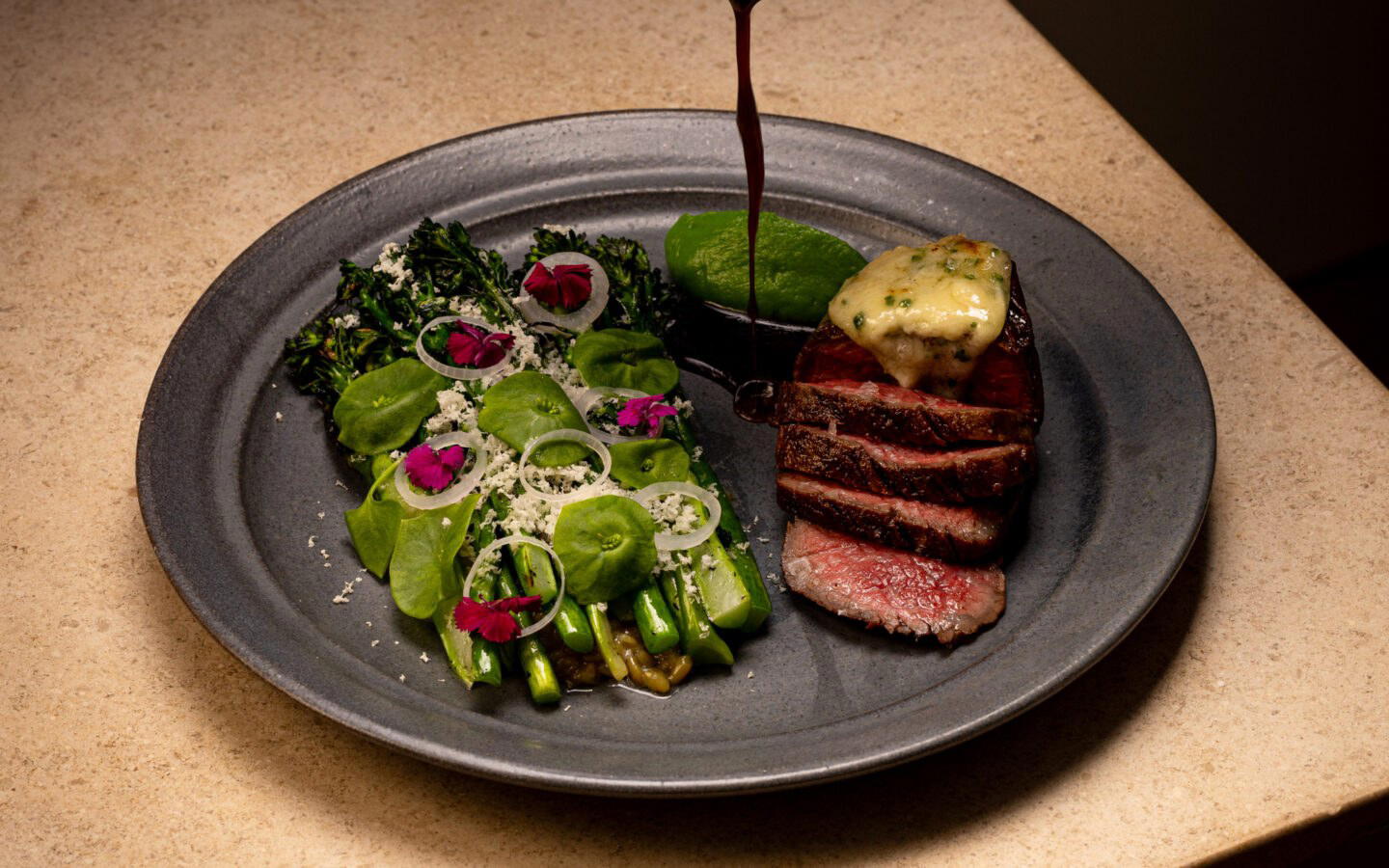
The format itself is the answer: steak and frites is the throughline at this Denman Street address, following the French and Belgian brasserie tradition where a single preparation is executed repeatedly rather than rotated across a broad menu. That kitchen discipline tends to produce consistency, which is what regulars return for.
Can I walk in to Handson Steak and Frites Restaurant?
Walk-in availability at 847 Denman St depends on the time of day and week, and no reservations policy is documented. Denman Street draws steady foot traffic from the West End neighbourhood, so arriving early for dinner service gives the best chance of a seat. Calling ahead or checking at the door is the practical approach until a booking channel is confirmed.
Peers You’d Cross-Shop
Comparable venues nearby, for context on price, style, and recognition.
| Venue | Cuisine | Price | Notes |
|---|---|---|---|
| Handson Steak and Frites RestaurantThis venue (the venue you are viewing) | Steak and Frites Bistro | Not listed | Not listed |
| Top Of Vancouver Revolving Restaurant | Steakhouse & Seafood with Pacific Northwest influences | $100–150 | Downtown |
| Heirloom Restaurant | Vegetarian Fine Dining | Not listed | Fairview |
| Itosugi Kappo Cuisine | Kappo Sushi Omakase | $50–100 | Kitsilano |
| The Sequel | Modern French-Italian Casual Fine Dining | $50–100 | Coal Harbor |
| Say Mercy! | Italian-Southern American BBQ Fusion | Not listed | Kensington-Cedar Cottage |