
Tucked into a residential alley off Yanji Street in Da'an District, this Bib Gourmand-recognised spot has earned consecutive Michelin recognition in 2024 and 2025 for its halal-style Chinese beef noodles.
Pearl is the En Primeur Club membership app — saves, bookings, and concierge access live there. Same editors, same standards.
- Address
- No. 1號, Alley 7, Lane 137, Yanji St, Da’an District, Taipei City, Taiwan 106
- Phone
- +886 2 2721 4771
- Website
- facebook.com
- Directions
- Get directions
 Saves & bookings on Pearl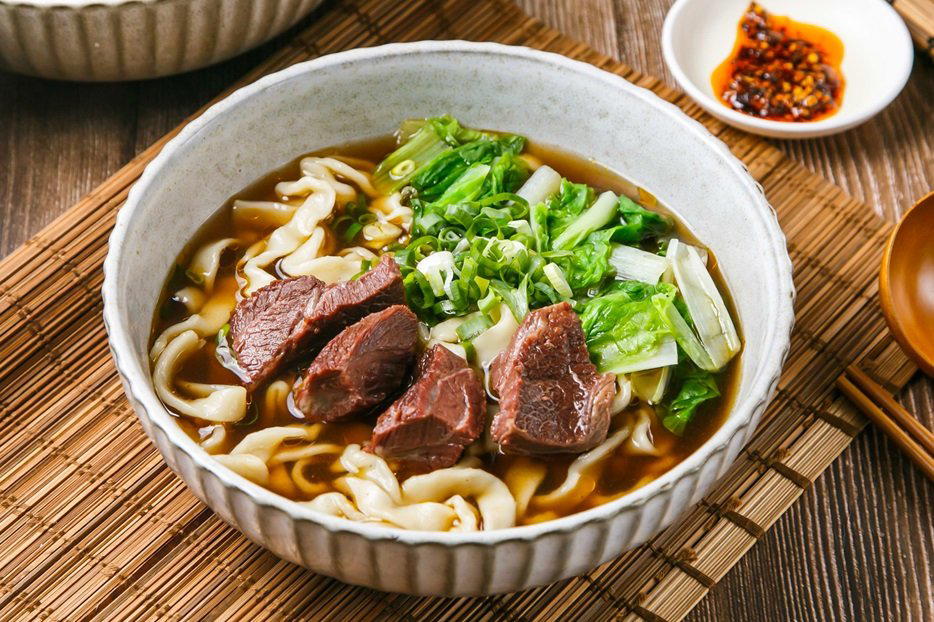
Yanji Street and the Alley Noodle Tradition
Da'an District is home to some of Taipei's most consistent everyday eating, and the residential lanes branching off Yanji Street represent that character at its clearest. Alley 7 off Lane 137 is not a destination strip; it is the kind of address that requires a deliberate search, which means the people arriving at Halal Chinese Beef Noodles are almost always there by intent. That specificity of audience tends to produce a particular kind of atmosphere: focused, local, and entirely unbothered by performance.
The physical approach matters here. Narrow alleyways in Da'an tend to compress sound and scale, placing you close to the cooking before you see a menu. In spots like this, the broth smell arrives first, followed by the low visual density of a counter or a handful of tables. That sensory sequence is the Taipei noodle shop experience in its most legible form.
Where Halal Chinese Beef Noodle Sits in Taipei's Noodle Ecosystem
Taipei has among the more internally varied noodle cultures in East Asia. The city's offerings run from Mainlander-style braised beef broth brought across after 1949, to Tainan-influenced clear soup preparations, to Shandong wheat noodle traditions. Halal Chinese beef noodle as a category occupies a specific branch of that tree: the beef is sourced and prepared according to Islamic dietary standards, which historically connects this style to Muslim communities from northwestern China, particularly Hui populations, whose culinary influence spread through Taiwan's military and civilian migration in the mid-twentieth century.
That lineage matters for understanding the broth profile and the cut choices. Halal beef noodle shops in Taipei typically produce a cleaner, often spice-forward broth compared to the soy-heavy Mainlander-style standard. The noodles themselves are generally hand-pulled or machine-cut into a thicker gauge suited to absorb a broth with more aromatic depth. Among Taipei's noodle addresses, Lao Shan Dong Homemade Noodles represents the Shandong wheat tradition, while Muji Beef Noodles and Chang Hung Noodles sit in adjacent parts of the beef noodle spectrum. Each occupies a different historical and technical position.
Michelin Bib Gourmand: What Two Consecutive Years Signal
The Bib Gourmand designation, awarded here in both 2024 and 2025, functions as Michelin's explicit signal for quality at accessible price points. Consecutive inclusion carries its own weight. A single year could reflect a fortuitous inspection; two consecutive years indicate that the kitchen is operating with enough reliability to pass scrutiny across different visits and inspectors.
Kou Gyu Rou and Mai Mien Yen Tsai represent other points on Taipei's recognised noodle map. Being singled out twice in the halal-specific niche is a narrower achievement than it might appear, given the relatively limited number of formally recognised halal Chinese noodle shops in the city. For context on the breadth of Taiwan's Michelin-recognised dining beyond Taipei, JL Studio in Taichung, GEN in Kaohsiung, and A Cun Beef Soup in Tainan each anchor distinct regional culinary characters.
The Price Tier and What It Tells You
At the lowest price tier on Taipei's dining scale, this is not a venue where the economics need justification. For a city where beef noodle soup rarely exceeds NT$200-350 at informal counters, landing a Michelin Bib Gourmand at that price point is precisely the point of the designation. The value signal is built into the category. What changes the calculation here is the,433 reviews, a volume that is difficult to sustain without genuine repeat custom. That review count places it among the more actively visited noodle spots in Da'an, not just as a Michelin stop but as a functioning neighbourhood institution.
Comparing this price bracket to the starred end of Taipei's dining offers perspective on how the city's food culture is structured. A meal at a three-star room runs into the thousands of New Taiwan Dollars per head; the gap in price between those experiences and a bowl here is not just economic but categorical. Both matter to the city's dining identity, but they serve completely different functions in a visitor's itinerary.
Eating Your Way Through the Broader Region
For those using Taipei as a base for wider eating across Taiwan, the noodle tradition extends beyond the capital in significant ways. A Kun Mian in Taichung is a reference point for the central Taiwan style, while comparisons to East Asian noodle cultures more broadly can be drawn through A Bing Bao Shan Mian in Hangzhou and A Niang Mian Guan in Shanghai. The Da'an spot sits within a regional conversation about beef noodle traditions that runs from the Chinese mainland through Taiwan's distinctive post-1949 culinary history.
Planning Your Visit
The address, No. 1, Alley 7, Lane 137, Yanji Street, Da'an District, requires mapping rather than signage-following. Yanji Street itself is accessible from the Da'an MRT area, and the alley system off Lane 137 is navigable on foot once on the street. Arriving at off-peak hours (mid-morning or mid-afternoon where the shop's schedule permits) is the standard approach for popular spots at this tier. No dress code applies, and the price point makes this accessible without financial planning.
Accolades, Compared
Comparable venues nearby, for context on price, style, and recognition.
| Venue | Cuisine | Price | Awards | Notes |
|---|---|---|---|---|
| Halal Chinese Beef Noodles (Da'an)This venue — the venue you are viewing | Halal Chinese Beef Noodles | $$ | Bib Gourmand | Not listed |
| Sung Chu Yuan | Traditional Taiwanese Farm-to-Table | $$ | Bib Gourmand | Gongguan |
| Good Friend Cold Noodles | Taiwanese Cold Noodles | $ | Bib Gourmand | Yixin |
| Yuan Wei | Authentic Taiwanese Home-Style | $$ | Bib Gourmand | Jiangong |
| Wu Wang Tsai Chi | Taiwanese Popiah Spring Rolls | $ | Bib Gourmand | Longxing |
| Yuan Fang Guabao | Taiwanese Gua Bao | $ | Bib Gourmand | Fumin |
Recognition history
Dated appearances from independent guides and award organizations, with the underlying list record or original source where available.
Michelin Plate
Michelin
Michelin Bib Gourmand
Michelin
Michelin Bib Gourmand
Michelin
Continue exploring
More in Taipei
Restaurants in Taipei
Browse all →
Bars in Taipei
Browse all →
Hotels in Taipei
Browse all →
Wineries in Taipei
Browse all →
At a Glance
- Classic
- Cozy
- Casual Hangout
- Family
- Standalone
Current opening hours
- Monday
- 11:30 AM–2 PM, 5–8:30 PM
- Tuesday
- 11:30 AM–2 PM, 5–8:30 PM
- Wednesday
- Closed
- Thursday
- 11:30 AM–2 PM, 5–8:30 PM
- Friday
- 11:30 AM–2 PM, 5–8:30 PM
- Saturday
- 11:30 AM–2 PM, 5–8:30 PM
- Sunday
- 11:30 AM–2 PM, 5–8:30 PM
Hours can change for holidays and private events. Last verified .
Simple, unpretentious, and basic with old decor, communal round tables, and a bustling local atmosphere.