
Goichi Nishitenma ten places Osaka yakitori in the careful middle ground between casual grill culture and allocation-driven counter dining. Its Tabelog 100 Yakitori WEST 2025 selection, compact counter-and-room format, and ingredient-led course structure make it a serious Nishitenma address without pushing into the city’s highest sushi pricing tier.
Pearl is the En Primeur Club membership app — saves, bookings, and concierge access live there. Same editors, same standards.
- Address
- 2 Chome-7-24 Nishitenma, Kita Ward, Osaka, 530-0047, Japan
- Phone
- +81 6-6360-4510
- Website
- s.tabelog.com
 Saves & bookings on Pearl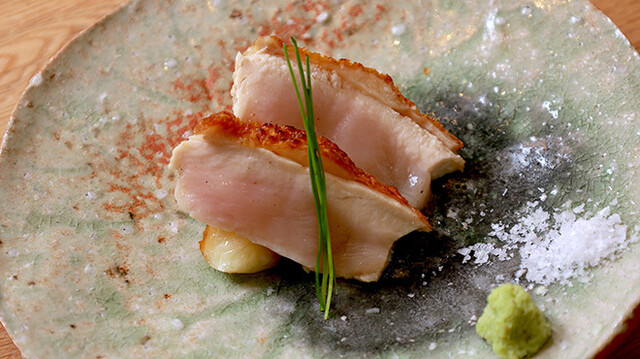
Nishitenma does not announce itself with Dotonbori’s neon certainty. North of the river, the streets are quieter, more legal district than nightlife postcard, which suits yakitori: a format of concentration, a small grill, and diners who understand Japanese chicken cookery as timing rather than ornament. Goichi Nishitenma ten belongs to this narrower Osaka register, where room, pacing, and sourcing matter as much as smoke.
Osaka’s eating identity is often reduced to batter, sauce, and street-side speed, but its stronger restaurant culture is wider: serious yakitori, sushi counters, kappo rooms, curry specialists, bakeries, and small Italian dining rooms, each with its own rhythm. For that spread, Our full Osaka restaurants guide maps the city beyond one genre, while nearby references such as .cafe, 52CHO-ME BAKERY, 551 Horai (551蓬莱), 99 Pizza Napoletana Gourmet, and a canto (Italian) show how wide the city’s appetite runs.
Yakitori where sourcing carries the argument
Ingredient quality is where yakitori gains authority or collapses into repetition. The vocabulary is familiar: skewers, grill heat, tare or salt, drinks alongside. At the serious end, selection and sequencing make the difference. A course format lets the kitchen move through cuts and preparations with less dependence on à la carte grazing, important when the appeal is calibration, not abundance. Goichi Nishitenma ten is listed for yakitori, with a course built around selected ingredients, placing it closer to ingredient-led counter dining than an after-work skewer shop.
The Tabelog 100 Yakitori WEST 2025 selection is a useful external marker. Tabelog’s Hyakumeiten lists are not Michelin stars and should not be read as the same judgement, but they show a venue has entered a recognized regional conversation. For Osaka yakitori, that matters because the category is crowded: inexpensive neighborhood grills at one end, expensive chef-counter formats at the other. This address sits in the controlled middle, with a budget below higher sushi counters such as Sushi shizuku Nishitenma and broadly aligned with dinner spending at Shushi Mon, while places such as Ren occupy a lower bracket.
That position helps travelers allocate meals in Osaka. An itinerary can easily become sushi-heavy or kaiseki-heavy, especially when awards drive choices. Yakitori offers another test of Japanese technique: heat management, poultry sourcing, offal acceptance, drink compatibility, and keeping a sequence lively without luxury seafood. Sake, shochu, and wine support that reading. This category does not need elaborate plating; it needs raw material worthy of attention.
A compact room suits the grill rather than the group dinner
The format is small enough to keep the grill central. The restaurant has 26 seats, including counter seating, table seating, and private rooms, which tells experienced diners something before the menu opens. Counter seats foreground the cooking; tables and private rooms add flexibility beyond a purist counter-only yakitori shop. That mix is particularly Osaka: serious enough for focused dining, practical enough for families or small groups poorly served by a rigid eight-seat room.
Private rooms change yakitori’s social use. In Tokyo, the tighter end often rewards pairs who can fit limited counter availability. In Osaka, where dining can be more socially elastic, a small private-room option lets grilled chicken become a group meal without becoming a banquet hall. That matters for travelers with children or multi-generation parties, and for locals using the restaurant outside a tasting-menu mindset. The family-friendly designation and children-welcome policy distinguish it from adult-only counters without weakening the cooking’s seriousness.
Nishitenma shapes the mood. This part of Kita is within reach of business districts and transport nodes, but lacks Namba’s tourist density. A meal here reads as a north-side Osaka evening, not a spectacle for first-timers. Visitors who want the city around the table can pair dinner with planning across Our full Osaka hotels guide, Our full Osaka bars guide, Our full Osaka wineries guide, and Our full Osaka experiences guide; the point is dinner as part of Kita’s quieter evening pattern, not an isolated booking.
How it fits into a wider Japan dining itinerary
For travelers moving through Japan, Goichi Nishitenma ten works as counterpoint rather than trophy slot. Osaka gives easy access to specialist formats across the country’s dining map: beef-driven meals such as -Grilled beef Sukiyaki- KAMAKURA TANUKIAN 鎌倉 たぬき庵 in Kamakura, casual charcoal references like. 鮪と炭火焼き うお炭 秋葉原店 in Tokyo, regional modern dining at.know in Kumamoto, Vietnamese cooking at (Shoku) Vietnam in Kawasaki, curry specialization at [Curry Senmon Ten] Maruyama Kyoju. in Sapporo, and Kyoto’s smaller-format dining at [ki:] in Kyoto. Outside Japan, Japanese drinking and rice formats have diaspora logic, visible at Jōdo Saké Bar in Los Angeles and Onigiri Time in Pasadena.
The better reason to come is not rarity. It is seeing how Osaka handles a disciplined grill category without losing comfort. The restaurant opened in 2022 and reached Tabelog 100 Yakitori WEST recognition by 2024 and 2025, a quick move into the region’s recognized yakitori conversation. That trajectory suggests a kitchen and format that found an audience in a city with many cheaper ways to eat chicken and many more expensive ways to spend an evening.
The editorial call is simple: choose this for sourced-ingredient yakitori in Kita when the aim is focus without ceremony. Diners chasing luxury markers should look elsewhere; diners who want Osaka’s serious but flexible grill culture will understand the appeal quickly.
What It’s Closest To
Nearby venues at a similar price tier for orientation.
| Venue | Cuisine | Price | Notes |
|---|---|---|---|
| Goichi Nishitenma tenThis venue — the venue you are viewing | Yakitori Omakase | $$$ | Not listed |
| Goichi | Yakitori (Japanese grilled chicken skewers) | $$$ | Kita |
| ZEN | Yakitori & Japanese Izakaya | $$$ | Fukushima |
| Kiyo Suke | Traditional Sukiyaki & Shabu-shabu | $$$ | Chūō |
| Shushi Mon | Traditional Japanese Izakaya | $$$ | Kita |
| Kitashinchi Shabushabu Sukiyaki Kiraku | Traditional Wagyu Shabu-shabu & Sukiyaki | $$$ | Kita |
Recognition history
Dated appearances from independent guides and award organizations, with the underlying list record or original source where available.
Tabelog 100 #72 · No. 72
Tabelog · Tabelog 100 - Yakitori - WEST - 2025
Continue exploring
More in Osaka
Restaurants in Osaka
Browse all →




Bars in Osaka
Browse all →




Hotels in Osaka
Browse all →




Wineries in Osaka
Browse all →
At a Glance
- Cozy
- Lively
- Intimate
- Modern
- Date Night
- Business Dinner
- Group Dining
- Special Occasion
- After Work
- Solo
- Chefs Counter
- Open Kitchen
- Private Dining
- Standalone
- Sake Program
- Beer Program
- Local Sourcing
Current opening hours
- Monday
- 5–11 PM
- Tuesday
- 5–11 PM
- Wednesday
- 11:30 AM–1 PM, 5–11 PM
- Thursday
- 11:30 AM–1 PM, 5–11 PM
- Friday
- 11:30 AM–1 PM, 5–11 PM
- Saturday
- 11:30 AM–1 PM, 5–11 PM
- Sunday
- 5–11 PM
Hours can change for holidays and private events. Last verified .
A relaxed but polished yakitori dining room with counter and table seating, subdued lighting, and a calm, modern atmosphere suited to both special occasions and everyday dinners; the focus is on the grill and course experience rather than flashy design.