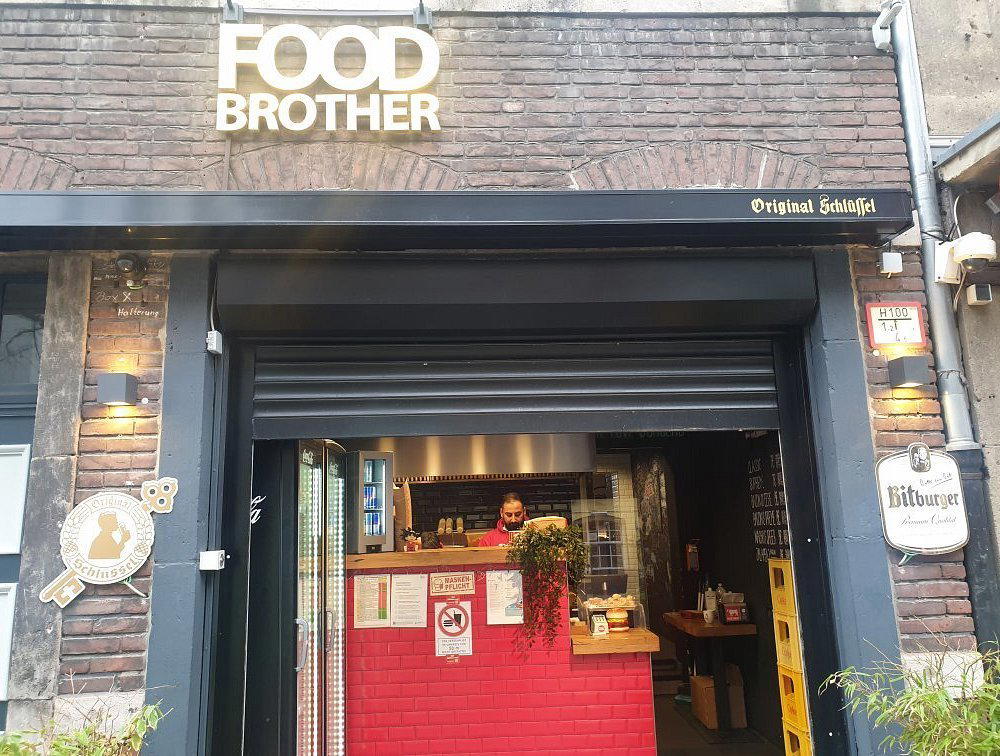
FOOD BROTHER
Our verdict
On Ratinger Strasse in Düsseldorf's Altstadt, FOOD BROTHER occupies a stretch of street where casual dining and neighbourhood regulars converge. The kitchen's approach sits within a growing European movement toward ingredient-conscious cooking, where sourcing decisions and waste reduction inform the menu as much as flavour does. It is a useful reference point for understanding how Düsseldorf's mid-market dining scene is quietly maturing.

Pearl is the En Primeur Club membership app — saves, bookings, and concierge access live there. Same editors, same standards.
- Address
- Ratinger Str. 22, 40213 Düsseldorf, Germany
- Phone
- +4921194191307
- Hours
- Mon–Thu 11:30 AM–11 PMFri–Sat 11:30 AM–1 AMSun 1–10 PM
- Website
- duesseldorf.foodbrother.com
- Directions
- Get directions
The menu
What to order
- Black Angus Beef Burger
- Nacho Burger
- Crispy Chicken Burger
- Sweet Potato Fries
Ratinger Strasse and the Changing Register of Düsseldorf Casual Dining
The Altstadt in Düsseldorf is frequently reduced to its beer-hall reputation, a dense corridor of Altbier taps and tourist-facing kitchens running from the Rheinuferpromenade inward. Ratinger Strasse cuts through that assumption. The street hosts a more layered mix of neighbourhood restaurants, independent operators, and the kind of address that draws locals on a Tuesday rather than visitors on a Saturday. FOOD BROTHER at number 22 sits inside that pattern, on a block where the dining register shifts from performance to practicality.
Across Germany's mid-tier restaurant scene, the last several years have seen a consolidation around a specific set of values: shorter supply chains, ingredient transparency, and menus that respond to what is seasonally available rather than what a fixed card demands year-round. This is not a niche reserved for Michelin-starred kitchens. Operations like JAN in Munich and CODA Dessert Dining in Berlin have demonstrated that sustainability-oriented thinking can operate across different price points and formats. The question for any Düsseldorf address is how it translates that broader shift into a specific neighbourhood context.
The Sourcing Logic Behind Ingredient-Conscious Kitchens
When a kitchen builds its identity around ethical sourcing and waste reduction, the operational decisions become visible on the plate in ways that conventional menus obscure. Portions are calibrated against what the kitchen can use fully. Preparations shift to accommodate secondary cuts or less commercially obvious produce. The result, when the execution is sound, is a menu that reads as genuinely seasonal rather than seasonally decorated.
This approach has been documented across European casual dining at varying levels of commitment. Some operators adopt the language without changing the supply chain. Others restructure purchasing entirely, working directly with regional producers and adjusting what they serve based on what arrives that week. The distinction matters for the diner because it determines whether the menu reflects a genuine relationship with ingredients or a marketing posture. On Ratinger Strasse, FOOD BROTHER positions itself within this conversation, in a part of the city where that framing is not yet the default expectation.
For context on how this plays out at the fine-dining end of the German spectrum, Schwarzwaldstube in Baiersbronn, Aqua in Wolfsburg, and Vendôme in Bergisch Gladbach have each built reputations partly on sourcing discipline. The gap between those operations and a street-level Altstadt kitchen is significant in terms of resources and profile, but the underlying logic of ingredient accountability runs across both tiers.
Düsseldorf's Altstadt contains a wider range of dining options than its beer-tourism image suggests. The immediate neighbourhood around Ratinger Strasse includes operations at very different price points and with distinct culinary orientations. Alanya Döner represents the high-volume, value-driven end of the street's food offer. Amuni Wein- und Käsebar operates in a more curated, product-focused register. Anfora and Arca Alacati each occupy specific cuisine niches. And 3h's burger and chicken sits at the casual, quick-service end of the spectrum.
FOOD BROTHER reads as a mid-point in that range, an address where the format is accessible but the underlying sourcing commitments, where present, distinguish it from purely transactional dining. That positioning is increasingly common in European cities where the casual segment is bifurcating: operators either compete on price and speed, or they differentiate on ingredient story and kitchen transparency. The middle ground is contracting.
Sustainability as Operating Principle, Not Decoration
The restaurants that have made ingredient ethics structurally central rather than cosmetically applied tend to share a few operational characteristics. They work with a smaller number of suppliers and maintain those relationships across seasons. They adjust their menus frequently, sometimes weekly, based on what those suppliers can provide. And they tend to treat waste reduction not as a chef's creative exercise but as a kitchen management discipline, tracking what leaves the kitchen unused and adjusting ordering accordingly.
This operational seriousness is what separates the movement from its imitations. At the higher end of the German market, kitchens like ES:SENZ in Grassau, Schanz in Piesport, Waldhotel Sonnora in Dreis, and Victor's Fine Dining by Christian Bau in Perl have each built sourcing frameworks over years of supplier relationships. At the street level, the challenge is achieving similar discipline without the purchasing volume or staffing depth those kitchens command.
Internationally, the template for making sustainability structurally central at different price points is well established. Le Bernardin in New York City has documented sourcing accountability for its seafood programme across decades. Lazy Bear in San Francisco operates a communal-table format that inherently reduces waste through fixed-count service. The models vary, but the underlying principle, that ingredient decisions should be visible and defensible, connects them.
Planning a Visit to Ratinger Strasse
FOOD BROTHER is located at Ratinger Str. 22, 40213 Düsseldorf, in the northern section of the Altstadt, walkable from the Rheinuferpromenade and well-served by the city's tram network via the Heinrich-Heine-Allee stop. The Altstadt is densest on Friday and Saturday evenings, when the beer halls operate at full capacity and foot traffic on adjacent streets increases significantly. Midweek visits give a clearer read on the kitchen's day-to-day output. For a fuller view of what the city's restaurant scene offers across categories and price points, the EP Club Düsseldorf restaurants guide maps the broader options. For Hamburg's equivalent fine-dining reference, Restaurant Haerlin provides a useful north German benchmark.
Frequently asked questions
What's the address for FOOD BROTHER?
FOOD BROTHER is located at Ratinger Str. 22, 40213 Düsseldorf, Germany, Dusseldorf.
Is FOOD BROTHER a good option for diners avoiding conventional tourist restaurants in Düsseldorf's Altstadt?
FOOD BROTHER at Ratinger Str. 22 sits in the northern Altstadt, a section of Düsseldorf's old city that supports a more varied dining register than the beer-hall corridor that dominates most visitor itineraries. Its ingredient-conscious kitchen model places it outside the tourist-facing mainstream, making it a relevant choice for those specifically seeking a kitchen where sourcing ethics are structurally embedded rather than decorative. Düsseldorf's Altstadt contains this range; FOOD BROTHER is one of its clearer examples of it.
What's the signature dish at FOOD BROTHER?
Specific menu items have not been published in documented sources available to us. What the kitchen at Ratinger Str. 22 is structured around, based on its operating identity, is ingredient-led cooking where sourcing decisions shape what appears on the plate rather than the other way around.
Do I need a reservation for FOOD BROTHER?
22, Düsseldorf. Given the venue's position in the northern Altstadt — a stretch that draws both locals and visitors — arriving without a plan during peak evening hours carries some risk. Contacting the venue directly in advance is the practical approach.
What has FOOD BROTHER built its reputation on?
In a neighbourhood better known for Altbier taps and high-volume tourist kitchens along Ratinger Strasse, a kitchen that structures its supply chain around ethical sourcing and waste reduction occupies a distinct position. That distinction, rather than any single award or chef profile, appears to be the foundation of its local identity.
Cuisine and Credentials
Comparable venues nearby, for context on price, style, and recognition.
| Venue | Cuisine | Price | Notes |
|---|---|---|---|
| FOOD BROTHERThis venue — the venue you are viewing | American Burgers & Street Food | $10–20 | Not listed |
| Bob & Mary | American Smash Burgers | $10–20 | Hafen |
| Arca Alacati | Smashburger | $30–50 | Friedrichstadt |
| Louisiana Düsseldorf Altstadt | American BBQ & Burgers | $20–30 | Altstadt |
| Ruff's Burger | American Smash Burgers | $10–20 | Altstadt |
| What's Beef | Modern American Smash Burgers with Turkish Spices | $20–30 | Stadtmitte |