FARM TO BURGER
Farm to Burger plants itself on West 40th Street in Midtown Manhattan, bringing a sourcing-conscious approach to the American hamburger at a price point well below the neighborhood's expense-account dining tier. The format is casual and counter-friendly, positioned as a fast-casual alternative in a corridor dominated by pre-theater prix fixe and hotel dining rooms. For New York's farm-sourcing burger category, it occupies a distinct middle ground between street-cart simplicity and the premium smash-burger bars now spreading across the boroughs.
Pearl is the En Primeur Club membership app — saves, bookings, and concierge access live there. Same editors, same standards.
- Address
- 310 W 40th St, New York, NY 10018
- Phone
- +16466095200
- Website
- farmtoburger.com
- Directions
- Get directions
 Saves & bookings on Pearl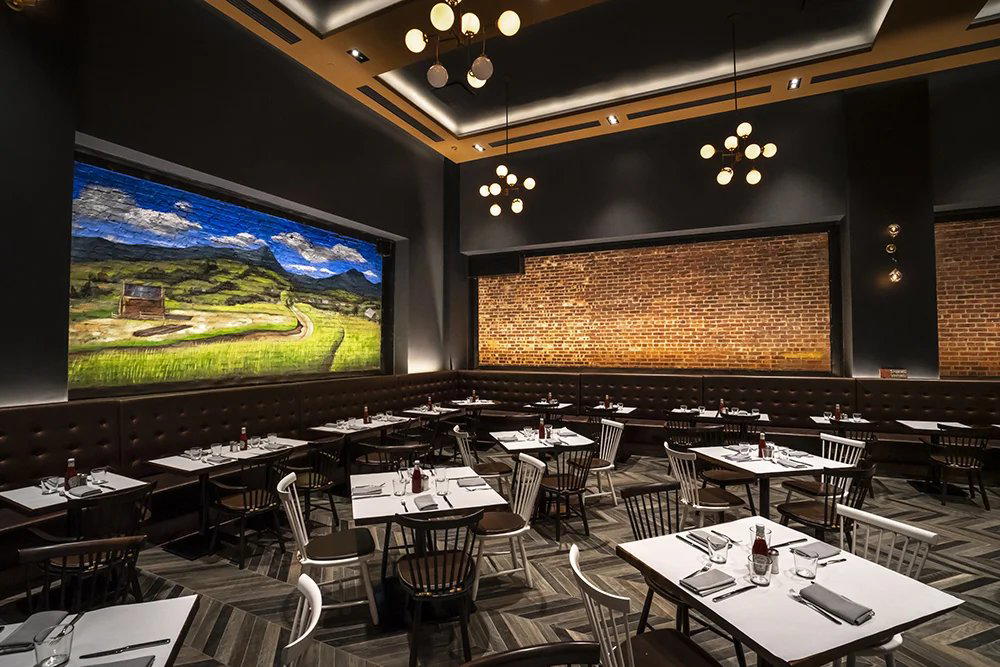
The Ritual of the American Burger, Revisited in Midtown
FARM TO BURGER is a casual New York City restaurant at 310 W 40th St, serving Farm-to-Table American Burgers at about $20 per person. At the high end, you have steakhouse-derived pat melts and dry-aged blends priced at thirty dollars and up, served with cloth napkins and a wine list. At the low end, you have the griddle-smashed street-corner slice of beef served in wax paper. Farm to Burger, at 310 West 40th Street in Midtown, positions itself in the space between those poles: a counter-service format that centers sourcing language as its primary differentiator, in a part of the city where lunch options tend toward either the utilitarian or the expensively formal.
West 40th Street sits in the transition zone between the Garment District and the Theater District, a corridor that feeds office workers at noon, tourists oriented toward Times Square in the afternoon, and theatergoers who need to eat before an eight o'clock curtain. The dining pattern in this neighborhood is shaped by those three pressures, and most operators optimize for speed and volume. A farm-sourcing premise adds a layer of narrative to the transaction, asking the guest to engage slightly differently with what would otherwise be a habitual, unreflective lunch stop.
Sourcing as the Central Argument
The farm-to-table framework, which has shaped the serious American dining conversation since at least the early 2000s, has progressively filtered down from tasting-menu formats into casual and fast-casual categories. In New York, that filtering is visible across burger formats: operations across Brooklyn and lower Manhattan have built identities around named farms, specific cattle breeds, and traceable supply chains. This approach represents a different set of cultural assumptions than the traditional burger stand. It asks guests to treat the hamburger as an agricultural product first and a convenience food second.
That framing carries real consequences for the dining ritual. A meal shaped by sourcing language tends to slow down slightly, even in a fast-casual setting. The guest is implicitly invited to think about the provenance of what they are eating, to notice the flavor differences that different breeding and grazing conditions produce, to engage with the menu as a document rather than a transaction. Venues in this category, from Blue Hill at Stone Barns in Tarrytown at the formal end to sourcing-forward fast-casual operations like Farm to Burger at the accessible end, share that underlying premise even when they operate in entirely different price brackets and formats.
For context, the farm-sourcing approach in tasting-menu formats has produced particularly discussed American restaurants of the past decade. Single Thread Farm in Healdsburg, Smyth in Chicago, and Lazy Bear in San Francisco each built their identity around a tight relationship between sourced ingredients and the form of the meal. The restaurant operates at a different altitude entirely, but the foundational argument, that knowing where your food comes from changes how you experience eating it, is the same.
Midtown's Burger Category and Where This Address Fits
Midtown Manhattan's burger category is broader and more varied than visitors often expect. The neighborhood supports everything from the classic New York diner patty to the chef-driven, press-covered burger programs attached to restaurants like Le Bernardin or Per Se, where off-menu or lunch-format burgers occasionally circulate among regulars. At the other end, quick-service chains occupy the ground-floor retail of office towers throughout the district.
The restaurant's position in this field is defined by its sourcing premise and its price accessibility, two factors that together create a specific kind of value proposition in a neighborhood where lunch decisions are made under time pressure. The ritual here is compressed: you order at the counter, you wait a short interval, you eat with a degree of engagement slightly higher than a chain transaction. That compression is itself a format, and in Midtown, where table-turn speed and pedestrian volume shape almost every operator's calculus, it reflects a clear operational logic.
The contrast with the neighborhood's formal dining tier is worth noting. Restaurants like Atomix, Eleven Madison Park, and Masa represent the long-form, high-attention end of New York dining, where the meal is structured as a sequence of courses with explicit pacing and service choreography. The restaurant operates in a mode that is the structural inverse of that format, and understanding both ends of that spectrum is part of reading New York's dining culture with any accuracy.
The Broader American Farm-Sourcing Restaurant Conversation
The sourcing-forward restaurant movement in the United States has generated particularly credentialed dining addresses in the country. The French Laundry in Napa, Providence in Los Angeles, Addison in San Diego, The Inn at Little Washington in Washington, and Frasca Food & Wine in Boulder each demonstrate how a sourcing philosophy can anchor a restaurant's identity across decades. Emeril's in New Orleans helped popularize the idea that American regional ingredients deserved serious culinary attention. Even internationally, operations like Atelier Moessmer Norbert Niederkofler in Brunico and Dal Pescatore in Runate demonstrate that a rigorous local-sourcing premise operates across formats and price points globally.
The restaurant does not compete in that company. It occupies a category that is less about culinary ambition and more about making sourcing-conscious choices accessible to a Midtown lunch crowd. That is a legitimate and distinct role, and in a neighborhood where most fast-casual options make no sourcing claims at all, the positioning carries meaning even if the format keeps it practical rather than elaborate.
Planning Your Visit
The address at 310 West 40th Street places the restaurant within walking distance of the Port Authority Bus Terminal and the 42nd Street subway hub, making it accessible from most Manhattan neighborhoods without a cab. Reservations are recommended. Dress: casual. Budget: about $20 per person. Timing: Mon-Sun 7 AM-12:30 PM and 5-10 PM.
Reputation Context
Comparable venues nearby, for context on price, style, and recognition.
| Venue | Cuisine | Price | Notes |
|---|---|---|---|
| FARM TO BURGERThis venue — the venue you are viewing | Farm-to-Table American Burgers | $$ | Not listed |
| Brine | Fire-Grilled Brined Chicken | $$ | Chelsea-Hudson Yards |
| Café Standard | American Bistro Café | $$ | East Village |
| Joe & MissesDoe | New American with Old World Twists | $$ | East Village |
| EJ's Luncheonette | Classic American Diner | $$ | Upper East Side-Carnegie Hill |
| Baby's All Right | American Gastropub | $$ | Williamsburg |
Continue exploring
More in New York City
Restaurants in New York City
Browse all →
Bars in New York City
Browse all →
Hotels in New York City
Browse all →




At a Glance
- Rustic
- Modern
- Casual Hangout
- Group Dining
- Hotel Restaurant
- Farm To Table
- Local Sourcing
- Organic
Current opening hours
- Monday
- 7 AM–12:30 PM, 5–10 PM
- Tuesday
- 7 AM–12:30 PM, 5–10 PM
- Wednesday
- 7 AM–12:30 PM, 5–10 PM
- Thursday
- 7 AM–12:30 PM, 5–10 PM
- Friday
- 7 AM–12:30 PM, 5–10 PM
- Saturday
- 7 AM–12:30 PM, 5–10 PM
- Sunday
- 7 AM–12:30 PM, 5–10 PM
Hours can change for holidays and private events. Last verified .
Laid-back and casual hotel restaurant atmosphere with a focus on wholesome, burger-centric dining.