Enoteca L'Armadillo

A Michelin Plate-recognised wine bar in Courmayeur's La Palud district, Enoteca L'Armadillo brings Japanese technique to Aosta Valley ingredients at a €€€ price point. The intimate room doubles as its own cellar: bottles are chosen directly from the shelves. Booking is recommended, particularly during ski and summer high seasons.
Pearl is the En Primeur Club membership app — saves, bookings, and concierge access live there. Same editors, same standards.
- Address
- Strada la Palud, 27, 11013 Courmayeur AO, Italy
- Phone
- +39 340 961 0226
- Directions
- Get directions
 Saves & bookings on Pearl
Where the Alps Meet a Different Culinary Tradition
The La Palud district sits at the base of Mont Blanc's Italian flank, a stretch of road more accustomed to mountaineers heading for cable cars than to restaurant-hunters. That context matters. When a small wine bar operating out of this address earns consecutive Michelin Plate recognition in 2024 and 2025, it signals something worth understanding: the Aosta Valley's dining scene is no longer exclusively defined by fondue and polenta. A quieter, more compositionally ambitious strand has been developing alongside the valley's traditional mountain table, and Enoteca L'Armadillo is one of the clearest expressions of it.
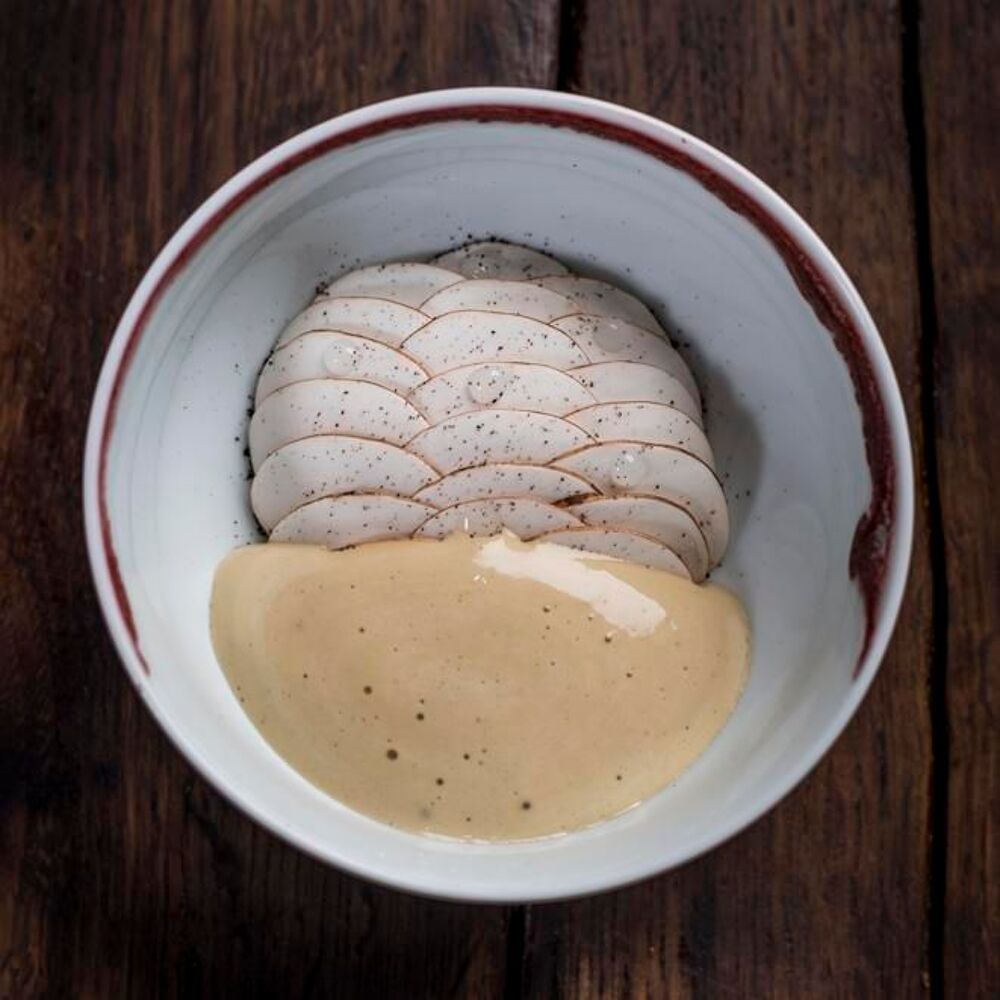
Japanese culinary technique applied to Alpine produce is a combination that has emerged in several European mountain towns over the past decade, typically where small, independently run restaurants can afford the editorial freedom that large resort operators cannot. The pattern tends to follow the same logic: a chef trained in Japanese discipline finds that the precision-first approach translates particularly well to high-altitude ingredients whose quality needs handling rather than transforming. In Courmayeur, that logic plays out in dishes such as a capon salad with yuzu, puntarelle and black garlic, where a local bird is reframed through Japanese citrus and Italian bitter greens. The combination is neither purely Alpine nor purely Japanese; it occupies the productive middle ground that defines the better end of fusion cooking.
The Room and Its Cellar Logic
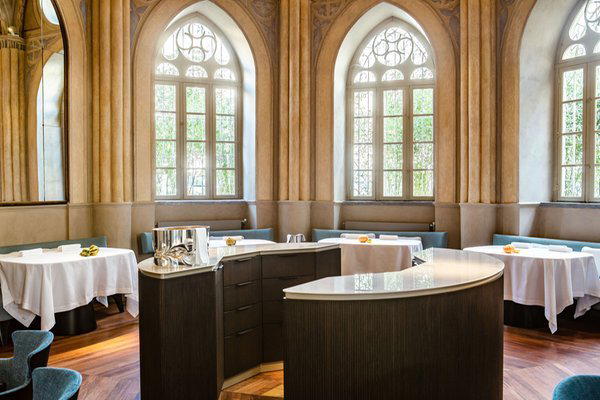
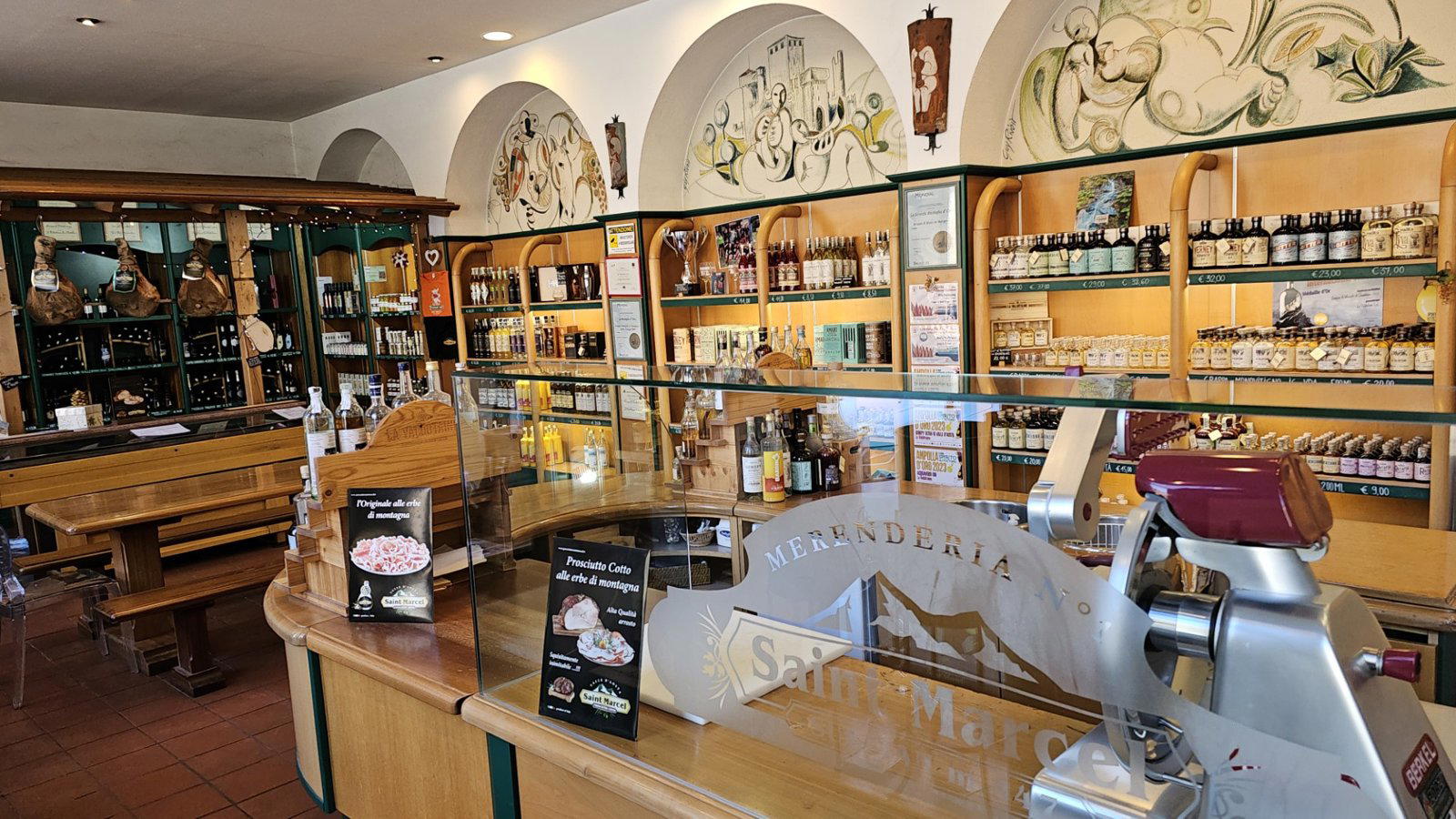
The physical arrangement of Enoteca L'Armadillo sets expectations before a dish arrives. Wine is chosen directly from the shelves of the dining room itself, a format that places the cellar and the table in the same space and changes the rhythm of an evening. Rather than consulting a printed list and waiting for a sommelier to disappear into a back room, the selection process becomes part of the room's ambient activity. That intimacy is consistent with the broader character of La Palud: this is not a ski resort showroom. It is a small space built around a specific proposition.
For the visitor coming from a larger Italian wine reference point, such as Enoteca Pinchiorri in Florence with its three Michelin stars and one of Italy's most catalogued cellars, L'Armadillo operates at a structurally different scale and price tier. That comparison is instructive rather than hierarchical: it maps where this kind of intimate wine-and-food format sits relative to Italy's most formal enoteca tradition. The Courmayeur version is smaller, more casual, and keyed to the specific produce of a mountain valley rather than to a comprehensive national or international wine programme.
Courmayeur's Broader Restaurant Context
Courmayeur divides roughly into two dining registers. The first is the Alpine-traditional, represented by addresses such as Bistrot Royal and Pierre Alexis 1877, where the cuisine follows the valley's French-Italian borderland identity: cured meats, fontina, game, and the heavy-bodied wines of the region. The second register is smaller and harder to map: restaurants that use Aosta Valley ingredients as raw material for something less categorically Alpine. L'Armadillo belongs to this second group.
Italy's most formally recognised creative restaurants, including Osteria Francescana in Modena, Le Calandre in Rubano, and Piazza Duomo in Alba, operate at three Michelin stars and at price points well above the €€€ bracket. L'Armadillo's Michelin Plate recognition at €€€ places it in a different tier of the same credentialled ecosystem: accessible without being casual, recognised without being institutional. For the type of traveller who prioritises culinary curiosity over ceremony, that positioning has real value in a town where the default fine-dining mode can lean heavily on resort conventions.
For further regional comparison, Atelier Moessmer Norbert Niederkofler in Brunico offers a point of reference for how Alpine ingredients can be handled at the three-star level further east. The distance between that operation and L'Armadillo is not just one of stars: it is one of format, scale, and the kind of evening each one proposes. Neither renders the other redundant.
Fusion at Altitude: What the Approach Actually Means
The term fusion carries enough baggage from the 1990s that it is worth being precise about what it means here. The fusion cooking that earned widespread scepticism was characterised by combinations that prioritised novelty over coherence: Thai-Mexican, Peruvian-Italian, assembled for the surprise of the pairing rather than for any internal logic. The better strand of contemporary fusion, represented elsewhere by venues such as Ajonegro in Logroño and Arkestra in Istanbul, tends to be anchored in a primary culinary tradition that uses techniques or flavour references from a second tradition to clarify rather than obscure the first.
At L'Armadillo, the primary anchor appears to be the Aosta Valley's ingredient base: the produce, the proteins, the local agricultural identity. The Japanese influence enters through technique and through specific flavour elements like yuzu, which adds acidity and brightness to preparations that might otherwise lean into richness. That is a compositionally coherent approach. It does not reinvent Alpine cooking; it gives it a different kind of precision.
Fusion at this altitude also carries a practical logic. Mountain ingredients in the Aosta Valley, whether that means high-pasture dairy, game from the surrounding terrain, or wild herbs gathered at elevation, are already highly specific in character. They require restraint rather than transformation. Japanese culinary philosophy, with its emphasis on letting primary ingredients speak with minimal interference, aligns with that requirement in a way that heavier French or northern Italian treatment sometimes does not.
Planning a Visit
Enoteca L'Armadillo sits on Strada la Palud, 27, in the La Palud district of Courmayeur, a short distance from the Mont Blanc tunnel approach and the Skyway Monte Bianco cable car base. The area is quieter than Courmayeur's centre, which suits the register of the restaurant. Booking is recommended and during the winter ski season or summer alpine trekking peak, it should be treated as essential rather than advisory: a small room at this recognition level fills quickly when the valley is operating at full visitor capacity.
At €€€, the price sits in the middle tier of Courmayeur's restaurant market, above casual mountain trattorie but below the formal resort-hotel dining rooms. Wine selection from the shelves of the room gives the evening a particular kind of flexibility that a conventional wine list does not. Those with wider Italian appetites can cross-reference against Dal Pescatore in Runate, Quattro Passi in Marina del Cantone, Reale in Castel di Sangro, and Enrico Bartolini in Milan for a sense of the range of credentialled Italian cooking operating at comparable and higher price points.
Cost Snapshot
Comparable venues nearby, for context on price, style, and recognition.
| Venue | Cuisine | Price | Awards | Notes |
|---|---|---|---|---|
| Enoteca L'ArmadilloThis venue — the venue you are viewing | La Palud, Modern Italian Fusion Wine Bar | $$$ | Michelin Plate | Not listed |
| Pierre Alexis 1877 | Not listed | $$$ | Michelin Plate | Historic heart of Courmayeur, Modern Alpine Italian |
| Bistrot Royal | Courmayeur, Modern Alpine Italian | $$$$ | Michelin Plate | Not listed |
| Valli di Lanzo | Céres, Modern Piedmontese | $$$ | Michelin Plate | Not listed |
| Piccolo Lord | Vanchiglia, Modern Piedmontese | $$$ | Michelin Plate | Not listed |
| La Pista | Not listed | $$$ | Michelin Plate | Nizza Millefonti, Modern Italian with Piedmontese Influences |
Recognition history
Dated appearances from independent guides and award organizations, with the underlying list record or original source where available.
Michelin Plate
Michelin
Michelin Plate
Michelin
Michelin Plate
Michelin
Continue exploring
More in Courmayeur
Restaurants in Courmayeur
Browse all →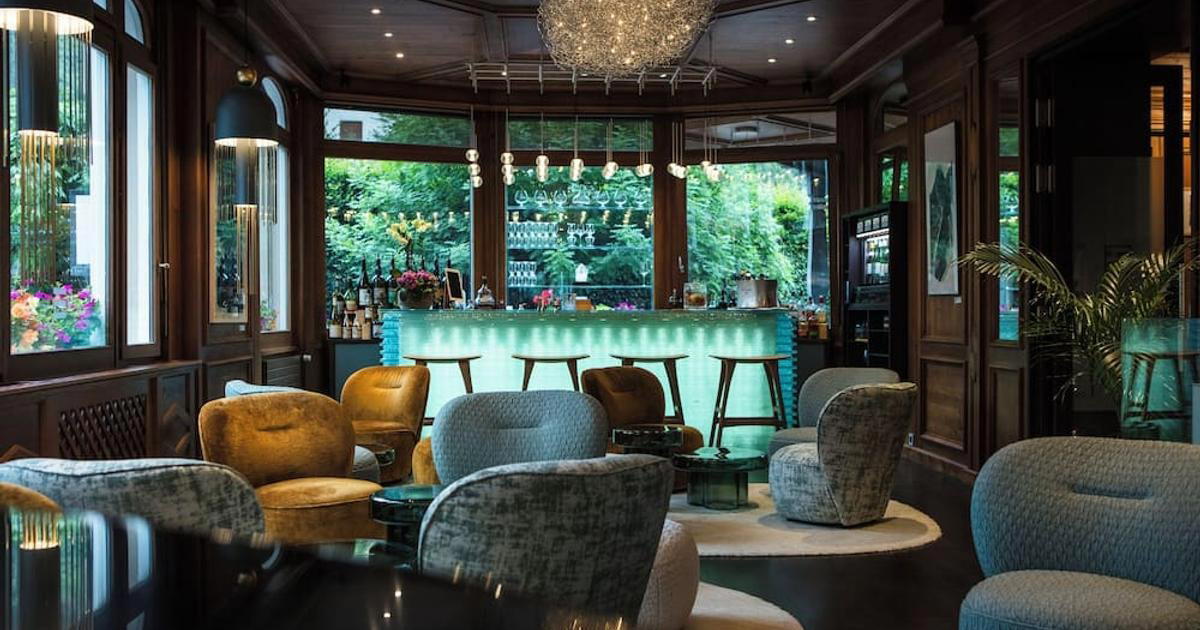
Bars in Courmayeur
Browse all →
Hotels in Courmayeur
Browse all →

At a Glance
- Cozy
- Intimate
- Rustic
- Elegant
- Date Night
- Special Occasion
- Wine Cellar
- Extensive Wine List
- Local Sourcing
- Mountain
Current opening hours
- Monday
- 7–10 PM
- Tuesday
- 7–10 PM
- Wednesday
- 7–10 PM
- Thursday
- 7–10 PM
- Friday
- 7–10 PM
- Saturday
- 7–10 PM
- Sunday
- 7–10 PM
Hours can change for holidays and private events. Last verified .
Cozy and intimate dining room with warm, welcoming atmosphere, often featuring live music.