El Tapeo de Cervantes
Our verdict
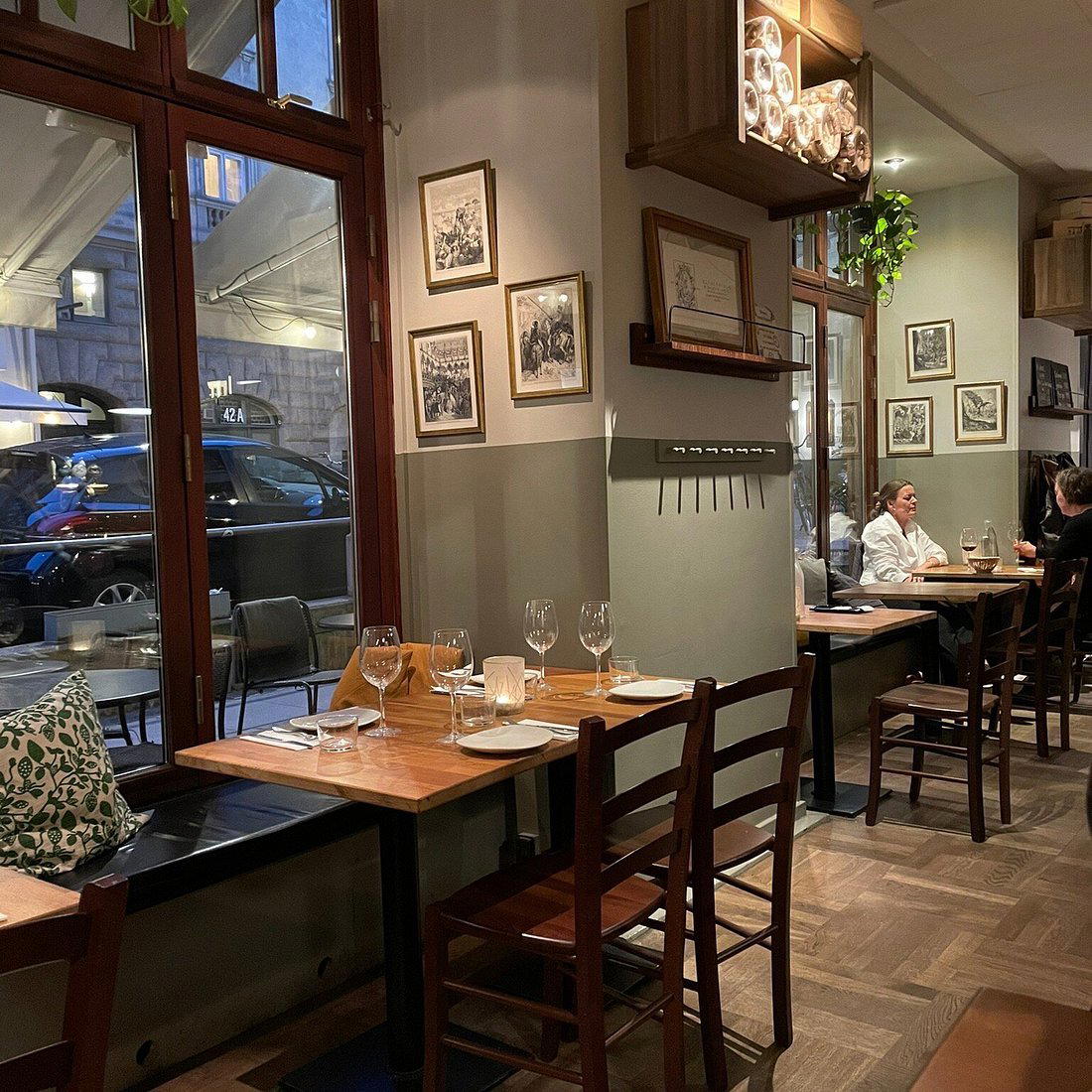
On Vesterbrogade, one of Copenhagen's most traversed commercial streets, El Tapeo de Cervantes occupies a distinct position: a Spanish tapas address operating in a city whose dining conversation is almost entirely dominated by New Nordic. That contrast defines the experience here, where the Iberian small-plates format meets a neighbourhood that rewards the curious diner willing to look past the obvious.

Pearl is the En Primeur Club membership app, where members save venues, book tables and use the concierge.
The menu
What to order
- Grilled red tuna with cauliflower puree and capers
- Baby squid
- Croquettes
- Calamari
Vesterbro's Contrarian Address
Copenhagen's dining reputation has been shaped, for well over a decade, by the New Nordic movement and its many inheritors. From the tasting counter at Geranium to the boundary-pushing theatrical format at Alchemist, the city's high-profile restaurant story runs through Scandinavian ingredient philosophy and creative restraint. Against that backdrop, a Spanish tapas address on Vesterbrogade reads as a deliberate counterpoint, and that positioning is worth taking seriously.
Vesterbro is not Copenhagen's tourist corridor, nor is it the polished gallery district of Frederiksberg to its west. It is a working neighbourhood that gentrified in waves, with a food scene that now runs from Vietnamese sandwich shops to natural wine bars, from Moroccan grocers to Nordic brunch cafés. Vesterbrogade 42 sits inside that mix, on a stretch of the street where the density of everyday commerce keeps the atmosphere grounded. For a Spanish-format restaurant, that grounding matters: tapas culture, at its most functional, was never meant to feel ceremonial.
The Iberian Small-Plates Format in a Nordic Context
Across northern Europe, Spanish small-plates restaurants operate in a specific tension. The format is social and iterative by design, built around ordering in rounds, sharing across the table, and extending the meal through conversation rather than through a fixed sequence of courses. That rhythm sits somewhat at odds with the Nordic tasting-menu tradition, where the kitchen controls pacing and the diner follows a predetermined arc. Cities like Copenhagen, Amsterdam, and Stockholm have absorbed the tapas format with varying degrees of fluency, and the most credible addresses are those that commit to the original logic rather than adapting it into something that feels like an approximation.
El Tapeo de Cervantes draws its name from Cervantes, the reference being to the literary and cultural tradition of old Castile, a lineage that runs through Spanish social life as much as through its letters. That frame suggests an intention to place the food within a broader cultural register rather than simply serving Spanish dishes in a northern European setting. Whether the kitchen follows through on that intention is the question a first visit answers.
The Vesterbro neighbourhood has form in absorbing non-Nordic culinary traditions. The area's commercial streets have long supported international restaurants that operate with genuine conviction rather than tourist-facing simplicity. For a Spanish address at this postcode, the relevant comparison is not the Michelin-starred Nordic houses like Noma or the kaiseki-inflected precision of Koan, but rather the mid-register restaurants that serve a local clientele with regularity and build their reputation on consistency rather than spectacle.
Where This Sits in Copenhagen's Broader Scene
Copenhagen's restaurant map has, over recent years, become one of the more stratified in Europe. At the leading end, tasting-menu restaurants command prices that place them in direct comparison with Paris or Tokyo: Kadeau and Geranium operate at a price point that reflects both their ambition and the city's status as a global dining destination. Below that tier sits a broader range of mid-market restaurants where the value proposition is less about prestige and more about reliable, well-executed cooking that does not require a months-long booking horizon.
Spanish cuisine occupies a particular niche in that mid-market. The tapas format scales well for casual dining without losing culinary seriousness, and the leading examples in northern European cities demonstrate that Iberian cooking can hold its own as a distinct tradition rather than functioning as an affordable alternative to something grander. Venues in this category are measured by the sourcing of their charcuterie, the quality of their olive oil and conservas, the temperature and crunch of their croquetas, and the accuracy of their tortilla, all dishes where there is nowhere to hide.
For context on the wider Danish fine-dining map, the country's Michelin-starred addresses extend well beyond Copenhagen. Jordnær in Gentofte, Frederikshøj in Aarhus, and rural addresses like Henne Kirkeby Kro and Dragsholm Slot Gourmet all operate within a national scene that takes kitchen craft seriously. El Tapeo de Cervantes is not positioned in that conversation, but the wider context is useful: Danish diners are not easily satisfied with approximate cooking, which means any restaurant with longevity in this city has earned it through the plate.
Farther afield, the Spanish small-plates model has found rigorous expression at restaurants in other markets, from the technically precise seafood work at Le Bernardin in New York City to the collaborative, community-focused dining format at Lazy Bear in San Francisco. Neither is a Spanish restaurant, but both demonstrate how format conviction translates into sustained reputation, a principle that applies with equal force to a tapas address on Vesterbrogade.
Planning a Visit
Vesterbrogade is served by multiple bus lines and is within walking distance of Copenhagen Central Station, making the address direct to reach from most central neighbourhoods. For those combining this with broader Copenhagen dining research, the full Copenhagen restaurants guide covers the city's current scene in detail, including newer addresses in Vesterbro and the adjacent districts of Frederiksberg and Nørrebro.
Other Danish restaurants worth scheduling around a Copenhagen visit include Frederiksminde in Præstø, LYST in Vejle, Ti Trin Ned in Fredericia, Tri in Agger, Pearl by Paul Proffitt in Kruså, and Syttende in Sønderborg, addresses that collectively map the range of serious cooking happening outside the capital.
Know Before You Go
- Address: Vesterbrogade 42, 1620 København, Denmark
- Neighbourhood: Vesterbro, accessible from Copenhagen Central Station on foot
- Format: Spanish tapas, small-plates sharing format
- Hours: Not confirmed at time of publication; verify before visiting
- Price range: Not confirmed; consistent with Vesterbro mid-market positioning
- Dress code: No formal dress code expected for this neighbourhood and format
Frequently asked questions
Where is El Tapeo de Cervantes located?
El Tapeo de Cervantes is located at Vesterbrogade 42, 1620 København, Denmark, Copenhagen.
How does El Tapeo de Cervantes fit into the Vesterbro dining scene in Copenhagen?
Vesterbro is Copenhagen's most densely concentrated neighbourhood for casual dining, running from Kødbyen's meatpacking-district restaurants toward the residential blocks of Vesterbrogade. El Tapeo de Cervantes at number 42 sits in the latter zone, closer to the Central Station end, where the dining offer is more local and less tourist-facing than the areas around Istedgade. For visitors already exploring Copenhagen's Spanish food scene, the Vesterbro address places it outside the city-centre cluster and gives it a distinctly neighbourhood character.
What dish is El Tapeo de Cervantes famous for?
What the Vesterbrogade address signals is a commitment to the Spanish small-plates format, where the menu is built around a rotating selection of shareable plates rather than any single centrepiece. Arriving with a table willing to order broadly is the approach that makes the format work.
What has El Tapeo de Cervantes built its reputation on?
El Tapeo de Cervantes occupies a specific gap in Copenhagen's restaurant map: Spanish small-plates dining on Vesterbrogade, a street more associated with neighbourhood bars than destination dining. In a city where the dominant restaurant grammar for a decade has been New Nordic tasting menus, a Spanish counter format built around social, iterative ordering reads as a deliberate counter-position. That contrast is the venue's clearest credential.
Can El Tapeo de Cervantes adjust for dietary needs?
The small-plates format typical of Spanish tapas restaurants does, structurally, offer more flexibility than a fixed tasting menu, guests can select around restrictions rather than negotiate course-by-course substitutions. Confirming specific requirements directly with the venue before arrival is the reliable approach.
Is a meal at El Tapeo de Cervantes worth the investment?
No pricing data is currently listed for El Tapeo de Cervantes, so a direct cost-value comparison is not possible here. What can be said is that the Spanish small-plates format in Copenhagen generally sits below the price tier of the city's tasting-menu restaurants, making it one of the more accessible formats for the neighbourhood. The Vesterbrogade address, served by multiple bus lines and walking distance from Copenhagen Central Station, also reduces the friction of a visit.
Same-City Peers
Comparable venues nearby, for context on price, style, and recognition.
| Venue | Cuisine | Price | Notes |
|---|---|---|---|
| El Tapeo de CervantesThis venue (the venue you are viewing) | Authentic Spanish Author Tapas | $30–50 | Not listed |
| MaoBao | Taiwanese Steam Buns (Gua Bao) | $20–30 | Nørrebro |
| Osteria 16 | Authentic Italian Antipasti | Not listed | Vesterbro-Kongens Enghave |
| Lamfuz | Authentic Nepali | $20–30 | Indre By |
| Himitsu Ramen | Plant-Based Ramen | $20–30 | Indre By |
| Cock's & Cows | American Gourmet Burgers | $20–30 | Indre By |