Dunya
Dunya sits on Polk Street in San Francisco's Russian Hill corridor, a neighborhood that rewards local knowledge over headline recognition. The address places it within reach of the city's broader fine-dining circuit, which spans from Michelin-decorated counters in SoMa to progressive tasting rooms in the Mission. Visitors should confirm current hours and booking availability directly with the venue before planning a visit.
Pearl is the En Primeur Club membership app — saves, bookings, and concierge access live there. Same editors, same standards.
- Address
- 1609 Polk St, San Francisco, CA 94109
- Phone
- +14154005770
- Website
- dunyabistrosf.com
- Directions
- Get directions
 Saves & bookings on Pearl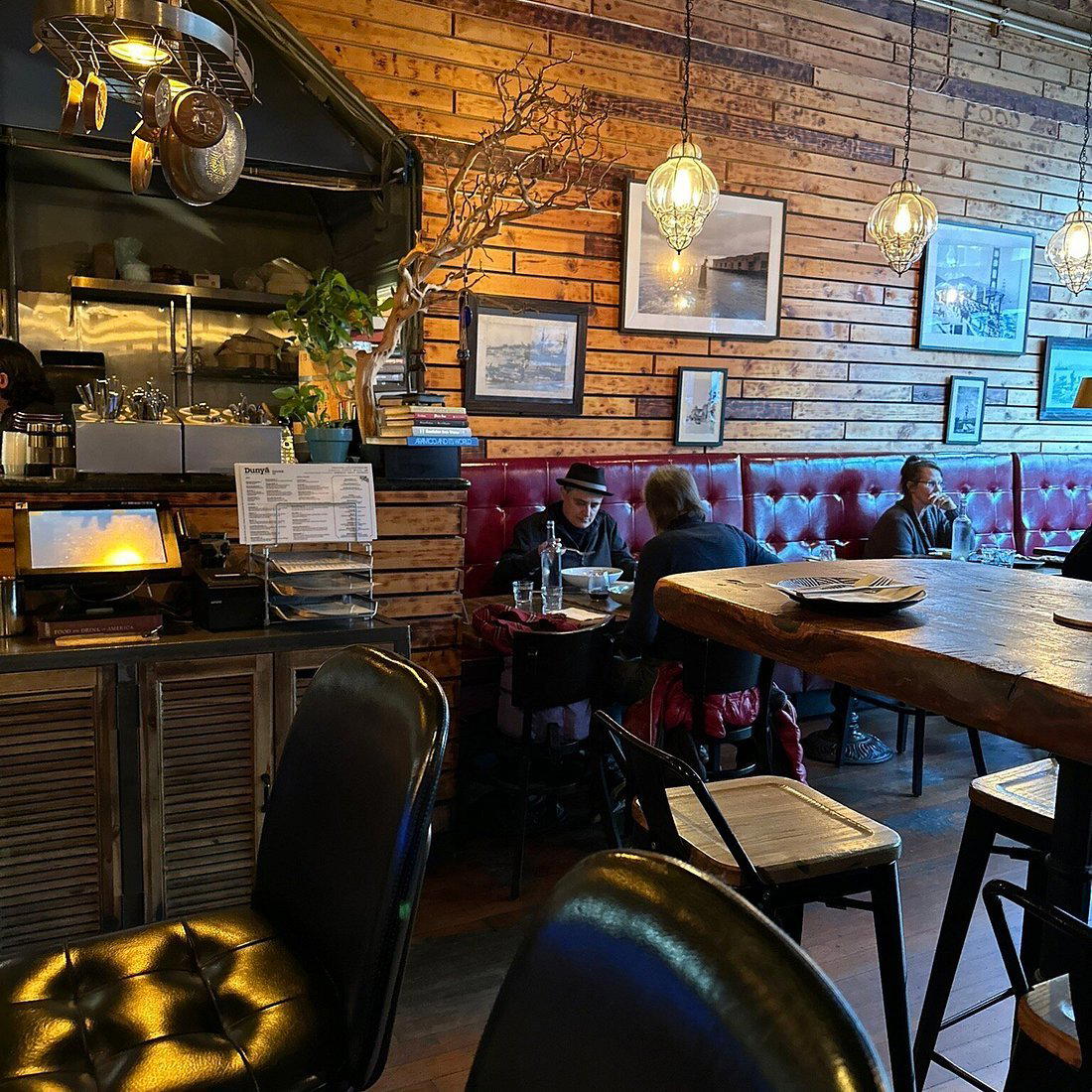
Polk Street and the Restaurants That Survive on Reputation
San Francisco's restaurant geography has always been more layered than its headline venues suggest. While SoMa and the Mission absorb most of the critical attention, Polk Street in Russian Hill runs a quieter, more durable dining tradition. The corridor has never chased the same validation cycles as the tasting-menu circuit at Lazy Bear or Atelier Crenn, and that distance from the prestige track has allowed certain addresses to build neighborhood loyalty over years rather than seasons. Dunya, at 1609 Polk St, occupies that kind of position: a Mediterranean restaurant serving Greek, Middle Eastern, and Turkish cooking at a casual price tier that survives on repeat custom.
That distinction matters in a city where dining rooms at the formal end, places like Benu and Quince, operate within a tightly defined prestige economy of Michelin stars and long reservation windows. The addresses that hold their own outside that economy do so through consistency and a clear sense of what they are. Polk Street has several of those, and Dunya is among them.
How Wine Functions as Editorial Signal in a Neighborhood Room
In San Francisco's mid-tier and neighborhood restaurant segment, wine lists function as one of the clearest indicators of a kitchen's seriousness. A room that invests in cellar depth, even modestly, signals something about how it expects its guests to eat. The city's most discussed programs, at Saison for instance, treat the wine list as a co-equal to the menu, with deep California and European selections that price against their food ambitions. That model requires both capital and expertise, and it sets the standard against which neighborhood programs are quietly measured.
Curation philosophy matters as much as depth at this tier. A list with forty well-chosen bottles, organized around drinkability and food logic rather than prestige labels, often serves a room better than five hundred options managed without point of view. Restaurants in cities like Chicago (Smyth) and New York (Atomix) have demonstrated that wine programs at non-trophy addresses can anchor a dining experience as firmly as the food does, provided the selection reflects genuine editorial thinking rather than distributor defaults.
Placing Dunya in the Broader San Francisco Dining Conversation
San Francisco's fine-dining tier is well-documented and internationally legible. The French Laundry in Napa and Single Thread Farm in Healdsburg represent the Bay Area's most formal registers. Within the city, the Michelin-starred addresses command booking windows of weeks to months and price points that place them in direct comparison with Le Bernardin in New York City or Providence in Los Angeles. Dunya operates in a different register entirely, one defined less by formal recognition and more by neighborhood function.
That positioning is not a deficit in the San Francisco context. The city's dining culture has long supported a middle tier of independently operated rooms that serve as the actual infrastructure of local eating. These are the addresses that fill on Tuesday nights without a PR campaign, that anchor a block's identity over years, and that accumulate the kind of local trust that no award can substitute for. Polk Street has historically been that kind of street, and 1609 sits within that tradition.
For visitors constructing a multi-night San Francisco itinerary, the strategic question is sequencing: the Michelin rooms require forward planning and absorb significant budget, while addresses like Dunya can accommodate more spontaneous decisions and offer relief from the formality of tasting-menu dining. The same logic applies in other American cities, where neighborhood independents around Blue Hill at Stone Barns or Addison in San Diego serve as context for the flagship rooms rather than competitors to them.
What the Address Tells You Before You Arrive
1609 Polk St places Dunya within walking distance of Russian Hill's residential core, a neighborhood whose dining character skews toward longevity over novelty. The blocks around Polk and Broadway have seen turnover, as every San Francisco corridor has, but the addresses that survive tend to do so because they serve an actual community rather than a demographic trend. That pattern repeats across American cities with strong neighborhood identities: the restaurants that endure are the ones that function as genuine local infrastructure, not concept vehicles.
Visitors arriving from outside the neighborhood should treat Polk Street as a destination in its own right rather than a detour from the headline dining circuit. The street's character, quieter and more residential than the Mission or Hayes Valley, rewards that approach. It is worth comparing to how Frasca Food and Wine in Boulder or Emeril's in New Orleans function as anchors in their respective neighborhoods: restaurants that carry a block's identity without requiring the validation of a formal dining tier to do so.
For a broader orientation to the city's dining scene across all price points and neighborhoods, our full San Francisco restaurants guide maps the relevant tiers and addresses with greater granularity. Internationally, the comparison point for wine-forward neighborhood rooms with genuine curation ambition would be somewhere like Atelier Moessmer Norbert Niederkofler in Brunico, where regional identity and cellar depth reinforce each other without requiring formal prestige validation, or The Inn at Little Washington, where the address itself becomes the organizing principle of the experience.
Planning Your Visit
Address: 1609 Polk St, San Francisco, CA 94109. Reservations: Recommended. Hours: Mon: 5–10 PM; Tue: 5–10 PM; Wed: 11 AM–10 PM; Thu: 11 AM–10 PM; Fri: 11 AM–10 PM; Sat: 11 AM–10 PM; Sun: 11 AM–10 PM. Budget: About $30 per person. Dress: Casual.
Booking and Cost Snapshot
Comparable venues nearby, for context on price, style, and recognition.
| Venue | Cuisine | Price | Notes |
|---|---|---|---|
| DunyaThis venue — the venue you are viewing | Not listed | $$ | Not listed |
| Penaber Mediterranean meze house | Nob Hill, Mediterranean Meze House | $$ | Not listed |
| Gola | Mission, Modern Tunisian | $$ | Not listed |
| La Mediterranee | Not listed | $$ | Castro/Upper Market, Armenian & Lebanese Mediterranean |
| Zevi Cafe & Bistro | Not listed | $ | South of Market, Mediterranean Bistro Cafe |
| Sens Restaurant | Not listed | $$$ | Financial District/South Beach, Modern Mediterranean |
Continue exploring
More in San Francisco
Restaurants in San Francisco
Browse all →
Bars in San Francisco
Browse all →
Hotels in San Francisco
Browse all →
At a Glance
- Cozy
- Intimate
- Trendy
- Date Night
- Group Dining
- Celebration
- Casual Hangout
- Open Kitchen
- Extensive Wine List
- Local Sourcing
Current opening hours
- Monday
- 5–10 PM
- Tuesday
- 5–10 PM
- Wednesday
- 11 AM–10 PM
- Thursday
- 11 AM–10 PM
- Friday
- 11 AM–10 PM
- Saturday
- 11 AM–10 PM
- Sunday
- 11 AM–10 PM
Hours can change for holidays and private events. Last verified .
Warm and inviting industrial chic atmosphere with floor-to-ceiling wine displays illuminated by blown glass pendants, fostering a cozy social hub.