
Dontaku places Osaka’s okonomiyaki culture in a compact Doyamacho setting, where teppan cooking, counter seating, sake and shochu belong to the same late-evening rhythm. Its repeated Tabelog Okonomiyaki 100 selections, including 2025, put it among the city’s more credible casual specialist addresses rather than the higher-spend meat and tasting-menu tier.
Pearl is the En Primeur Club membership app — saves, bookings, and concierge access live there. Same editors, same standards.
- Address
- 16-12 Doyamacho, Kita Ward, Osaka, 530-0027, Japan
- Phone
- +81 6-6311-3148
- Website
- tabelog.com
 Saves & bookings on Pearl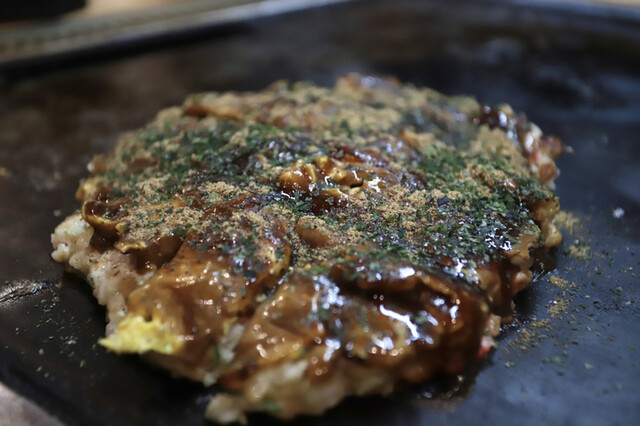
Doyamacho changes after dark, sitting between Umeda’s transport churn, Nakazakicho’s smaller streets, and late-night Osaka eating culture that makes more sense at a counter than on a spreadsheet. Here, okonomiyaki is not a tourist symbol or nostalgia under glass. It is working-night food, drinking food, solo food, friend-group food, and, in the right hands, a serious test of heat control.
Dontaku belongs to Osaka’s compact, teppan-led category, where the room matters because cooking happens close. The format is small, counter-heavy, and built around okonomiyaki and teppanyaki rather than a broad izakaya menu. Its Tabelog Okonomiyaki 100 selection in 2025, after selections in 2024, 2023, 2022 and 2019, is a useful signal in a city where casual specialists can be harder to read than luxury counters. Osaka has many places for batter, cabbage and sauce; fewer keep appearing in a category-specific list over multiple cycles.
Doyamacho puts okonomiyaki back into its after-hours setting
Osaka’s okonomiyaki reputation often gets flattened into Dotonbori imagery: neon, queues, giant signs, and quick visitor explanations. Doyamacho is different. This part of Kita is less postcard than operating system, with diners moving between bars, small restaurants and station-adjacent streets rather than committing to one formal evening. A teppan specialist here feels native to the neighbourhood, not staged for it.
The useful comparison is not refined kappo or omakase, but Osaka’s wider casual hierarchy. Goichi and Yakiniku Horumon Uchida sit in higher dinner-budget territory, while Niku Ryori PINE occupies another meat-led bracket. Dontaku reads as a low-spend specialist stop within everyday city grammar: narrow focus, direct heat, and a room where the counter is part of the point. For travellers using Our full Osaka restaurants guide, it is one piece of the city’s casual canon, not a substitute for sushi, kaiseki or yakiniku.
That neighbourhood frame also explains why it differs from daytime Osaka eating. Compare the convenience-led appeal of 551 Horai (551蓬莱), the bakery rhythm of 52CHO-ME BAKERY, or the café tempo around .cafe. Those addresses answer different city needs. Doyamacho okonomiyaki is the evening handoff from work, trains and drinks to something hot from the iron plate.
The teppan counter is the argument, not decoration
Okonomiyaki rewards proximity. A counter-facing format shows why the category endures in Osaka: simple in outline, unforgiving in execution, with timing, turning and surface heat doing more work than luxury ingredients. Teppanyaki alongside okonomiyaki broadens the meal without turning it into izakaya sprawl. Sake and shochu fit the structure, not as a beverage program demanding attention, but as the expected drinking vocabulary for this room.
The seating profile matters because small teppan restaurants can feel communal or cramped depending on the night. Dontaku’s scale reads better as compact specialist than group dining solution. The solo-dining signal also matters in Osaka, where counter culture is less about solitude than efficiency and access. A lone diner at an okonomiyaki counter is not compromising; the format was built for direct contact with the grill.
Repeated Tabelog category recognition is the strongest reason to choose it over a random okonomiyaki stop near the station. In Japan, user-review ecosystems can be severe, and a 3.65 score in a heavily trafficked casual category is not throwaway. The 2025 Okonomiyaki 100 selection places the restaurant in a national specialist conversation, while the modest price bracket keeps it close to the dish’s democratic roots. That combination is why Osaka’s casual dining can reveal more than formal dining: lower stakes, visible standards.
For a broader Osaka itinerary, this pairs naturally with neighbourhood movement rather than a single-destination evening. Place it beside Italian cooking at a canto (Italian) or the pizza focus of 99 Pizza Napoletana Gourmet to see how Osaka absorbs non-Japanese formats without losing its appetite for counters and heat. The city’s drinking layer belongs on the same map; Our full Osaka bars guide gives after-dinner context, while Our full Osaka hotels guide helps choose a base near Kita or elsewhere.
How to place it in a Japan food trip
Dontaku is strongest as a city-specific meal, not a grand statement dinner. Osaka’s dining identity depends on formats that look casual outside but carry deep local expectation: okonomiyaki, kushikatsu, takoyaki, udon, standing bars, and compact counters where cooking is visible. The value is seeing how an everyday dish performs when the room is built around it.
For travellers moving across Japan, the comparison helps. A sukiyaki address such as -Grilled beef Sukiyaki- KAMAKURA TANUKIAN 鎌倉 たぬき庵 in Kamakura, a Tokyo charcoal-and-tuna format like. 鮪と炭火焼き うお炭 秋葉原店 in Tokyo, or Kumamoto’s.know in Kumamoto all speak different regional languages. Osaka’s contribution is less ceremonious: heat, speed, sauce, batter, drink, conversation, and a room that can turn late without changing costume.
That does not make it lesser; it makes it specific. Visitors planning beyond restaurants can widen the frame through Our full Osaka experiences guide, while Our full Osaka wineries guide reminds that not every city page needs to revolve around dinner alone. Still, this is food-first Osaka: a small specialist can explain more about the city than a polished room with a longer bill.
Its usefulness depends on the occasion. Families should weigh the smoking-allowed environment and compact room before treating it as an easy all-ages meal. Diners wanting quiet and space will find better fits elsewhere. Those seeking late-night Osaka in a focused okonomiyaki register have the clearer case, especially given the repeated category recognition and low-spend positioning. For additional Japan context, compare formats as widely as (Shoku) Vietnam in Kawasaki, [Curry Senmon Ten] Maruyama Kyoju. in Sapporo, [ki:] in Kyoto, Jōdo Saké Bar in Los Angeles, and Onigiri Time in Pasadena: one format does not replace another, but serious eating often sits inside narrow, practical rooms with a clear point of view.
Just the Basics
Comparable venues at a similar level for quick context.
| Venue | Cuisine | Price |
|---|---|---|
| DontakuThis venue — the venue you are viewing | Not listed | $$ |
| Ginza Kagari Ruku a oosaka ten | Kita, Modern Japanese Ramen | $$ |
| Japoni | Kita, Modern izakaya | $$ |
| Naminino Curry | Kita, Japanese Curry | $$ |
| Yuni yumo | Kita, Modern Japanese Izakaya Counter | $$ |
| Kakomo Kitahama ten | Chūō, Japanese Standing Bar | $$ |
Recognition history
Dated appearances from independent guides and award organizations, with the underlying list record or original source where available.
Tabelog 100 #86 · No. 86
Tabelog · Tabelog 100 - Okonomiyaki - 2025
Continue exploring
More in Osaka
Restaurants in Osaka
Browse all →




Bars in Osaka
Browse all →




Hotels in Osaka
Browse all →



Wineries in Osaka
Browse all →
At a Glance
- Lively
- Cozy
- Classic
- Energetic
- Solo
- Casual Hangout
- After Work
- Late Night
- Chefs Counter
- Open Kitchen
- Standalone
- Sake Program
- Beer Program
Current opening hours
- Monday
- 6 PM–1 AM
- Tuesday
- 6 PM–1 AM
- Wednesday
- 6 PM–1 AM
- Thursday
- 6 PM–4 AM
- Friday
- 6 PM–4 AM
- Saturday
- 6 PM–4 AM
- Sunday
- Closed
Hours can change for holidays and private events. Last verified .