Our verdict
Dolcetto occupies a quiet address on Kyrkogatan in central Sundsvall, operating in a city where fine dining is a considered choice rather than a default habit. The name signals Italian sensibility in a Swedish context, a pairing that has found a foothold in Norrland's small but serious restaurant culture. For visitors planning time in the city, it sits within the compact dining circuit that rewards advance research.

Pearl is the En Primeur Club membership app, where members save venues, book tables and use the concierge.
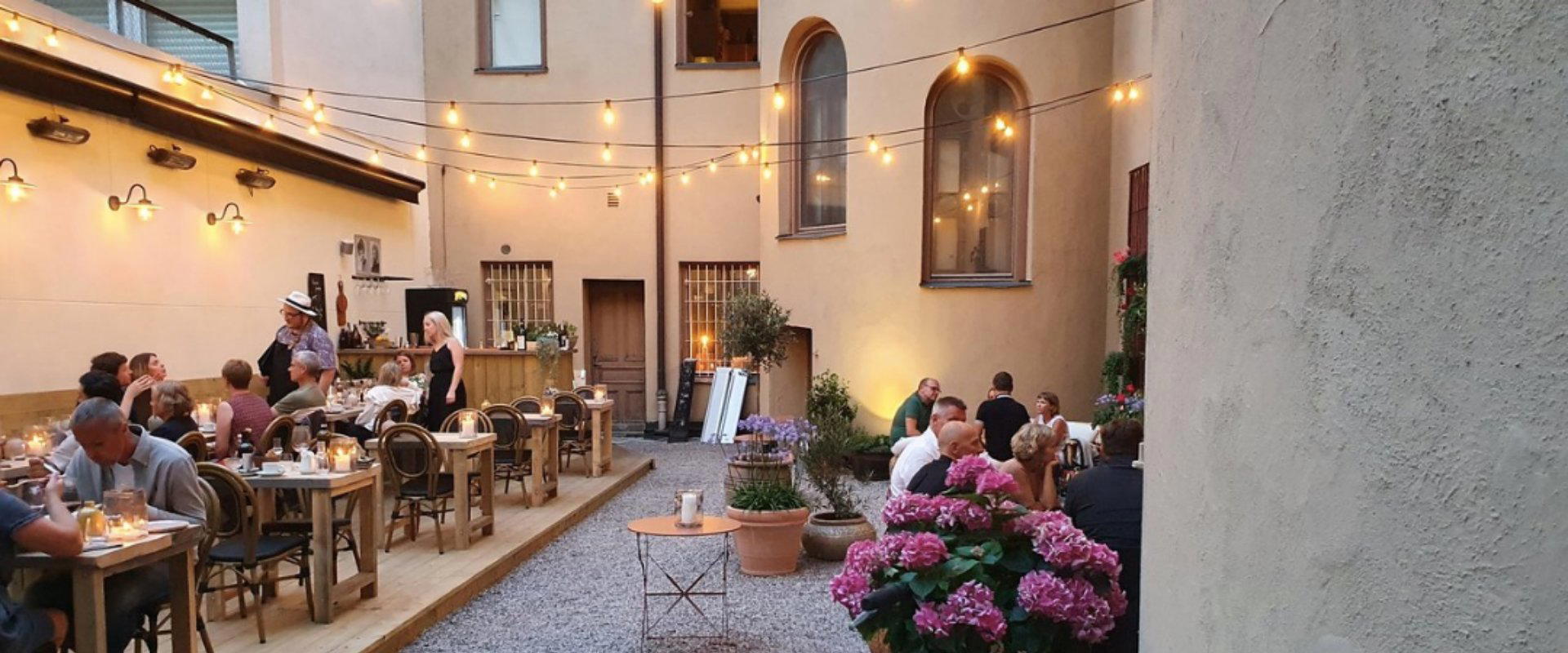
Kyrkogatan and the Case for Eating Well in Sundsvall
Sundsvall is not a city that announces itself as a dining destination. Situated roughly halfway up the Swedish coastline, it functions as the commercial and cultural hub of Medelpad, a region more associated with timber history and coastal archipelago than with restaurant culture. That context matters when assessing what a place like Dolcetto, at Kyrkogatan 8, is doing and what it represents in the local scene.
The street itself sits in the stone city grid, the part of central Sundsvall rebuilt in limestone and sandstone after the 1888 fire. The architecture is deliberate, even austere, and a restaurant operating here inherits that seriousness of tone. Arriving on Kyrkogatan in the quieter months, when the Baltic wind comes in off the Gulf of Bothnia and the light drops early, you understand immediately that whatever is on offer inside needs to justify the decision to come out. Swedish provincial dining at its most considered works that way: the occasion is always slightly weighted, which tends to concentrate the quality of what gets put on the table.
Italian Naming in a Nordic Frame: What the Provenance Signal Means
The name Dolcetto carries a specific weight for anyone who follows wine and northern Italian table culture. Dolcetto is a red grape variety native to Piedmont, producing wines that are typically dry, low in acid, and built for food rather than cellar time. Choosing it as a restaurant name is a provenance signal, a way of aligning with a tradition where what grows locally and what arrives at the table are understood as the same conversation.
That Piedmontese frame is relevant to how ingredient sourcing tends to work in restaurants that adopt this kind of reference. The Langhe and Monferrato hills that produce Dolcetto the grape are also the terrain of white truffles, tajarin pasta made with forty-plus egg yolks, and hazelnuts used with the same seriousness that Nordic kitchens apply to wild herbs and root vegetables. When a restaurant in northern Sweden reaches for that tradition, it is typically making a claim about the relationship between a specific place and what that place produces: not fusion, but a parallel philosophy applied to different raw materials.
Swedish restaurants operating in this register have learned from the broader New Nordic movement, which spent the 2010s demonstrating that sourcing specificity, knowing the farm, the water, the season, is a competitive advantage. Restaurants like VYN in Simrishamn and Vollmers in Malmö have built their reputations in part on that granularity. Further afield, ÄNG in Tvååker and Knystaforsen in Rydöbruk demonstrate how rural Swedish addresses can anchor a serious kitchen in the produce immediately available to them. The argument is the same whether the frame is Italian or Nordic: the food is interesting because of where it comes from, not despite it.
Norrland's Supply Chain and Why Geography Shapes the Plate
Sundsvall's position in Norrland gives any kitchen sourcing seriously from the region access to a specific set of ingredients that are difficult to replicate further south. The rivers and coastal waters around the Gulf of Bothnia produce fish species, particularly Baltic herring and freshwater varieties, that differ in fat content, texture, and flavour from their North Sea counterparts. The forests of Medelpad and the adjacent counties contribute game, chanterelles, lingonberries, and cloudberries at a scale and quality that urban Swedish kitchens often have to source from exactly this region.
A restaurant at this latitude that takes sourcing seriously is, in practical terms, working with some of the most characterful raw materials in Sweden. The challenge is less finding good produce and more deciding how close to bring the reference point: a Piedmontese name suggests that the kitchen has chosen to mediate local materials through a southern European lens, which is a legitimate creative position and one that distinguishes Dolcetto from the strictly Nordic-coded kitchens that dominate the country's fine dining conversation.
For comparison, consider how Fäviken in Kall, before its closure, made Nordic isolation itself the aesthetic and the argument. Dolcetto's Italian naming suggests a different choice: that European table tradition is the frame, and Norrland's ingredients are what fills it. This is closer in spirit to what PM & Vänner in Växjö achieves in Småland, applying classical training to regional produce without insisting on a purely local identity.
Sundsvall in the Swedish Dining Map
Sweden's serious restaurant culture clusters predictably: Stockholm carries the flagship addresses, including Frantzén at the top of the tier; Gothenburg contributes kitchens like Hoze; and a scatter of regional anchors, from Signum in Mölnlycke to Bistro Jarlen in Halmstad, demonstrates that the country's quality is not entirely concentrated in its two main cities. Sundsvall sits outside those established corridors, which means a restaurant here is not competing for the same tourist or business-travel traffic that sustains city-centre fine dining. Its audience is local, repeat, and relatively committed. That tends to produce a particular kind of restaurant: one that has to be genuinely good rather than merely convenient, because it cannot rely on footfall to fill seats.
Within Sundsvall itself, Dolcetto shares the premium end of the market with a small number of other addresses. Naturaj represents the more overtly Nordic-focused end of the local offer. The city's full restaurant circuit is compact enough that visitors can assess the alternatives in a single evening's research, which makes the case for pre-booking wherever possible.
Planning Your Visit
Sundsvall is accessible by train on the main coastal line from Stockholm, with journey times of around three to four hours depending on the service. The city centre is walkable from the station, and Kyrkogatan sits within that grid. For visitors combining a meal here with broader travel through central Sweden, the city functions well as an overnight stop rather than a day trip, particularly if the intention is to eat seriously in the evening. Given the limited number of high-end covers available in a city of this size, contacting Dolcetto directly to confirm availability before building an itinerary around it is the sensible approach. Provincial Swedish restaurants at the premium end operate on smaller margins of spare capacity than their urban counterparts, and a sold-out Friday is a genuine possibility rather than a remote one.
Frequently asked questions
Is Dolcetto suitable for children?
Nothing in the available record rules children out. Dolcetto sits on Kyrkogatan 8 in central Sundsvall, a city-centre address that tends to draw a mixed local crowd rather than a strictly adult fine-dining set. If a quieter, adult-focused atmosphere is a concern, check the venue's official channels before booking with young children.
What makes Dolcetto worth visiting specifically in Sundsvall rather than Stockholm or Gothenburg?
Sweden's serious restaurant culture concentrates heavily in Stockholm and Gothenburg, which makes a venue carrying an explicit Italian table reference in Sundsvall, a Norrland city some three to four hours north of Stockholm by rail, a different proposition entirely. Dolcetto on Kyrkogatan 8 operates in a city where competition for this type of offer is limited, giving it a local relevance that destination-city restaurants rarely achieve. For travellers moving through the Swedish coast by train, it represents one of the few addresses in the region with a defined culinary identity.
What do regulars order at Dolcetto?
Given the Italian provenance of the name and Sundsvall's position in Norrland, any kitchen drawing seriously on both traditions would likely work with locally sourced game, fish, and foraged produce alongside Italian-inflected preparations, but confirmed dishes require verification with the venue directly.
Where exactly is Dolcetto?
Dolcetto is located at Kyrkogatan 8, 852 31 Sundsvall, Sweden, Sundsvall.
At-a-Glance Comparison
| Venue | Cuisine | Price | Awards | Notes |
|---|---|---|---|---|
| DolcettoThis venue (the venue you are viewing) | Italian Trattoria | $30–50 | Not listed | Not listed |
| Operakällaren | Modern Scandinavian Fine Dining | $150–200 | 1 Michelin Star · World's 50 Best #27 | Swedish, Modern Cuisine |
| VYN | Modern Scandinavian Fine Dining | $300–500 | 2 Michelin Stars · World's 50 Best #47 | New Nordic, Creative |
| Vollmers | Modern New Nordic with Scanian Terroir | $150–200 | 2 Michelin Stars · La Liste Top Restaurants | New Nordic, Contemporary |
| AIRA | Modern Nordic Seasonal Tasting Menu | $200–300 | 2 Michelin Stars · La Liste Top Restaurants | Modern European, Modern Cuisine |
| PM & Vänner | Modern Småland Regional Cuisine | $150–200 | 1 Michelin Star · La Liste Top Restaurants | Nordic, Creative |
Continue exploring
More in Sundsvall
Restaurants in Sundsvall
All restaurants in Sundsvall →
Details
- Cozy
- Intimate
- Classic
- Date Night
- Family
- Casual Hangout
- Standalone
- A La Carte
- Wine
- Vegetarian Friendly
- Vegan Options
Current opening hours
- Monday
- Closed
- Tuesday
- 4–10 PM
- Wednesday
- 4–10 PM
- Thursday
- 4–10 PM
- Friday
- 4–11 PM
- Saturday
- 2–11 PM
- Sunday
- Closed
Hours can change for holidays and private events. Last verified .
Cozy, quite small restaurant with family atmosphere.