Dhabkwan
.png)
Inside Dhabkwan Resort in Nonthaburi, a teak house restaurant opens onto lotus ponds and formal gardens to serve a traditional Thai menu that reaches well beyond the tourist circuit. Dishes like Miang Kam with lotus petals and santol curry with roasted pork represent the kind of regional specificity that Bangkok's mainstream dining rarely attempts. Meals arrive on Benjarong porcelain, and cookery classes run alongside the regular service program. Rated 4.3 across 460 Google reviews.
 Discover on Pearl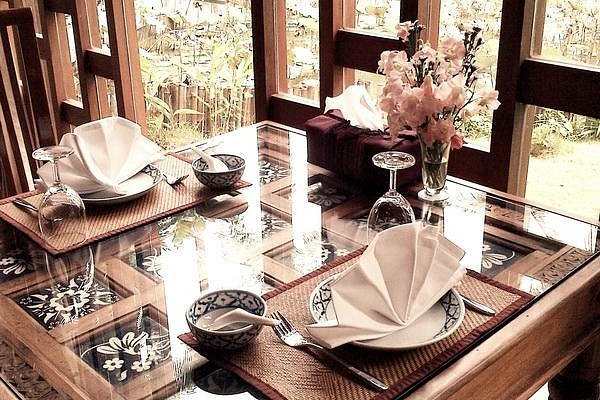
A Teak House at the Edge of Bangkok
The restaurant culture running north out of Bangkok along the Chao Phraya corridor tells a different story from what fills the capital's Michelin lists. Where Bangkok's premium Thai dining — places like Sorn in Bangkok or Nahm and Samrub Samrub Thai — operates at ฿฿฿฿ price points and with considerable ceremony, Nonthaburi has a quieter tradition: cooking tied to the rhythm of orchards, river markets, and older household methods that never made it onto a tasting menu. Dhabkwan sits firmly inside that tradition. Set within a teak house at Dhabkwan Resort on Soi Nonthaburi 1, the restaurant opens onto a lotus pond and surrounding gardens that frame the meal before a single dish arrives. The physical setting is not decorative , it is structural to how the menu reads.
What the Teak House Format Signals
Across Thailand, the traditional teak sala or pavilion restaurant carries specific associations: slower pacing, dishes prepared with more ceremony than speed, and menus that skew toward regional specialties over crowd-pleasing standards. It is an architecture of intention. Dhabkwan operates inside that format, and the menu backs it up. This is not a restaurant serving pad thai and green curry to visitors who want the familiar version. The dishes listed , Miang Kam prepared with lotus petals rather than the betel leaf version found in Bangkok street stalls, and a santol curry with roasted pork built around a fruit that is almost entirely absent from restaurant menus , point toward a kitchen with genuine archival interest in Thai cuisine as it was cooked in central-region households.
The shortlist, unlocked.
Hard-to-book tables, cellar releases, and concierge-planned trips.
Get Exclusive Access →Santol, a tart tropical fruit common in Thai home cooking but rarely featured in any formal restaurant context, requires a specific approach: its bitterness needs balancing against fat and aromatics, and the roasted pork pairing is a considered one. The fact that this dish appears here, in a mid-price restaurant in Nonthaburi rather than on a ฿฿฿฿ tasting menu, is itself an editorial statement about what this kitchen is doing. For context, similar regional Thai specificity in Bangkok tends to sit at a significantly higher price tier, as seen at Sorn. Dhabkwan offers comparable specificity at ฿฿.
Miang Kam and the Hawker Tradition
Miang Kam is one of Thai cuisine's oldest appetiser formats: a wrapped bite assembled by the diner, combining toasted coconut, dried shrimp, lime, ginger, peanuts, and shallots into a single mouthful tied together by a palm-sugar dressing. In its hawker form, it appears on market stalls throughout the central region, wrapped in cha plu (wild pepper leaf). Dhabkwan's version substitutes lotus petals , a shift that is not purely aesthetic. The lotus has deep associations with Thai Buddhist culture and with the Nonthaburi region specifically, which was historically known for its lotus cultivation along the river's banks. Using the petal in place of the standard leaf is a locational gesture, connecting the dish to where it is being served rather than to a generalised Thai tradition.
This kind of detail separates restaurants with genuine culinary grounding from those trading on Thai aesthetics. At ฿฿ pricing, Dhabkwan is accessible well below what AKKEE in Pak Kret or similar destination-level restaurants in the province charge, which means the specificity here is not being sold as a luxury premium. It is simply how the kitchen works.
Benjarong Service and the Language of the Table
The choice to serve on Benjarong porcelain is worth pausing on. Benjarong , the five-coloured enamelware produced in royal workshops and later in cottage industries across central Thailand , carries a specific cultural register. It belongs to formal Thai domestic hospitality: the tablecloth-and-teak setting where cooking was an expression of household status and regional identity. Using it in a restaurant dining room signals that the service format here is consciously aligned with that tradition rather than with the modern bistro or open-kitchen format that now dominates Bangkok's Thai dining. It is the tableware equivalent of the teak architecture: a deliberate framing of what kind of meal this is.
Cookery Classes and the Broader Program
Dhabkwan also runs Thai cookery classes on-site, which positions the restaurant as part of a broader category of traditional-format dining properties that function as both restaurant and cultural experience. This model appears more frequently in Chiang Mai (see Aeeen in Chiang Mai) and Phuket (see PRU in Phuket) than in Nonthaburi, making Dhabkwan an outlier in its own city. The classes extend the kitchen's educational commitment beyond the menu. The property is also available for private events, which suggests the resort format and teak house setting draw a significant proportion of bookings for ceremonies and corporate lunches rather than purely walk-in trade.
Placing Dhabkwan in Nonthaburi's Dining Scene
Nonthaburi's restaurant scene is not large, and the options at the more considered end of the spectrum are limited. Banya and Kaeng Pa Loong Sa-Nga represent different registers of local cooking, but neither operates in a teak-house resort format with the same combination of regional menu depth and setting coherence that Dhabkwan offers. The restaurant holds a 4.3 rating across 460 Google reviews, which at that volume indicates consistent delivery rather than a handful of exceptional visits skewing the average. For travellers staying in the province or combining this with a broader visit to the region, Dhabkwan sits at the accessible end of the Nonthaburi dining picture without sacrificing specificity. You can find more options in our full Nonthaburi restaurants guide.
Planning Your Visit
Dhabkwan is located at 178-184 Soi Nonthaburi 1, within the Dhabkwan Resort compound. The ฿฿ price range places it well below Bangkok's destination Thai restaurants, making it accessible for a weekday lunch as easily as a considered dinner. Given the property also takes event bookings, calling ahead before visiting , particularly on weekends , is advisable to confirm availability. No booking method is listed publicly, so direct contact through the resort is the practical route. Travellers planning a broader Nonthaburi itinerary can also reference our full Nonthaburi hotels guide, our full Nonthaburi bars guide, our full Nonthaburi experiences guide, and our full Nonthaburi wineries guide. For further regional comparison, Angeum in Phra Nakhon Si Ayutthaya, Anuwat in Phang Nga, and Baan Chik Pork Noodles in Udon Thani offer a sense of how traditional-format Thai cooking varies by province. Agave in Ubon Ratchathani and The Spa in Lamai Beach round out the comparative picture for travellers moving through the country.
The shortlist, unlocked.
Hard-to-book tables, cellar releases, and concierge-planned trips.
Get Exclusive Access →Frequently Asked Questions
Cost and Credentials
A compact peer snapshot based on similar venues we track.
| Venue | Price | Awards | Notes |
|---|---|---|---|
| Dhabkwan | ฿฿ | Located in a teak house in the middle of Dhabkwan Resort, this traditional Thai… | This venue |
| Sorn | ฿฿฿฿ | Michelin 3 Star | Southern Thai, ฿฿฿฿ |
| Côte by Mauro Colagreco | ฿฿฿฿ | Michelin 2 Star | Mediterranean, Modern Cuisine, ฿฿฿฿ |
| Baan Tepa | ฿฿฿฿ | Michelin 2 Star | Thai contemporary, ฿฿฿฿ |
| Gaa | ฿฿฿฿ | Michelin 2 Star | Modern Indian, Indian, ฿฿฿฿ |
| Sühring | ฿฿฿฿ | Michelin 2 Star | German, ฿฿฿฿ |
Need a table?
Our members enjoy priority alerts and concierge-led booking support for the world's most difficult tables.
Get Exclusive AccessThe shortlist, unlocked.
Hard-to-book tables, cellar releases, and concierge-planned trips.
Get Exclusive Access →