Dene & Gör
Our verdict
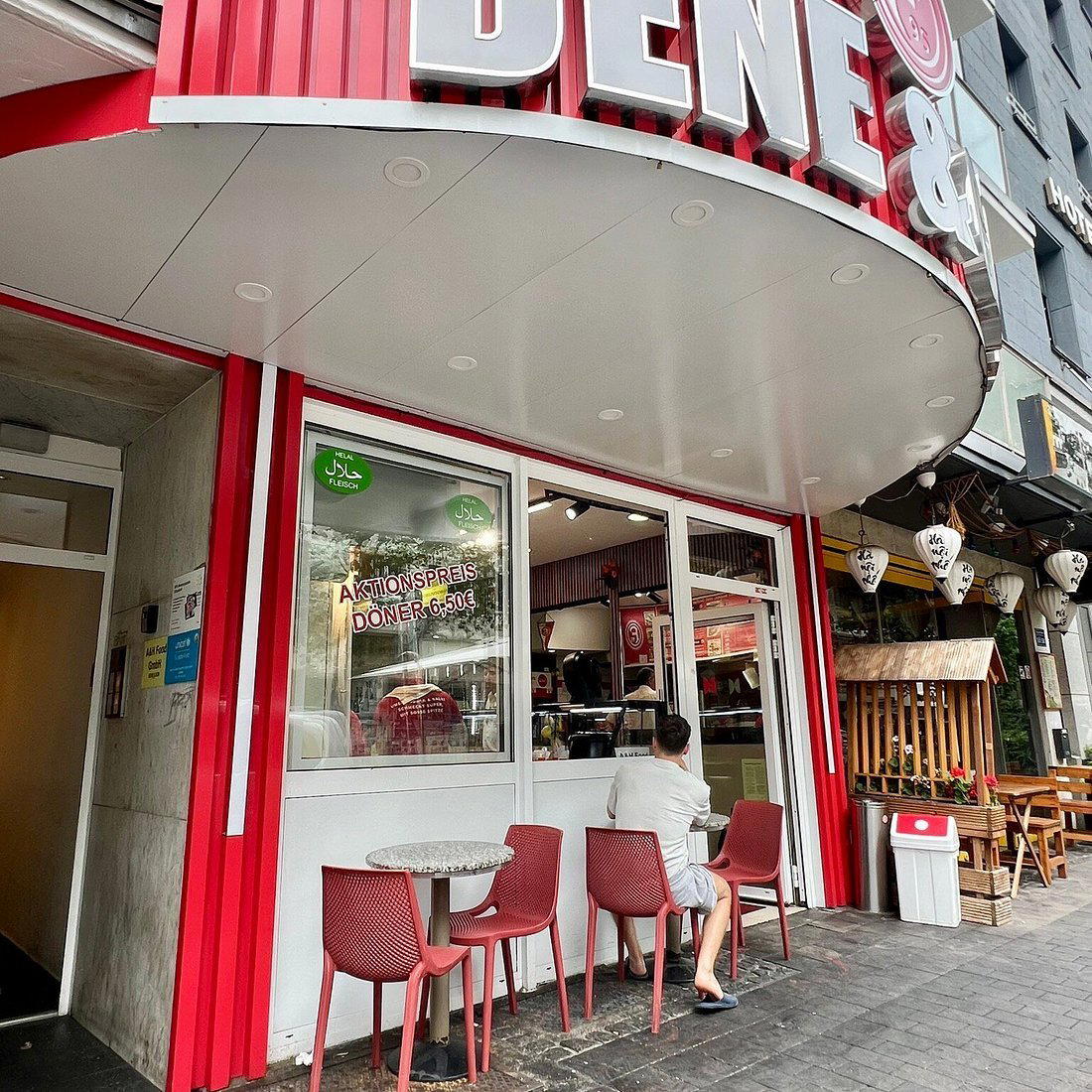
Dene & Gör serves Authentic Turkish Döner Kebab at counter service on Graf-Adolf-Straße in Düsseldorf, with döner kebab and chicken kebab suited to a quick lunch or dinner.

Pearl is the En Primeur Club membership app, where members save venues, book tables and use the concierge.
The menu
What to order
- Döner kebab
- Chicken kebab
Graf-Adolf-Straße and the Question of What Düsseldorf Does Next
Graf-Adolf-Straße cuts through the commercial core of Düsseldorf with the purposeful anonymity of a street that has always been more useful than celebrated. The buildings here are mixed-use mid-century and postwar reconstruction, the foot traffic a blend of office workers, shoppers cutting through to the Altstadt, and the occasional tourist who has strayed from the Rhine promenade. It is not where you would expect to find a dining room that demands advance planning, which is precisely why Dene & Gör has attracted the kind of attention that spreads laterally through a city rather than downward from a press release.
Düsseldorf sits in a complicated position within the German fine-dining map. The city has never accumulated Michelin stars the way Munich or Hamburg has, and it lacks the culinary mythology that Berlin exports. What it does have is a concentrated business-travel economy, a Japanese expatriate community large enough to sustain serious Japanese restaurants, and a growing appetite among locals for the kind of serious, format-conscious dining that elsewhere in Germany is found mostly outside city limits. Addresses like Schwarzwaldstube in Baiersbronn or Waldhotel Sonnora in Dreis define the national conversation precisely because they operate at a remove from urban competition. Düsseldorf's more interesting recent development is the arrival of serious tables inside the city itself.
The Booking Question, Before Anything Else
The editorial angle on Dene & Gör begins with a practical one: what do you need to know before you try to secure a seat? The venue's data footprint is deliberately spare. In the current German dining scene, this signals one of two things: a venue still in its early formation period, or a room that fills through word of mouth and regular-guest priority, making public-facing booking infrastructure largely redundant.
Neither reading is unusual in 2024. Across Germany, a tier of serious smaller restaurants has moved away from third-party reservation systems entirely, preferring direct contact or a tight network of returning guests. CODA Dessert Dining in Berlin operates a similarly controlled booking model, with capacity managed to maintain format integrity rather than revenue volume. Lazy Bear in San Francisco pioneered the ticket-based model that removed walk-in ambiguity entirely. Dene & Gör appears to sit in that same philosophical territory: control the intake, control the experience.
For visitors arriving from outside Düsseldorf, the planning implication is direct. Treat any attempt to book as a research project that begins at least two to three weeks ahead of a planned visit. The address at Graf-Adolf-Straße 58 is confirmed, placing the venue in the southern section of the street, within walking distance of the Hauptbahnhof and the broader Stadtmitte, which simplifies logistics for those arriving by rail from Cologne, Frankfurt, or Amsterdam. What the sparse public profile cannot tell you is whether a specific night has availability, which means your first contact with the venue is also your first test of how the operation handles inquirers.
Where Dene & Gör Sits in the Düsseldorf Scene
Düsseldorf's restaurant grid, as documented in our full Dusseldorf restaurants guide, breaks into several distinct tiers. At the street-food and casual end you find addresses like 3h's burger & chicken and Alanya Döner, which serve the city's dense daily foot traffic. The wine-and-small-plates middle tier is represented by venues like Amuni Wein- und Käsebar, while Mediterranean-rooted kitchens such as Anfora and Arca Alacati have grown a committed local following. Dene & Gör does not fit neatly into any of these clusters, which is itself informative.
The name, combining what reads as a hybrid of linguistic registers, suggests a considered branding decision rather than a descriptive one. In the German restaurant scene, this kind of naming tends to correlate with a certain type of owner or chef: someone who has worked abroad, who has thought carefully about identity, and who wants the name to function as a signal of seriousness without being legible as a direct category claim. It is the kind of naming logic that connects to venues like JAN in Munich or Vendôme in Bergisch Gladbach, where brevity and opacity in the name correlate with ambition in the kitchen.
Germany's Serious-Restaurant Moment, and Where Düsseldorf Fits
The broader German fine-dining scene has spent the past decade in an interesting state of geographic dispersal. The country's most-decorated tables cluster outside major cities: Aqua in Wolfsburg, ES:SENZ in Grassau, Schanz in Piesport, Victor's Fine Dining by Christian Bau in Perl. The logic has always been that rural or semi-rural settings allow the investment in kitchen and service that urban rents make harder to justify at comparable price points. But the hospitality economics of German cities have been shifting. Restaurant Haerlin in Hamburg demonstrates that urban fine dining can sustain a Michelin two-star format when anchored to hotel infrastructure. What is newer is the emergence of independently operated, high-format rooms in urban commercial streets, without hotel backing and without the safety net of a destination-drive customer base.
Dene & Gör sits at Graf-Adolf-Straße in exactly that context. It is urban, independent in form, and operating in a city that has historically exported its dining ambitions to the suburbs or neighboring small towns. For visitors who track this particular shift in German hospitality, the address alone is worth noting.
Either way, the planning approach is the same. Arrive in the vicinity during service hours to assess the format directly, or identify a contact route through the venue's presence on local review platforms, where staff responses to reviews sometimes include a contact method. The Graf-Adolf-Straße address places Dene & Gör within a ten-minute walk of Düsseldorf Hauptbahnhof, and the surrounding blocks contain enough alternative dining to make the area a viable evening destination even if a first-visit attempt does not land a table.
For travelers who have already committed to the kind of careful pre-planning that venues like Le Bernardin in New York City demand, Dene & Gör represents a different but equally deliberate challenge: the research itself is part of the process, and the reward for doing it properly is a seat in a room that has not yet been smoothed into the frictionless booking experience of a brand-managed restaurant.
Frequently asked questions
What's Dene & Gör's location?
Dene & Gör is located at Graf-Adolf-Straße 58, 40210 Düsseldorf, Germany, Dusseldorf.
What kind of dining experience does Dene & Gör offer compared to other Düsseldorf restaurants?
That absence of publicly verified credentials places it outside the tier of Düsseldorf restaurants that critics and guides actively track. Whether it occupies a neighbourhood-focused niche or a more ambitious register is something only a visit can settle.
What's the signature dish at Dene & Gör?
No menu or dish list is currently published for Dene & Gör at Graf-Adolf-Straße 58. The venue has not yet established a public-facing online presence, which makes dish-level intelligence unavailable before a visit. Arriving without expectations may actually serve you well on a street more used to utility than culinary destination status.
Is Dene & Gör reservation-only?
Walk-in availability can change or ruled out from available data. The practical move is to visit in person or ask your concierge to make contact directly through local channels. Check the venue's official channels for the latest details.
What's the standout thing about Dene & Gör?
Its address on Graf-Adolf-Straße places it in the commercial spine of Düsseldorf, a stretch that sees considerable foot traffic but fewer destination restaurants than the city's Altstadt or Medienhafen zones. Operating without a visible web presence or listed awards in a city with documented Michelin-starred competition is a specific kind of positioning, whether by design or circumstance.
How does Dene & Gör handle allergies?
No allergy or dietary policy is documented for Dene & Gör. Given the absence of a website or phone number at Graf-Adolf-Straße 58, guests with serious dietary requirements should plan to clarify directly on arrival. Düsseldorf's restaurant scene broadly follows German statutory allergen-disclosure requirements, which apply to all food businesses.
Does Dene & Gör justify its prices?
Graf-Adolf-Straße sits within Düsseldorf's mid-city commercial district, where restaurant pricing tends to span a wide range depending on format and ambition. Until menu and pricing details are publicly available, a value assessment cannot be made with any honesty.
Similar Picks
| Venue | Cuisine | Price |
|---|---|---|
| Dene & GörThis venue (the venue you are viewing) | Authentic Turkish Döner Kebab | $10–20 |
| Alanya Döner | Turkish Döner | $10–20 |
| Amuni Wein- und Käsebar | Sicilian Wine & Cheese Bar | $30–50 |
| Anfora | Modern Turkish Grill | $30–50 |
| Arca Alacati | Smashburger | $30–50 |
| Askitis greekcuisine | Authentic Greek Cuisine | $30–50 |