DeLaurenti Food & Wine
DeLaurenti Food & Wine has anchored Pike Place Market's specialty food culture for decades, offering an edited selection of imported Italian and European provisions alongside Pacific Northwest pantry staples. The store occupies a particular position in Seattle's food retail scene: part wine merchant, part salumeria, part cheese counter, operating at the crossroads where Old World craft meets Northwest sourcing.
Pearl is the En Primeur Club membership app — saves, bookings, and concierge access live there. Same editors, same standards.
- Address
- 1435 1st Ave, Seattle, WA 98101
- Phone
- +12066220141
- Website
- delaurenti.com
- Directions
- Get directions
 Saves & bookings on Pearl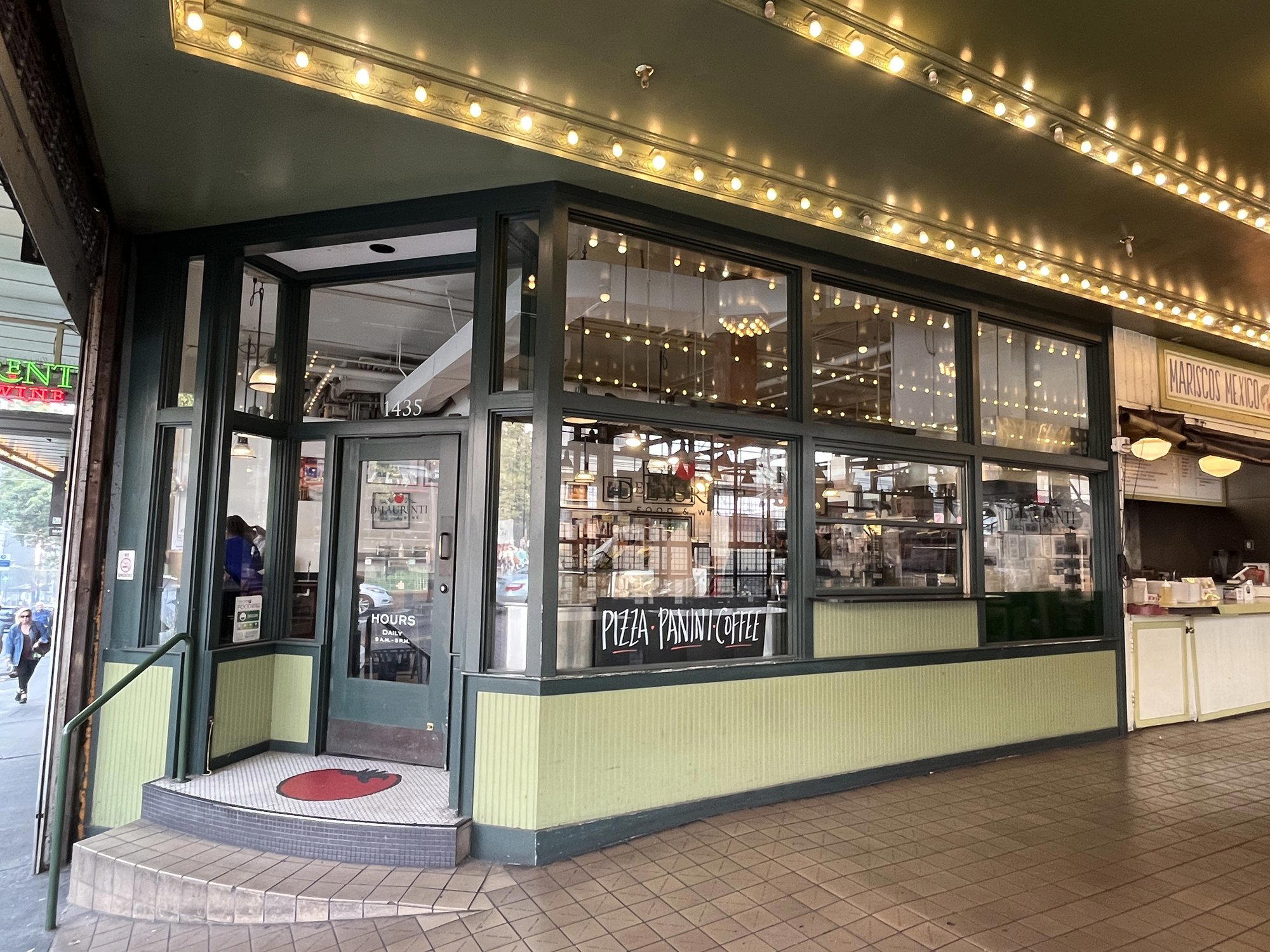
Pike Place, Permanence, and the European Pantry Tradition
There is a particular kind of food shop that European cities take for granted and American cities spend decades trying to cultivate: the serious provisions store, the one where the person behind the counter can tell you the specific valley a salumi came from or which vintage to open with a hard Parmigiano. At 1435 1st Ave, inside the dense retail corridor of Pike Place Market, DeLaurenti Food & Wine has occupied that role in Seattle longer than most of the city's celebrated restaurants have existed. Pike Place itself is one of the oldest continuously operating farmers markets in the United States, and DeLaurenti's persistence within it is less a coincidence than a structural fit: the market has always prioritized producers, provenance, and the kind of retail that assumes the customer wants to cook, not just consume.
Seattle's food culture has, over the past two decades, developed a genuine fluency with sourcing. The same instinct that sends diners to Canlis for carefully sourced New American cooking, or to Joule for Korean-inflected technique applied to Pacific Northwest ingredients, drives a different kind of customer to a shop like DeLaurenti. The editorial angle is the same across all three: local ingredients interrogated through a global lens, or global product lines placed in conversation with what the region grows and produces. DeLaurenti sits at the retail end of that continuum.
The Import-Local Intersection at the Counter
The intersection of imported European methods and Pacific Northwest raw materials is not merely a marketing frame in Seattle; it is how the region's food identity actually developed. Washington State produces serious wine, much of it from grapes with Old World lineage grown in the Columbia Valley and Walla Walla. The Puget Sound region generates notable shellfish, cured fish, artisan dairy, and small-batch preserved goods. A shop that stocks imported Italian pasta alongside local smoked salmon, or places a column of aged European cheeses next to Washington farmstead varieties, is not being eclectic for its own sake. It is reflecting the actual pantry logic of the city's most engaged home cooks and professional kitchens.
DeLaurenti's wine section extends that logic into the bottle. The store has historically carried a selection weighted toward Italian and European producers, which places it in a different conversation from the big-box wine retailers or the domestic-focused boutique shops that have proliferated in Seattle's neighborhoods. For readers who track how wine retail operates in cities with serious food cultures, the comparison is instructive: just as Le Bernardin in New York City commits to a specific French-derived tradition of seafood cookery while remaining financially competitive in a dense market, DeLaurenti maintains a specific European provisions identity within a city that could easily have pulled it toward broader, safer inventory choices.
What the Pike Place Location Actually Means
Location inside Pike Place Market carries specific implications that are worth stating plainly. The market draws tourists in enormous numbers, particularly between June and September, but its core vendor relationships are built around professional buyers, serious home cooks, and restaurant sourcing staff who treat the stalls as a working ingredient pipeline. DeLaurenti operates in both registers simultaneously. A summer afternoon will bring visitors from across the country who may be buying a wedge of Pecorino or a bottle of Barbera d'Alba as a souvenir; a Tuesday morning in October will bring a sous chef cross-referencing imported anchovy brands before a prep shift. Both are legitimate customers, and the store's floor plan and staff depth have to accommodate that range.
Stores like DeLaurenti are the connective tissue.
Placing DeLaurenti in Seattle's Specialty Retail Tier
Seattle's specialty food retail operates across several distinct tiers. There are neighborhood grocers with edited provisions sections, large natural-food retailers with broad selection but limited depth, and then a small cohort of destination specialty shops where the selection assumes a customer who already knows what they are looking for. DeLaurenti belongs to that last group. The comparison set is closer to the kind of focused import shop that serious food cities in Europe and the American Northeast have supported for generations.
For context on how this kind of focused specialty retail fits into a broader food culture, consider how restaurants at the level of Single Thread Farm in Healdsburg or Blue Hill at Stone Barns in Tarrytown treat the ingredient supply chain as central to the dining proposition. DeLaurenti operates the retail equivalent of that premise: the product selection is the argument.
Planning Your Visit
| Detail | DeLaurenti Food & Wine | Typical Pike Place Specialty Retail | Seattle Neighborhood Specialty Shops |
|---|---|---|---|
| Location | Pike Place Market, 1435 1st Ave | Market interior or adjacent stalls | Ballard, Capitol Hill, Fremont corridors |
| Crowd Timing | Lighter on weekday mornings; peak tourist pressure July-August | Similar seasonal pattern | Generally lighter year-round |
| Primary Offering | Italian imports, European provisions, wine selection | Varies; produce, seafood, baked goods | Broader domestic focus, some import sections |
| Leading Season to Visit | May-July for market context without peak compression | Same window applies | Year-round accessibility |
| Relevant for Cooking | High; imported pantry staples, local wine pairings | High for fresh produce and seafood | Moderate to high depending on shop |
Peers in This Market
Comparable venues nearby, for context on price, style, and recognition.
| Venue | Cuisine | Price | Notes |
|---|---|---|---|
| DeLaurenti Food & WineThis venue — the venue you are viewing | Italian Specialty Deli & Café | $$ | Not listed |
| Limoncello Belltown | Italian Pasta & Pizza | $$ | Belltown |
| Domani Pizzeria and Restaurant | Italian Pizzeria and Restaurant | $$ | West Queen Anne |
| Mioposto | Wood-Fired Italian Pizzeria | $$ | Mount Baker |
| Via Tribunali | Neapolitan Pizza | $$ | Van Asselt |
| That's Amore - Seattle | Authentic Italian Cafe | $$ | Mount Baker |
Continue exploring
More in Seattle
Restaurants in Seattle
Browse all →
Bars in Seattle
Browse all →
Hotels in Seattle
Browse all →
At a Glance
- Classic
- Cozy
- Casual Hangout
- Brunch
- Historic Building
- Extensive Wine List
- Street Scene
Current opening hours
- Monday
- 9 AM–5 PM
- Tuesday
- 9 AM–5 PM
- Wednesday
- 9 AM–5 PM
- Thursday
- 9 AM–5 PM
- Friday
- 9 AM–5 PM
- Saturday
- 9 AM–5 PM
- Sunday
- 9 AM–5 PM
Hours can change for holidays and private events. Last verified .
Casual market atmosphere with a cozy café section amid gourmet food displays.