Our verdict
Georgian dumpling culture has a firm address in Vienna's Sixth District, where Crazy Khinkali on Hofmühlgasse brings one of the Caucasus region's most tactile eating traditions to a neighbourhood better known for Viennese regulars than culinary tourism. The format is built around the khinkali itself: pleated, broth-filled, and eaten by hand according to a ritual that rewards attention and punishes impatience.

Pearl is the En Primeur Club membership app, where members save venues, book tables and use the concierge.
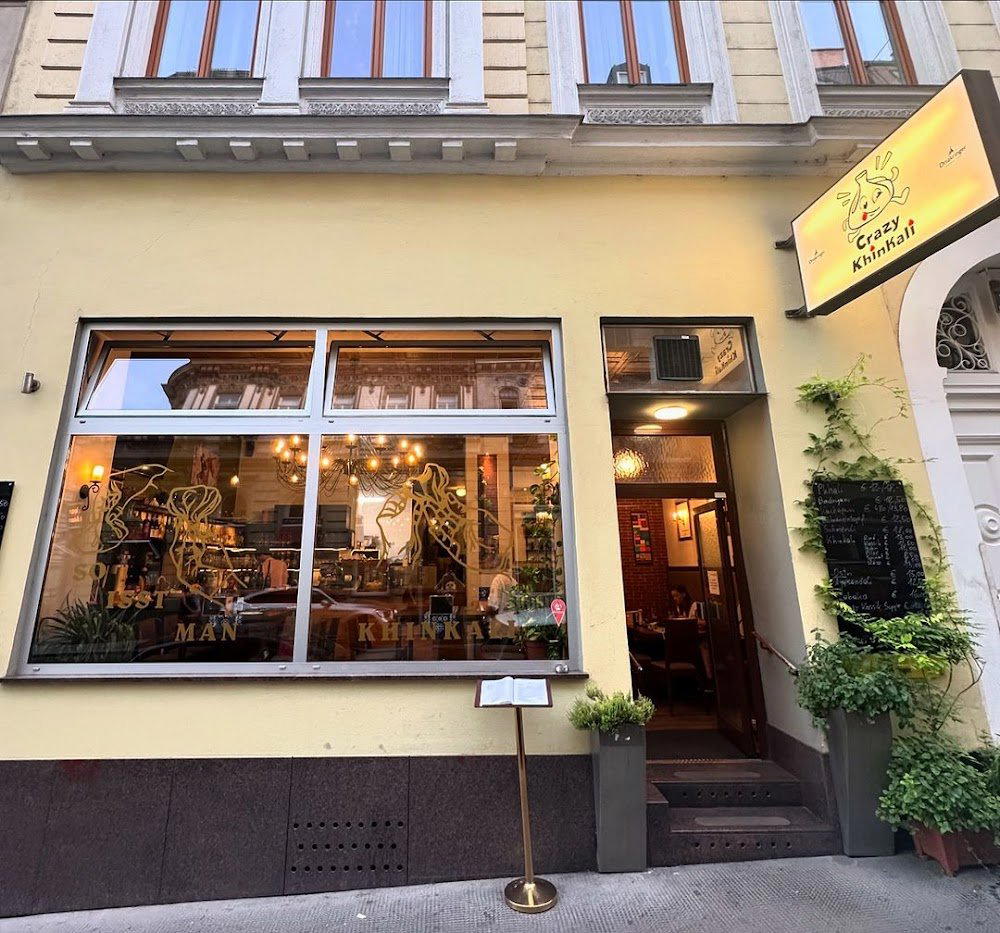
The Sixth District and Why It Matters Here
Mariahilf, Vienna's Sixth District, doesn't orbit the fine-dining corridors of the First. Its streets run between the Naschmarkt's southern edge and the Gürtel ring road, lined with the kind of neighbourhood restaurants that serve a local catchment first and a visiting one second. Hofmühlgasse sits toward the quieter western flank of the district, away from the market-day foot traffic, which places Crazy Khinkali in a context that says something about what it is: a specialist operation serving a cuisine that requires explanation in Vienna, not a tourist-facing dumpling bar capitalising on a passing crowd.
That distinction matters for how to read the restaurant. Georgian food remains a niche within Vienna's diverse mid-tier dining scene, a city whose restaurant map is shaped by Viennese tradition at the leading, a strong Turkish and Balkan mid-range, and relatively little representation from the Caucasus. A Georgian specialist on a residential side street in Mariahilf is, by definition, positioned for an audience that seeks it out rather than stumbles upon it. That self-selecting dynamic tends to produce kitchens that don't dilute for the unfamiliar, and that's the version of Crazy Khinkali worth visiting for.
Khinkali: The Dish That Defines the Format
Khinkali are the structural centre of Georgian dumpling culture and one of the more demanding items to make well. Each dumpling is gathered into a tight pleated knot at the leading, forming a handle, and the interior holds not just meat but a concentrated broth produced during cooking. The eating protocol is specific: you hold the dumpling by its knot, bite into the lower dome to drink the broth before eating the rest, and leave the dense dough knot on the plate. The knot is functional rather than culinary, and abandoning this sequence results in broth down your shirt and a diminished dumpling.
Across Georgia, khinkali fillings vary by region. Meat-filled versions, typically lamb or pork and beef combinations seasoned with fenugreek and black pepper, are the most established. Mushroom and cheese variants have gained ground in urban Georgian restaurants, and the dumpling format has absorbed potato fillings as it moved westward into Mingrelian cuisine. A specialist venue operating under the name Crazy Khinkali signals that the dumpling itself is the editorial point of the menu rather than a supporting role within a broader Georgian spread.
For context on how a cuisine can anchor a restaurant's identity around a single preparation, the model isn't Georgian in origin. Xiaolongbao specialists in Shanghai, ramen-ya in Tokyo, and the borek-focused pastane tradition in Istanbul all demonstrate that depth of execution within a narrow format tends to produce better results than breadth. Vienna's more expansive creative tasting menus, such as those at Steirereck im Stadtpark or Amador, operate on an entirely different register: multi-course architecture with wine pairing and considerable ceremony. Crazy Khinkali sits at the opposite structural pole, where the meal is built around repetition and refinement of a single form.
Vienna's Georgian Dining Niche
Georgian cuisine arrived in European capitals through diaspora communities and, more recently, through a broader wave of interest in Caucasian fermentation traditions, natural wine, and the country's Orthodox food calendar, which produces a substantial repertoire of vegetable and legume dishes. Vienna's Georgian offering is small by the standards of Berlin or London, both of which have larger Georgian communities and correspondingly denser restaurant coverage. That scarcity means that a Georgian specialist in the Sixth District occupies the field with limited local competition.
The city's high-end dining scene, anchored by restaurants like Konstantin Filippou and Mraz & Sohn, operates in a different tier and a different tradition entirely. Doubek represents the city's creative mid-range, while Austria's broader culinary geography extends to destination restaurants in the provinces, including Döllerer in Golling an der Salzach, Obauer in Werfen, and Landhaus Bacher in Mautern an der Donau, among the country's most formally recognised tables. None of that context is relevant to Crazy Khinkali's position, which is defined by its cuisine type and neighbourhood rather than by fine-dining competition. The more useful comparison set would be Vienna's mid-range ethnic specialists, where the benchmark is accuracy to tradition rather than innovation within it.
Planning Your Visit
The venue's address, Hofmühlgasse 19, 1060 Wien, places it within walking distance of the U3 Neubaugasse and Zieglergasse stations, which connect to the U2 interchange at Museumsquartier in under ten minutes. The Sixth District is compact and walkable, and the immediate area around Hofmühlgasse has the density of a residential neighbourhood rather than a dining quarter, so combining the visit with other Mariahilf stops is more natural than pairing it with the Naschmarkt's peak-hour activity.
For broad Vienna dining context and alternative recommendations across price tiers, see our full Vienna restaurants guide.
Austrian dining beyond Vienna extends to some of the country's most formally awarded rooms: Schwarzer Adler in Hall in Tirol, Restaurant 141 by Joachim Jaud in Mieming, Gourmetrestaurant Tannenhof in Sankt Anton am Arlberg, Stüva in Ischgl, Kräuterreich by Vitus Winkler in Sankt Veit im Pongau, Taubenkobel in Schützen am Gebirge, and Ois in Neufelden. For international reference points in specialist formats at the other end of the formality scale, Le Bernardin in New York City and Lazy Bear in San Francisco show how depth of focus within a defined cuisine type builds long-term reputation.
Logistics at a Glance
| Detail | Crazy Khinkali | |
|---|---|---|
| Address | Hofmühlgasse 19, 1060 Wien | Scattered across districts 4–7 |
| Nearest Metro | U3 Neubaugasse / Zieglergasse | Varies by district |
| Price Tier | Not confirmed | Typically €–€€€ |
| Reservations | Not confirmed | Walk-ins common at casual tier |
| Cuisine Focus | Georgian (khinkali specialist) | Mixed: Austrian, Turkish, Balkan |
Frequently asked questions
Where is Crazy Khinkali in Vienna?
Crazy Khinkali is located at Hofmühlgasse 19, 1060 Wien, Austria, Vienna.
Is Crazy Khinkali in Vienna a good option for a solo diner?
Khinkali are ordered by count rather than as shared plates in the conventional sense, which makes the format well-suited to solo dining, you set your own pace and volume. The Hofmühlgasse 19 address in Vienna's Sixth District is a neighbourhood spot rather than a formal dining room, and that casual register tends to accommodate single diners without the friction of table-minimum policies common in more structured restaurants.
What should I eat at Crazy Khinkali?
Khinkali are the reason to come here. These Georgian dumplings, each one hand-gathered into a tight pleated knot and filled with seasoned meat or other fillings, are the structural centre of the menu at Hofmühlgasse 19. Order enough rounds to work through the available varieties rather than treating them as a starter.
Do they take walk-ins at Crazy Khinkali?
No booking contact is publicly listed for Crazy Khinkali, which suggests the venue operates on a walk-in basis or manages reservations through in-person arrangement. The Sixth District address at Hofmühlgasse 19 is accessible from U3 Neubaugasse, so arriving early, particularly at peak dinner hours, is the practical approach.
What has Crazy Khinkali built its reputation on?
The venue's name says it plainly: khinkali is the focus. In a Vienna dining scene where Georgian cuisine remains a niche rather than a fixture, a kitchen that centres specifically on this one demanding dish occupies a distinct position. The Mariahilf location, away from the tourist-heavy First District, reinforces a local, repeat-customer character.
Do they accommodate allergies at Crazy Khinkali?
Specific allergen policy details are not available for Crazy Khinkali. Given that khinkali dough contains wheat and fillings typically include meat, guests with gluten or dietary restrictions should speak directly with staff at Hofmühlgasse 19 before ordering.
Cuisine and Credentials
| Venue | Cuisine | Price | Awards | Notes |
|---|---|---|---|---|
| Crazy KhinkaliThis venue (the venue you are viewing) | Georgian Khinkali | $20–30 | Not listed | Not listed |
| Steirereck im Stadtpark | Modern Austrian Fine Dining | $200–300 | 3 Michelin Stars · World's 50 Best #33 | Creative |
| Konstantin Filippou | Modern Fish-Led Fine Dining | $200–300 | 2 Michelin Stars · La Liste Top Restaurants | Modern European, Modern Cuisine |
| Mraz & Sohn | Contemporary Austrian Fusion | $150–200 | 2 Michelin Stars · La Liste Top Restaurants | Modern Austrian, Creative |
| Silvio Nickol Gourmet Restaurant | Modern Austrian Fine Dining | $300–500 | 2 Michelin Stars · La Liste Top Restaurants | Modern Cuisine |
| APRON | Modern Austrian Fine Dining | $150–200 | 1 Michelin Star · Falstaff Restaurant - 95 Falstaff Points | Austrian, Creative |