CopaCabana Brazilian Steakhouse on Eglinton Avenue East brings the churrascaria format to midtown Toronto, where continuous tableside carving defines the meal's pace and structure. In a city whose premium dining scene skews heavily toward tasting menus and omakase counters, the rodízio model offers a different contract between kitchen and guest. The address puts it squarely in the Yonge and Eglinton corridor, one of Toronto's more neighbourhood-driven dining pockets.
Pearl is the En Primeur Club membership app — saves, bookings, and concierge access live there. Same editors, same standards.
- Address
- 150 Eglinton Ave E, Toronto, ON M4P 1E8, Canada
- Phone
- +12892734240
- Website
- thecopa.ca
- Directions
- Get directions
 Saves & bookings on Pearl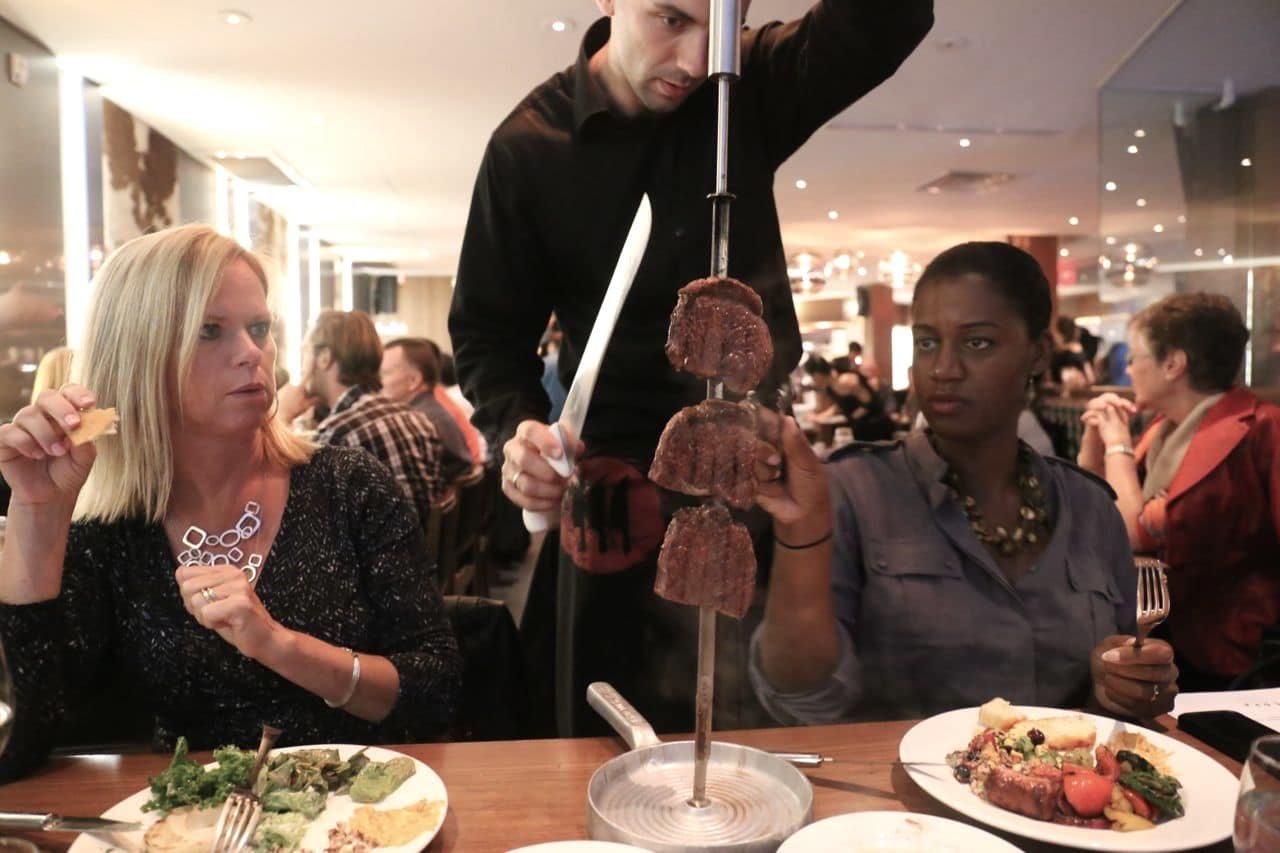
The Churrascaria Ritual in a Tasting-Menu City
Toronto's upper dining tier has consolidated around a particular format over the past decade: the multi-course tasting menu, often counter-based, often with a single seating per evening. Alo (Contemporary), Sushi Masaki Saito, and Aburi Hana all operate within that structure, where the kitchen controls pacing and the guest surrenders to the sequence. The Brazilian churrascaria inverts that contract entirely. Here, the guest controls tempo. Servers circulate continuously with skewers of fire-roasted meat, and a two-sided coaster, green face up to receive, red to pause, places the rhythm of the meal in the diner's hands. It is one of the more theatrically democratic formats in international dining.
CopaCabana Brazilian Steakhouse, at 150 Eglinton Ave E in midtown Toronto, operates within that rodízio tradition. The format is not a novelty act; it is a genuine Brazilian institution that dates to the southern state of Rio Grande do Sul, where gauchos developed the custom of roasting large cuts of meat on swords over open flame. The Toronto iteration sits on a commercial stretch of Eglinton that functions more as a neighbourhood dining corridor than a destination-dining strip, which positions it differently from the tasting-menu houses clustered downtown.
How the Meal Actually Works
The rodízio format has its own etiquette that first-time visitors sometimes underestimate. The meal unfolds in two simultaneous streams: the fixed salad bar and side-dish spread, which guests self-select, and the continuous tableside service from passadores, the servers who carry the skewered meats. The convention is to start at the salad bar, take what you intend to eat alongside meat, and return to the table before flipping the coaster to green.
The cuts arrive in a loosely choreographed rotation: typically beginning with sausages and chicken, progressing through pork and lamb, and arriving at the beef cuts that most guests are waiting for. Picanha, the leading sirloin cap that is the emblematic cut of Brazilian churrasco, tends to appear mid-service. The passador carves directly at tableside, and the accepted practice is to ask for the degree of doneness from the skewer, the outer crust of a picanha offers well-done slices, while the inner section remains closer to medium-rare. Communicating this preference is part of the meal's interactivity.
Pacing also rewards patience. Turning the coaster red is not a social slight; it is the mechanism. Guests who do not use it typically find themselves overwhelmed before the better cuts rotate to their table. The format punishes impatience and rewards those who treat it as a long, conversational dinner rather than an efficient protein delivery system.
Where Churrascaria Fits in Toronto's Dining Map
Toronto's contemporary dining conversation tends to privilege restraint: DaNico and Don Alfonso 1890 both operate in the precise, technique-forward register that dominates the city's critical attention. The churrascaria occupies a different position, it is abundance-forward, communal, and loud in the leading sense. It draws from a different culinary tradition and asks to be evaluated on different terms.
Brazilian steakhouses in North America span a considerable range. At one end sit the large-format chains that treat the format as entertainment-dining; at the other, smaller independent operators closer to the Brazilian original.
For diners familiar with the format from other cities, São Paulo, Rio de Janeiro, or even the New York churrascaria circuit, the Toronto version will feel recognisable in its bones. For those who have spent most of their dining hours in the tasting-menu tier alongside places like Tanière³ in Quebec City or Restaurant Pearl Morissette in Lincoln, the rodízio is a genuine format shift worth making deliberately.
The Eglinton Corridor Context
The Yonge and Eglinton intersection and the blocks radiating from it represent a section of Toronto that functions as a self-contained dining neighbourhood for the mid-city residential population. It is not a destination neighbourhood in the way that King West or Ossington draws visitors from across the city, but it supports a consistent dining culture that includes everything from quick-serve to sit-down international formats. A Brazilian steakhouse fits the internationalism of the strip; the corridor has historically absorbed global dining formats that serve a diverse residential population.
The address at 150 Eglinton Ave E is accessible via the Eglinton subway station on the Yonge line, and the Eglinton Crosstown LRT, when fully operational, will further improve east-west access along the corridor. For diners coming from outside the neighbourhood, the transit connections make it reachable without a car.
Comparing Format Across Canada's Restaurant Landscape
Rodízio format has fewer Canadian reference points than the tasting-menu tradition. Most of the country's editorial dining attention goes to precision-focused rooms: AnnaLena in Vancouver, Jérôme Ferrer - Europea in Montreal, or the remote destination model of Fogo Island Inn Dining Room. Against that backdrop, the churrascaria represents a format-driven alternative rather than a technique-driven one. The appeal is in the ritual itself, the fire, the skewer, the coaster, the rotation of cuts, not in minimalist plating or single-origin sourcing narratives.
That distinction is worth naming plainly. A guest evaluating CopaCabana against the tasting-menu tier is asking the wrong comparative question. The relevant comparable set is other Brazilian steakhouses in the region, and the relevant evaluation criteria are the quality of the picanha, the frequency of cut rotation, the freshness of the salad bar, and the competence of the tableside service. By those measures, the format itself does most of the talking.
Planning Your Visit
The venue is located at 150 Eglinton Ave E, Toronto, ON M4P 1E8. The Eglinton subway station (Yonge-University line) is one direct transit option; the address is a short walk east along Eglinton. Reservations are recommended. The rodízio model is typically priced as an all-inclusive per-person fee covering both the salad bar and the continuous meat service; beverages are generally charged separately. Who it suits: Groups and carnivores who want an interactive, long-format meal without the sequencing constraints of a tasting menu. Those seeking the edited, composed plating style of Eigensinn Farm or the quiet precision of The Pine in Creemore are looking at a different category entirely.
For a broader view of Toronto's dining options across price points and formats, see our full Toronto restaurants guide.
A Lean Comparison
Comparable venues nearby, for context on price, style, and recognition.
| Venue | Cuisine | Price | Notes |
|---|---|---|---|
| CopaCabana Brazilian Steakhouse - TorontoThis venue — the venue you are viewing | Not listed | $$$ | Not listed |
| Mercatto | Not listed | $$$ | Bay Street Corridor, Casual Elegant Italian |
| Labora Restaurant | Not listed | $$$ | Fashion District, Rustic Spanish Tapas and Paella |
| Lyla Toronto | West Queen West, Modern Mediterranean | $$$ | Not listed |
| Valerie | Niagara, Modern Japanese Fusion | $$$ | Not listed |
| F'Amelia | Cabbagetown, Northern Italian | $$$ | Not listed |
Continue exploring
More in Toronto
Restaurants in Toronto
Browse all →
Bars in Toronto
Browse all →
Hotels in Toronto
Browse all →

At a Glance
- Lively
- Energetic
- Group Dining
- Celebration
- Special Occasion
- Live Music
Current opening hours
- Monday
- 5–10 PM
- Tuesday
- 5–10 PM
- Wednesday
- 5–10 PM
- Thursday
- 5–10 PM
- Friday
- 5 PM–12 AM
- Saturday
- 4 PM–12 AM
- Sunday
- 5–10 PM
Hours can change for holidays and private events. Last verified .
Lively and lively with music and entertainment, featuring moderate noise levels.