
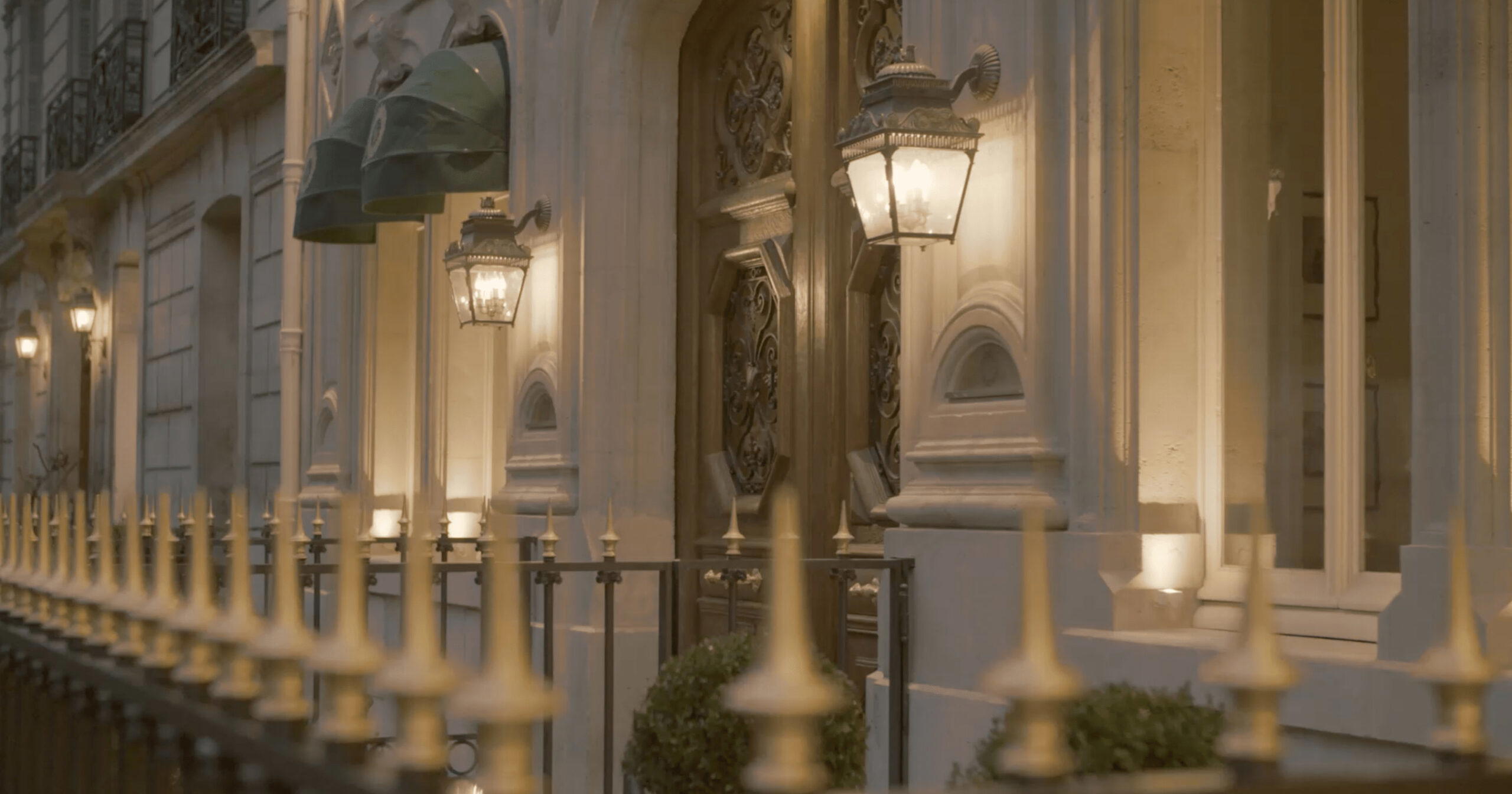
Clos d'Astorg announces its intentions from the street: the words cuisine au beurre on the façade leave nothing ambiguous. Inside, mosaic floors, exposed stone walls, and white tablecloths frame a menu built around the French bistro canon, leek vinaigrette, onglet with Bleu de Bresse, and a chou farci that has become the house signature. This is the 8th arrondissement without the performance.
Pearl is the En Primeur Club membership app — saves, bookings, and concierge access live there. Same editors, same standards.
- Address
- 22 rue d'Astorg
- Phone
- +33 1 55 06 18 16
- Directions
- Get directions
 Saves & bookings on Pearl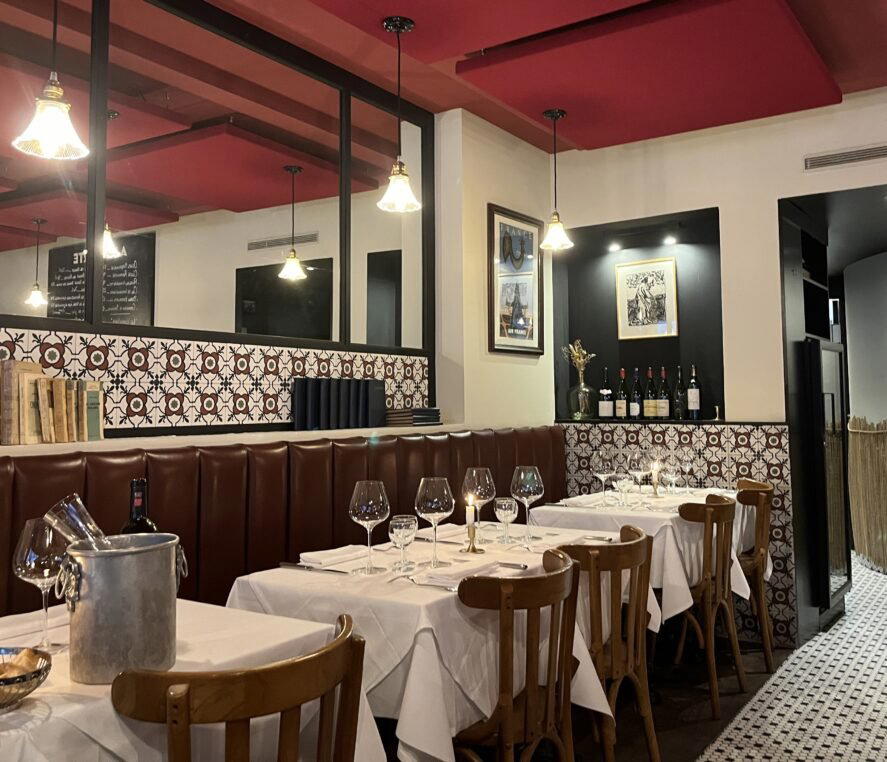
What the Façade Tells You Before You Sit Down
In Paris, a restaurant that announces cuisine au beurre on its exterior is making a commitment, not a suggestion. At 22 rue d'Astorg, Clos d'Astorg opens that contract before you reach the door. Butter is not a technique here in the way it functions at grand maisons like L'Ambroisie or Le Cinq, where it appears inside architecturally constructed sauces. Here it is the organizing principle, declared without apology and delivered without irony. That single piece of signage places Clos d'Astorg in a clear Parisian category: a Classic French Bistro that treats classical French cooking as a living practice rather than a heritage act.
The 8th arrondissement sits between the showpiece dining of the Champs-Élysées corridor and more residential streets to the east and west. It is not short of restaurants competing at the €€€€ tier, venues like Alléno Paris au Pavillon Ledoyen and Kei operate in the same arrondissement at a different register. Clos d'Astorg does not compete in that tier. It occupies a different position in the neighbourhood: a room where the references are bourgeois French cooking and the ambition is precision and comfort rather than transformation.
A Room That Means What It Looks Like
The interior reads as a catalogue of Paris bistro grammar: mosaic and hardwood floors, exposed stone and brick walls, white tablecloths, light wood chairs. None of this is accidental. Bistros that sustain this aesthetic in central Paris are making an active choice to hold against the drift toward stripped-concrete minimalism or the kind of curated rusticity that often signals a newer restaurant performing authenticity rather than practising it. The room reads as settled rather than styled.
That visual consistency carries through to the menu. The two registers reinforce each other, what you see in the room is what you are about to eat. For diners accustomed to reading French bistro environments as reliable indicators of what a kitchen will do, Clos d'Astorg is coherent at every level. This kind of legibility is increasingly rare in central Paris, where kitchen ambitions and room aesthetics often diverge. Here they do not.
How the Menu Is Organised and What It Reveals
The menu at the restaurant is structured around the logic of the classical French table, moving through a sequence that has not changed in its underlying grammar for generations. Starters include leek vinaigrette, egg mayonnaise, and green asparagus with mousseline sauce. These are not filler. In French cooking, the ability to execute leek vinaigrette or egg mayo at a level above the merely competent is a direct signal of kitchen discipline and sourcing attention. They are also among the hardest dishes to hide behind technique, there is nowhere for poor produce or imprecise seasoning to hide.
The meat section makes the kitchen's identity clear. Breaded veal sweetbreads meunière, onglet steak with Bleu de Bresse cheese, boudin noir: this is a list that runs toward offal and secondary cuts, which in French bistro terms signals both confidence and a kitchen that respects what the tradition actually ate rather than a softened version of it. Bleu de Bresse as a sauce component for onglet is a regional pairing with roots in eastern France, one that brings sharpness and funk to a cut that can otherwise be one-dimensional. That kind of specific regional citation in a Paris bistro menu is worth noting.
House speciality, chou farci, sits at the centre of the menu's architecture. Stuffed cabbage is one of those dishes that French regional cooking refined from peasant economy to proper craft, and it does not appear often on Paris menus at the level the dish deserves. Here the preparation is described as generously portioned, with a soft, fragrant farce wrapped in a delicate green cabbage leaf, a version that aims at lightness rather than density. As a house speciality, it is the dish against which the kitchen should be judged; returning visitors will use it as their benchmark.
Desserts follow the same pattern of deliberate classicism: chocolate mousse, hazelnut and caramel riz au lait. Rice pudding in France has a long tradition of appearing at bistros and brasseries as something close to a test of kitchen patience, the technique is simple but the result is unforgiving of inattention. Alongside a chocolate mousse done in the traditional style, these desserts round out a menu that has been composed with a clear editorial point of view: nothing here that the kitchen cannot execute at a level that justifies its presence.
Taken as a whole, the menu architecture at the restaurant is not about ambition in the contemporary sense. It is about range within a defined tradition. For context, the creative and modernist end of French cooking in Paris, places like Arpège or the kind of precision technique on display at Mirazur in Menton, operates on entirely different terms. The restaurant is not in that conversation, and it does not try to be. Its comparable set is the considered Paris bistro, and in that category the menu reads as one with real conviction.
Where It Sits in a Broader French Context
France's serious restaurant tradition spreads well beyond Paris, from Auberge de l'Ill in Illhaeusern and Flocons de Sel in Megève to the institutional weight of Paul Bocuse in Collonges-au-Mont-d'Or and the landscape-rooted cooking at Bras in Laguiole. That national range is worth keeping in mind when considering what the Paris bistro does and what it cannot do. The restaurant belongs to a specifically urban, specifically Parisian mode of French cooking, one that draws on the same classical canon as Troisgros in its foundations but expresses it at a scale and register suited to a neighbourhood restaurant in the 8th. For visitors to Paris already planning to dine at the higher end of the spectrum, this is a different kind of meal, not lesser, but operating in a different register with different criteria for success.
Planning a Visit
The restaurant is at 22 rue d'Astorg in the 8th arrondissement, within walking distance of Saint-Augustin and Miromesnil metro stations. Given the neighbourhood and the room's white-tablecloth presentation, dinner here is suited to anyone who wants serious cooking without the formality or price commitment of the 8th's grand tables. Booking ahead is advisable, this is a small room in a central location. For French cooking at a different scale and price point, Le Bernardin in New York and Emeril's in New Orleans offer reference points for how French technique travels and transforms in different contexts.
Awards and Standing
Comparable venues nearby, for context on price, style, and recognition.
| Venue | Cuisine | Price | Awards | Notes |
|---|---|---|---|---|
| Clos d'AstorgThis venue — the venue you are viewing | Classic French Bistro | $$$ | Michelin Plate | Not listed |
| Maison Cluny | Seasonal French Bistro | $$$ | Michelin Plate | Latin Quarter |
| Dessance | Modern French Gastronomic Dessert Cuisine | $$$ | Michelin Plate | Marais |
| Épopée | Modern French Bistronomique with Japanese Influences | $$$ | Michelin Plate | Charonne |
| Petit Boutary | Modern French Bistro | $$$ | Michelin Plate | Batignolles |
| 19.20 by Norbert Tarayre | Modern French Bistronomy | $$$ | Michelin Plate | 8th Arr. - Élysée |
Recognition history
Dated appearances from independent guides and award organizations, with the underlying list record or original source where available.
Michelin Plate
Michelin
Continue exploring
More in Paris
Restaurants in Paris
Browse all →
Bars in Paris
Browse all →

Hotels in Paris
Browse all →




At a Glance
- Cozy
- Classic
- Intimate
- Date Night
- Group Dining
- Celebration
- Casual Hangout
- Standalone
Current opening hours
- Monday
- 12–2:30 PM, 7:30–10 PM
- Tuesday
- 12–2:30 PM, 7:30–10 PM
- Wednesday
- 12–2:30 PM, 7:30–10 PM
- Thursday
- 12–2:30 PM, 7:30–10 PM
- Friday
- 12–2:30 PM, 7:30–10 PM
- Saturday
- Closed
- Sunday
- Closed
Hours can change for holidays and private events. Last verified .
Warm, cozy lighting with a classic bistro aesthetic that feels established despite being relatively new; intimate and welcoming atmosphere with attentive service.