Our verdict
On the Boulevard Saint-Germain, where Haussmann's Paris meets the Left Bank's café tradition, Café Saint Germain occupies a address that carries its own gravitational pull. Positioned in the 5th arrondissement among the neighborhood's brasseries and literary haunts, it sits at a different register than the grand-hotel dining rooms of the 8th — more neighbourhood anchor than destination tasting counter.

Pearl is the En Primeur Club membership app — saves, bookings, and concierge access live there. Same editors, same standards.
- Address
- 18 Bd Saint-Germain, 75005 Paris, France
- Phone
- +33142035356
- Hours
- Daily 9:30 AM–11 PM
- Website
- cafesaintgermain.metro.bar
- Directions
- Get directions
- Booking
- Book on the venue's website
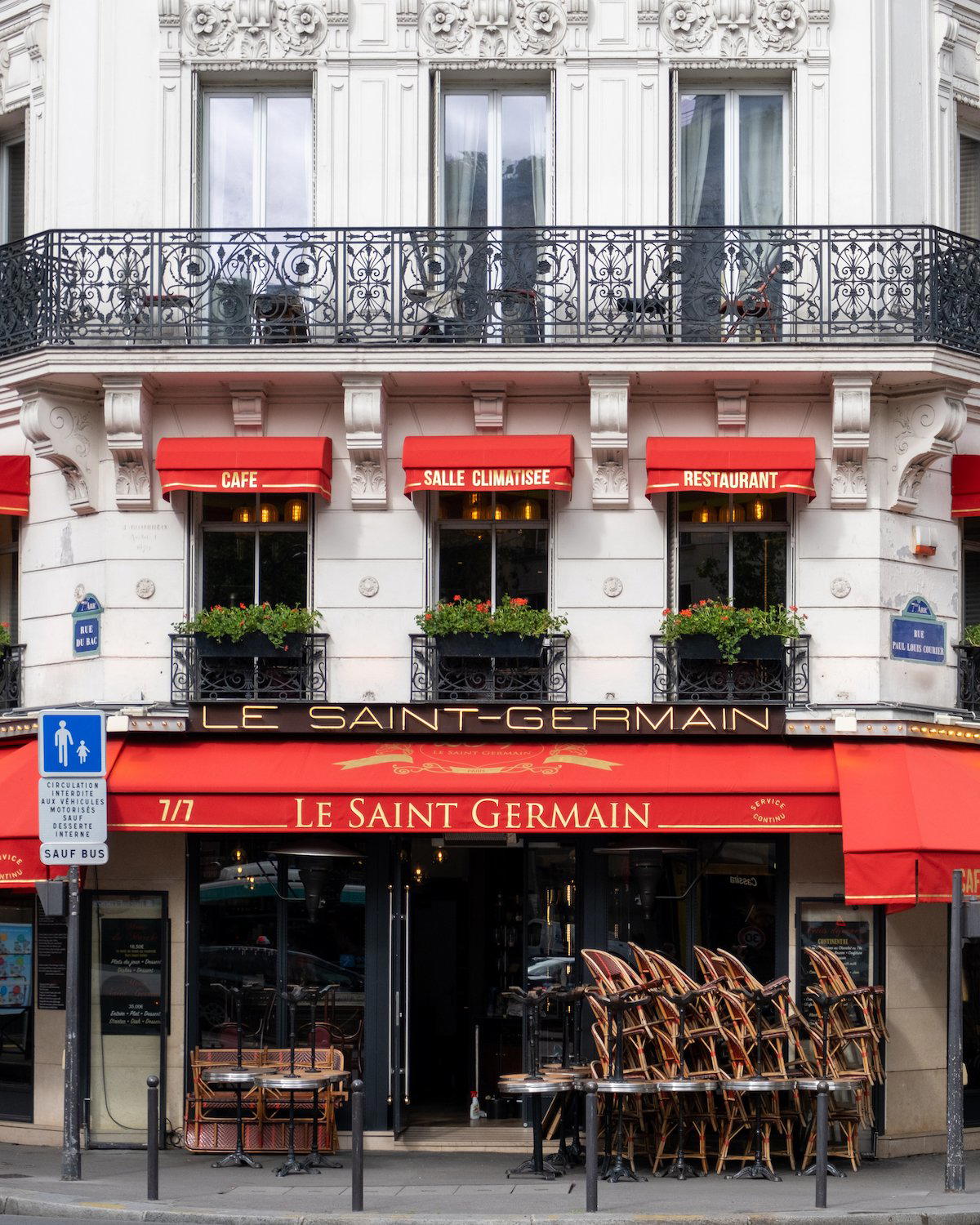
A Boulevard That Sets the Terms
The Boulevard Saint-Germain is one of those Parisian thoroughfares that does most of its work before you step inside anywhere. The 5th arrondissement stretch, running from the Seine toward the Luxembourg quarter, carries the particular weight of a neighbourhood that has housed philosophers, publishers, and the kind of café culture that France exports as a concept more than it still practices at home. At number 18, Café Saint Germain sits on this axis — not on a side street, not tucked behind a courtyard — but directly on the boulevard, where the light from the street and the movement of the city are part of the room.
That position matters architecturally. Left Bank café spaces built into Haussmann-era ground floors share a common structural logic: tall ceilings, large windows that fold or swing open toward the pavement, and an interior depth that moves from bright, street-facing tables toward a darker, more settled rear. This is not a design choice so much as a format inherited from the 19th century, and it produces a particular kind of social layering that hotel dining rooms and purpose-built restaurants rarely replicate. The street-side seat and the back-corner table at a boulevard café are functionally different experiences within the same address.
The Physical Container of a Saint-Germain Address
Paris's café-restaurant spaces in this part of the 5th and 6th arrondissements occupy a competitive tier that sits below the city's formal gastronomic circuit, places like L'Ambroisie on the Place des Vosges or Le Cinq at the Four Seasons George V, which operate as full theatrical productions, and above the purely transactional tourist café. The design language of the better addresses in this neighbourhood is one of accumulated patina rather than installed atmosphere: zinc bars worn to a particular sheen, bentwood chairs that have absorbed decades of use, tile floors that predate any current ownership. These interiors signal continuity, which is the currency the neighbourhood trades in.
Against peers in the broader French fine-dining orbit, from Alléno Paris at the Pavillon Ledoyen to Arpège in the 7th, a Boulevard Saint-Germain café address like this one operates on entirely different spatial terms. Those kitchens are built around a tasting-menu logic that requires a particular room: low lighting, acoustic control, spaced tables, a pace set by the kitchen. A boulevard address invites a different contract with the diner: the room belongs partly to the street, the rhythm is less controlled, and the design is as much about the city outside as the interior itself.
How the Neighbourhood Shapes the Experience
The 5th arrondissement around the lower boulevard has a denser academic and literary institutional presence than the more fashion-adjacent 6th. The Sorbonne, the Collège de France, and the proximity to the Seine-facing bouquinistes give this stretch a different daytime character than the Saint-Sulpice or Odéon end of Saint-Germain. Cafés here have historically served a different population at different hours, morning espresso for commuters, long midday tables for faculty and students, evening service for a neighbourhood clientele rather than a primarily tourist one. That rhythm influences the physical arrangement of a space, even if the specifics of Café Saint Germain's current seating format and hours are not available to confirm here.
What the address itself signals, verifiably, is positioning within a neighbourhood that French food culture has long associated with a particular kind of accessible-but-considered dining. The restaurants that have built durable reputations in this quartier, including some referenced across the broader French canon, from Troisgros to Bras in their respective regional contexts, earn that standing through consistency and a relationship with a returning local clientele, not through spectacle. The same dynamic operates at the neighbourhood level in Paris.
Positioning Within the Paris Dining Map
Paris's dining geography has several distinct registers. The 8th arrondissement, along the Champs-Élysées axis and in the Triangle d'Or, concentrates the city's highest-formality rooms. The 1st and 3rd have absorbed much of the contemporary bistronomy movement. The Left Bank, the 6th and 7th particularly, retains a density of serious, less aggressively avant-garde addresses that play to a clientele with established tastes rather than trend-responsive ones. The 5th, where Café Saint Germain sits, operates in a slightly more democratic register than the 6th's Saint-Sulpice corridor, with pricing and formats that tend to accommodate longer stays and more flexible occasions.
That broader pattern positions this address within a tier of Parisian dining that sits alongside neighbourhood institutions rather than against the city's formal gastronomic marquee. For a comparison of what the top end of that marquee looks like, the Kei and Alléno addresses offer a useful reference point. Internationally, the sustained French fine-dining tradition also shows up in rooms like Le Bernardin in New York, which carries similar classical French lineage in a very different city context.
For readers building a broader picture of the French regional dining circuit alongside a Paris visit, the contrast between a boulevard address like this one and destination properties such as Mirazur in Menton, Flocons de Sel in Megève, Auberge de l'Ill in Illhaeusern, Les Prés d'Eugénie in Eugénie-les-Bains, Auberge du Vieux Puits in Fontjoncouse, Georges Blanc in Vonnas, La Table du Castellet, and Paul Bocuse at the Auberge du Pont de Collonges is instructive. Those are rooms designed around the visit as a destination event. A boulevard café in the 5th is designed around the city itself as the destination, with the room as a permeable part of that.
Planning Your Visit
The Boulevard Saint-Germain address in the 5th arrondissement is accessible from the Maubert-Mutualité metro station (Line 10) and within walking distance of the Seine's Left Bank. The immediate neighbourhood rewards time spent before or after a meal: the rue de la Bûcherie, the Square Viviani, and the nearby quays are all within a five-minute walk. For a fuller picture of how this address fits within Paris's wider dining options, the EP Club Paris restaurants guide maps the city's key tiers and neighbourhoods.
As with most Paris café-restaurants in this neighbourhood tier, walk-in availability at off-peak hours (before noon for lunch, before 7:30 for dinner) is generally more reliable than at weekend prime service. Confirming current hours directly before visiting is advised.
Address: 18 Boulevard Saint-Germain, 75005 Paris, France.
Frequently asked questions
Where is Café Saint Germain located?
Café Saint Germain is located at 18 Bd Saint-Germain, 75005 Paris, France, Paris.
Is Café Saint Germain worth visiting if you're already exploring the Latin Quarter?
The 18 Boulevard Saint-Germain address sits at the hinge point between the Latin Quarter and the Saint-Germain-des-Prés corridor, making it a natural stop rather than a detour. The 5th arrondissement around the lower boulevard has a denser concentration of academic and cultural institutions than the more commercially oriented 6th. For anyone already moving between the Sorbonne, the Musée de Cluny, or the Seine embankment, the location requires no additional planning.
What should I eat at Café Saint Germain?
For a café-restaurant at 18 Boulevard Saint-Germain in the 5th arrondissement, the surrounding neighbourhood skews toward brasserie staples and café fare rooted in French bistro convention.
What's the best way to book Café Saint Germain?
Visiting in person or searching for updated contact details closer to your trip is the most reliable approach. The 5th arrondissement address is reachable via Maubert-Mutualité on Line 10, which makes a walk-in visit straightforward if advance booking proves difficult.
What's the standout thing about Café Saint Germain?
The address is the primary credential: 18 Boulevard Saint-Germain places the café directly on one of the Left Bank's most historically loaded thoroughfares, in a stretch of the 5th arrondissement shaped by academic institutions, publishing houses, and a century of literary café culture. That neighbourhood context does substantial work before you sit down. Venues at this address compete on location in a way that cafés a few streets back simply cannot.
Compact Comparison
Comparable venues nearby, for context on price, style, and recognition.
| Venue | Cuisine | Price | Notes |
|---|---|---|---|
| Café Saint GermainThis venue — the venue you are viewing | French-Italian Bistro | $20–30 | Not listed |
| Au Bourguignon du Marais | Traditional Burgundian French Bistro | $30–50 | Le Marais, Traditional Burgundian French Bistro |
| Bistrot de l'Oulette | Southwestern French Bistro | $20–30 | Le Marais, Southwestern French Bistro |
| La Tour Montlhéry - Chez Denise | Classic French Bistro | $30–50 | Les Halles, Classic French Bistro |
| Restaurant Martin Paris | Contemporary French Gastropub | $30–50 | 10th Arrondissement, Contemporary French Gastropub |
| Le Calbar | French Cocktail Bar | $20–30 | Bastille, French Cocktail Bar |
Continue exploring
More in Paris
Restaurants in Paris
Browse all →
Bars in Paris
Browse all →
Hotels in Paris
Browse all →



Details
- Classic
- Cozy
- Casual Hangout
- Brunch
- Terrace
- Street Scene
- A La Carte
Current opening hours
- Monday
- 9:30 AM–11 PM
- Tuesday
- 9:30 AM–11 PM
- Wednesday
- 9:30 AM–11 PM
- Thursday
- 9:30 AM–11 PM
- Friday
- 9:30 AM–11 PM
- Saturday
- 9:30 AM–11 PM
- Sunday
- 9:30 AM–11 PM
Hours can change for holidays and private events. Last verified .
Cozy classic Parisian café atmosphere ideal for people-watching on Boulevard Saint-Germain.