
A nine-seat counter near Juso Station gives Osaka ramen a tight, craft-focused expression: ramen and tsukemen, no reservations, cash-only payment, and a price band of JPY 1,000–1,999. Chuka Soba Kirimen Souhonten’s repeated Tabelog 100 Ramen selections from 2022 through 2025 place it in the city’s serious noodle tier rather than the casual stopgap category.
Pearl is the En Primeur Club membership app — saves, bookings, and concierge access live there. Same editors, same standards.
- Address
- 大阪府大阪市淀川区十三本町2-1-6
- Phone
- +81663098865
- Website
- tabelog.com
 Saves & bookings on Pearl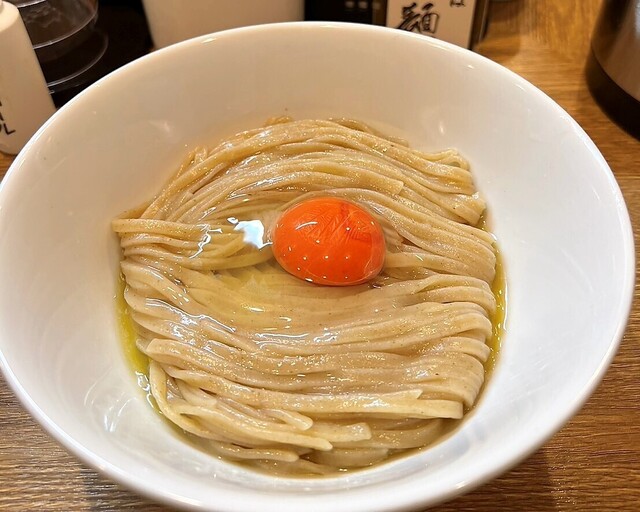
Juso is a different Osaka from the polished department-store dining floors around Umeda. The approach is station-side, compact, and transactional: commuters, narrow streets, small counters, and ramen shops judged less by theatre than by execution under pressure. In that setting, a nine-seat counter changes the rhythm of a meal. There is little room for drift, and the working relationship between kitchen and floor becomes part of the experience: orders move quickly, seats turn, and the counter format keeps attention on timing rather than ceremony.
Osaka’s ramen culture has always shared space with the city’s stronger public image of okonomiyaki, kushikatsu, takoyaki, and late-night drinking food. That makes serious ramen here more interesting, not less. The city’s stronger noodle shops often operate as specialists rather than broad comfort-food rooms, and Chuka Soba Kirimen Souhonten fits that model: ramen and tsukemen, counter seating, no private rooms, and a compact format that rewards decisive ordering. Compared with nearby casual Osaka benchmarks such as Negiyaki Yamamoto Honten or Nomiba Umeda, where the meal often spreads into a longer social format, this is a narrower proposition. The value is in focus.
Juso ramen, reduced to counter discipline
Ramen counters live or die by coordination. In a room with nine counter seats, the separation between cooking, service, and guest management is minimal; mistakes have nowhere to hide. That matters in tsukemen and chuka soba because pacing is not decorative. Noodles, broth, bowl temperature, seat turnover, and payment all sit inside a short window. The team dynamic here is less about formal front-of-house performance than about compression: a small group keeping a high-volume category precise at close range.
The Tabelog 100 Ramen selections give that format useful context. Chuka Soba Kirimen Souhonten was selected for Tabelog Ramen WEST in 2022 and for Tabelog Ramen OSAKA in 2023, 2024, and 2025, with a listed score of 3.72. In Japan, where user-driven restaurant platforms heavily influence ramen discovery, that run is a more meaningful signal than vague popularity. It places the shop among Osaka ramen rooms that have sustained attention across several cycles, not just a single burst of online interest.
The category also explains the price ceiling. At JPY 1,000–1,999 for lunch and dinner, the economics are closer to everyday Osaka dining than to destination tasting menus. That does not make the experience casual in effort. Ramen at this level asks a diner to read value differently: not by tablecloths or extended service, but by ingredient discipline, noodle handling, and whether a short meal can justify a queue. The presence of take-out and delivery broadens access, but the counter remains the critical format because it preserves the immediacy that defines the genre.
How it compares inside Osaka's eating map
Osaka visitors often build meals around a few dominant categories. For a broader read on the city, Our full Osaka restaurants guide is the better starting point, especially when pairing ramen with counter sushi, kappo, bakeries, and casual regional cooking. In that wider frame, Chuka Soba Kirimen Souhonten occupies a precise lane: a low-price, high-focus noodle counter in Juso rather than a polished central Osaka dining room.
The contrast becomes sharper against other local formats. Negiyaki Yamamoto Honten sits in a higher JPY 2,000–2,999 band and belongs to Osaka’s griddle tradition. Meganeya, at JPY 4,000–4,999, points toward a longer evening spend. ku:de kiyo, with French cooking and a ¥¥¥ positioning, belongs to another dining conversation entirely. The ramen counter is therefore not a lesser version of a restaurant night out; it is a different metric. Speed, turnover, and concentration matter more than courses, wine, or room design.
That distinction helps avoid a common mistake in Osaka planning. Ramen should not be treated only as a filler between reservations. The better move is to use it as a targeted meal in a neighbourhood with its own tempo. Juso has the advantage of access from a major rail node while feeling separate from the larger hotel-and-shopping axis. Travellers staying near Umeda can fold it into a day that also accounts for bars, hotels, and specialist stops via Our full Osaka bars guide, Our full Osaka hotels guide, Our full Osaka experiences guide, and, for category completists, Our full Osaka wineries guide.
Planning the meal without overcomplicating it
The practical profile is refreshingly strict. Reservations are unavailable, all seats are non-smoking, private rooms are unavailable, and the shop is counter-only. Payment is cash-led in the old ramen sense: credit cards, electronic money, and QR code payments are not accepted. Parking is unavailable, though coin parking is listed nearby. The address is in Juso Honmachi, close enough to Juso Station for the meal to function as a deliberate rail stop rather than a cross-city detour.
The hours split across lunch and dinner, and the shop is listed as open year-round. That structure suits ramen’s dual role in Osaka: a planned specialist meal at midday or a focused evening stop before a wider night out. With only nine seats and no reservation system, the better editorial expectation is not comfort but efficiency. Arrive ready to order, carry cash, and treat the counter as a working space.
For travellers mapping Osaka by appetite rather than neighbourhood alone, the city rewards mixing categories. Coffee and bakery stops such as.cafe and 52CHO-ME BAKERY show one side of the daytime circuit, while 551 Horai (551蓬莱), 99 Pizza Napoletana Gourmet, and a canto (Italian) point to how broad the city’s casual-to-specialist range has become. Outside Osaka, useful contrasts include -Grilled beef Sukiyaki- KAMAKURA TANUKIAN 鎌倉 たぬき庵 in Kamakura. 鮪と炭火焼き うお炭 秋葉原店 in Tokyo.know in Kumamoto, (Shoku) Vietnam in Kawasaki, [Curry Senmon Ten] Maruyama Kyoju. in Sapporo, [ki:] in Kyoto, Jōdo Saké Bar in Los Angeles, and Onigiri Time in Pasadena. The useful lesson is comparative: some meals are built around duration, while Osaka ramen at this level is built around concentration.
The Short List
Comparable venues by cuisine and category.
| Venue | Cuisine | Price | Notes |
|---|---|---|---|
| Chuka Soba Kirimen SouhontenThis venue — the venue you are viewing | Yodogawa, Ramen & Tsukemen | $ | Not listed |
| Chitose Udon | Namba, Osaka Nikusui Udon | $ | Not listed |
| Okonomiyaki Kiji Honten | Kita, Osaka okonomiyaki & modan-yaki | $ | Not listed |
| GARuRu KO-RI | Not listed | $ | Kita, Kakigori (Japanese shaved ice) specialty shop |
| Hagu Ne | Kita, Japanese Curry Shop | $ | Not listed |
| Curry Senmonten Hakugintei Itwu biru ten | Chūō, Japanese Curry House | $ | Not listed |
Recognition history
Dated appearances from independent guides and award organizations, with the underlying list record or original source where available.
Tabelog 100 #49 · No. 49
Tabelog · Tabelog 100 - Ramen - OSAKA - 2025
Continue exploring
More in Osaka
Restaurants in Osaka
Browse all →



Bars in Osaka
Browse all →




Hotels in Osaka
Browse all →



Wineries in Osaka
Browse all →
At a Glance
- Lively
- Cozy
- Well Known
- Solo
- After Work
- Casual Hangout
- Late Night
- Chefs Counter
- Standalone
- Local Sourcing
A compact, all-counter ramen bar with a functional, no-frills design where the focus is on the steaming bowls and quick turnover; bright and bustling, with the energy of a neighborhood favorite rather than a linger-and-chat destination.