
Hagu Ne brings Osaka’s curry culture into a dashi-led register, folding Japanese-cuisine technique into a casual curry, cafeteria, and tempura format near Tenjimbashisuji Rokuchome. Its selection for Tabelog Curry WEST “Tabelog 100” 2024 places it among the region’s more closely watched curry rooms, while the format remains compact, informal, and ingredient-minded.
Pearl is the En Primeur Club membership app — saves, bookings, and concierge access live there. Same editors, same standards.
- Address
- 大阪府大阪市北区浮田1-2-16
- Phone
- +81669406489
- Website
- instagram.com
 Saves & bookings on Pearl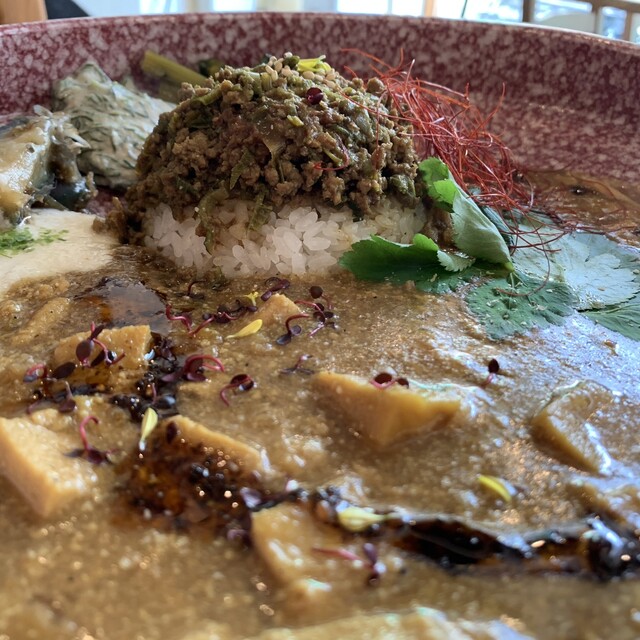
Ukida sits just north of Osaka’s central retail gravity: close enough to Umeda to feel connected, far enough for lunch counters and small neighborhood rooms to keep their rhythm. Here, curry is not only imported comfort. It becomes local grammar: rice, stock, spice, side dishes, frying oil, and the quiet discipline of Japanese set-meal cooking. Hagu Ne belongs to that Osaka strain, where the point is not heat itself, but how spice moves through dashi and fits a broader meal.
That matters in a city where casual dining often carries more technique than its price tier suggests. Osaka has long made room for foods between home cooking and specialist craft: okonomiyaki counters, standing udon, department-store bento, and curry shops drawing office workers and train-line regulars. Curry here can be quick, but rarely neutral. Better examples show themselves through sourcing, stock work, frying, pickles, vegetables, and plate structure rather than luxury cues.
Dashi, spice, and the Osaka curry register
The useful way to read this kitchen is through ingredients, not décor or biography. Its public description points to Japanese curry built around flavorful dashi, seasonal ingredients, and a chef with a Japanese-cuisine background. That places the food closer to washoku logic than to the thick, flour-heavy curry-rice style many travelers first meet in Japan. The stated absence of garlic, butter, and flour is not a wellness slogan; it changes the dish’s architecture. Body must come from stock, vegetables, spice extraction, and balance instead of roux weight.
The meal format says the same. Curry served with one soup and five dishes belongs to a set-meal tradition, not a standalone sauce-and-rice model. Osaka’s stronger casual restaurants often make side dishes carry the argument: texture, acidity, bitterness, and seasonality can surround the main plate. Tempura in the category mix adds another clue. Well-handled frying gives curry a crisp, saline, short-lived counterpoint, the kind of detail that rewards eating on site rather than treating curry as takeaway fuel.
Recognition by Tabelog Curry WEST “Tabelog 100” 2024 gives the room a concrete trust signal without turning it ceremonial. The list is regional and category-specific, useful in a crowded, highly local curry field. Hagu Ne is not competing with Osaka sushi counters such as Sushi Enishi, where scarcity and seafood procurement define the experience, or with a dinner-priced room such as Bakabon. It sits in the lower-cost curry tier, closer in everyday purpose to places such as Kantipur Tengo ten, but with a more explicitly Japanese-stock-driven reading of spice.
A small-room format built for solo diners and families
The room’s scale shapes the cooking’s impact. Twenty seats, counter seating, sofa seating, and a private room by advance arrangement create a hybrid format: casual lunch room, neighborhood hideout, and family-friendly stop. That is a specific Osaka combination. The city excels at democratic dining rooms that do not flatten technique for a broad audience. Children are welcome, strollers are accommodated, and children’s chairs and tableware are provided, yet the same place works for a solo diner seeking a focused curry lunch.
Hagu Ne’s sourcing angle becomes more than a menu note here. Seasonal ingredients in curry can sound decorative until the plate is treated as a set, with soup and side dishes doing part of the seasonal work. In Japanese cooking, seasonality often appears through supporting elements rather than the headline item. A curry shop borrowing that structure can reveal more than one that simply changes a garnish. The pleasure is calibration: stock depth, spice aroma, vegetable choice, fried element, rice, and side dishes moving as one lunch rather than separate attractions.
For readers mapping Osaka through food rather than landmarks, this room fits a broader itinerary of small-format eating. Nearby casual culture can be read alongside bakery and café stops such as .cafe and 52CHO-ME BAKERY, or against the city’s affection for portable classics at 551 Horai (551蓬莱). For another kind of casual precision, 99 Pizza Napoletana Gourmet and a canto (Italian) show how Osaka absorbs foreign formats without losing its appetite for directness.
How to place it in a wider Osaka eating day
The restaurant is strongest as a lunch anchor for travelers who want Osaka’s everyday food culture without reducing it to street-snack clichés. Curry gives structure, while Japanese-cuisine cues give specificity: dashi, seasonal produce, side dishes, and a lighter construction than roux-heavy curry. That makes it a smart counterweight to later meals built around sushi, grilled meat, izakaya cooking, or wine-led Italian dining.
Planning around the area is simple if the day is built by neighborhood rather than checklist. Tenjimbashisuji Rokuchome connects easily to longer walks through Osaka’s northern wards, and the city rewards moving between small venues rather than committing every meal to a formal reservation. For broader routing, use Our full Osaka restaurants guide with Our full Osaka hotels guide, then layer in drinks from Our full Osaka bars guide, regional bottles through Our full Osaka wineries guide, and cultural planning from Our full Osaka experiences guide.
Its place in Japan’s broader casual dining map is also worth noting. Curry specialists and compact set-meal rooms differ sharply by region, from [Curry Senmon Ten] Maruyama Kyoju. in Sapporo to ingredient-driven small rooms such as [ki:] in Kyoto. The comparison is not sameness; it shows how Japanese casual dining carries regional accent through stock, grain, spice, and side dishes. Travelers extending beyond Kansai can read that casual-specialist thread through -Grilled beef Sukiyaki- KAMAKURA TANUKIAN 鎌倉 たぬき庵 in Kamakura. 鮪と炭火焼き うお炭 秋葉原店 in Tokyo.know in Kumamoto, and (Shoku) Vietnam in Kawasaki.
For readers outside Japan, the category connects to a global appetite for compact, ingredient-led rooms that need no luxury signals to feel serious. Los Angeles and Pasadena offer their own versions of Japanese-leaning casual precision at Jōdo Saké Bar in Los Angeles and Onigiri Time in Pasadena. Osaka’s version is less about export polish than lunch culture: fast enough to fit the day, technical enough to justify the detour, and rooted in the stockpot rather than spectacle.
Pricing, Compared
Side-by-side context: comparable cuisine and price.
| Venue | Cuisine | Price | Notes |
|---|---|---|---|
| Hagu NeThis venue — the venue you are viewing | Kita, Japanese Curry Shop | $ | Not listed |
| Kokoro ni Amai Anpanya Umeda ten | Kita, Japanese Anpan Bakery | $ | Not listed |
| Sunshine | Not listed | $ | Kita, Retro Japanese kissaten & coffee shop |
| Okashi Tsukasa Takaoka Fukunobu | Chūō, Traditional Japanese wagashi shop | $ | Not listed |
| Hyakka Koushin Shokudo | Not listed | $ | Chūō, Spice curry & small plates with natural wine |
| Ikareta Noodle Fish Tons | Nishi, Japanese Ramen & Tsukemen | $ | Not listed |
Recognition history
Dated appearances from independent guides and award organizations, with the underlying list record or original source where available.
Tabelog 100 #40 · No. 40
Tabelog · Tabelog 100 - Curry - WEST - 2024
Continue exploring
More in Osaka
Restaurants in Osaka
Browse all →




Bars in Osaka
Browse all →




Hotels in Osaka
Browse all →



Wineries in Osaka
Browse all →
At a Glance
- Solo
- Casual Hangout
- After Work
- Standalone
A simple, no-frills lunchtime spot with a quiet, canteen-like feel focused on quick curry meals rather than extended dining.