
Tabelog 100 #99
Our verdict
Chuka Soba Efu belongs to Yokohama’s compact, counter-led ramen culture rather than the city’s waterfront dining circuit. The appeal is tightly focused: ramen and tsukemen, an eight-seat counter, repeated Tabelog 100 Ramen recognition, and a lunch-only rhythm that rewards diners who understand the Japanese ramen queue as part of the meal.

Pearl is the En Primeur Club membership app, where members save venues, book tables and use the concierge.
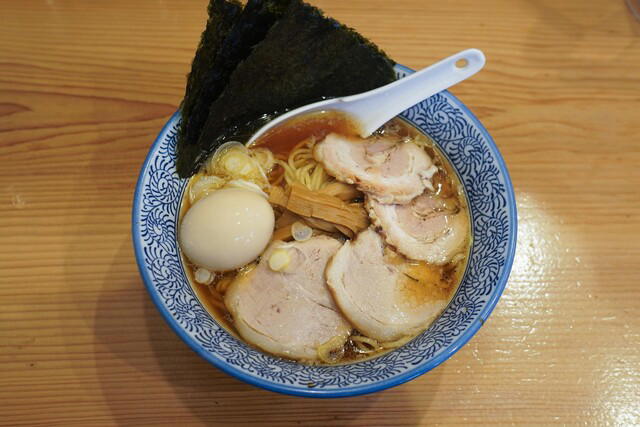
Approach the ramen shops of residential Yokohama and the ceremony starts before the bowl arrives. The room is small, the counter the stage, and the meal follows a disciplined pace: wait, sit, order, eat while the noodles are at their intended texture, then make room for the next diner. Chuka Soba Efu fits that ritual with unusual clarity. It is not for lingering, group dining, or long tasting-menu theatre. It belongs to the Japanese ramen counter tradition, where concentration is measured in minutes, not courses.
That matters in Yokohama, a city often flattened into two food clichés: Chinatown on one side, bayside destination dining on the other. The sharper local story sits in neighbourhood rooms across Kanagawa, where ramen houses compete on broth structure, noodle craft, turnover, and consistency. Chuka Soba Efu’s repeated selection for Tabelog 100 Ramen, including Kanagawa recognition in 2025 and 2024 and East Japan selections from 2021 to 2023, places it in that serious regional conversation, not a casual station-area lunch category.
An eight-seat ramen counter where pacing is part of the form
Ramen etiquette in Japan is functional, not decorative: it protects the bowl. Noodles keep changing once they hit hot soup, so counter rhythm matters. The compact seating, counter format, and no-reservations setup make the meal closer to a timed performance than a conventional restaurant booking. Diners treating ramen as a social pause may miss the point; those who understand the craft as a narrow window between service and texture will read the room correctly.
The house category is ramen and tsukemen, two related but different rituals. Soup ramen asks for immediacy: broth, noodles, aroma, and heat converging at once. Tsukemen separates noodles and dipping soup, stretching the act of eating and putting more emphasis on noodle structure. That dual identity matters because Kanagawa’s ramen scene has never been only about volume or late-night comfort. Its stronger shops often occupy a technical middle ground, where everyday pricing coexists with precise preferences around noodle thickness, soup density, and finishing pace.
Chuka Soba Efu’s stated emphasis on homemade whole-wheat noodles and dashi built with local chicken and seafood gives the counter a clear technical frame without turning the meal into chef biography. The broader reading is this: Yokohama and Kanagawa ramen are competitive enough that small shops can gain national attention through repeatable execution, not luxury signals. An eight-seat room earning repeated Tabelog 100 placement says more about discipline than scale.
Where it sits in Yokohama's everyday dining map
For travellers building a Yokohama food day, the choice is not only ramen versus fine dining; it is how much of the city’s ordinary appetite they want to see. Chuka Soba Efu belongs to the Yokohama that rewards station walks and short meals, opposite a destination dinner planned around wine pairings and waterfront views. It pairs better with a neighbourhood crawl than a formal evening itinerary.
Within EP Club’s Yokohama dining map, the contrast is useful. 1000 (Yakitori (Grilled chicken skewers)) points toward the city’s grilled-skewer tradition, while Aichun and Ajowan show casual local dining across Chinese and curry idioms. Alpenjiro Honten sits in a different comfort-food lane, and Anzen Shokudo broadens the view beyond Yokohama into the wider Japanese everyday table. Against that field, a ramen counter with repeated specialist recognition reads as a focused stop, not a general-purpose meal.
The comparison venues sharpen the point. Rakkyo & Star operates in a slightly higher casual price band, while TOTSZEN BAKER’S KITCHEN and Champs de Ble represent Yokohama’s bakery-and-café side rather than its noodle counters. Hi, How Are You shows how the city’s low-cost casual category is not one cuisine but a patchwork of small formats. Chuka Soba Efu sits apart because ramen compresses craft, speed, and price into one sitting. Economic accessibility is part of ramen’s cultural force, but recognition at this level depends on consistency over time.
How to plan the meal without fighting the format
The practical intelligence is simple: this is a small counter, not a flexible dining room. Reservations are unavailable, seating is limited, and the posted operating pattern is lunch-led, with service ending when stock runs out. Tuesday closure is part of the public schedule, and holiday notices are published on X, so same-day assumptions are a poor strategy. Payment is cash-oriented; credit cards, electronic money, and QR code payments are not accepted. The room is non-smoking, private rooms are not part of the setup, and there is no parking, making rail access the natural approach.
For visitors comparing Yokohama itineraries, give ramen its own slot rather than squeeze it between fixed appointments. Counter ramen punishes lateness and overplanning. Arrive with slack to wait, order decisively, and leave once finished. Families can make it work because school-age children are welcomed, but the format suits children who can handle a counter meal and quick pace. Solo diners, by contrast, are exactly in the grain of the room.
For broader planning, use Our full Yokohama restaurants guide to balance ramen with longer meals, and pair it with Our full Yokohama hotels guide if staying overnight. Drinking plans sit separately in Our full Yokohama bars guide, while Our full Yokohama wineries guide and Our full Yokohama experiences guide frame the city beyond lunch. Nearby and wider Japan comparisons also matter: -Grilled beef Sukiyaki- KAMAKURA TANUKIAN 鎌倉 たぬき庵 in Kamakura moves toward a slower beef format, 鮪と炭火焼き うお炭 秋葉原店 in Tokyo toward tuna and charcoal.cafe in Osaka toward café culture.know in Kumamoto toward regional dining, (Shoku) Vietnam in Kawasaki toward Vietnamese cooking, [Curry Senmon Ten] Maruyama Kyoju. in Sapporo toward specialist curry, Jōdo Saké Bar in Los Angeles toward sake-led dining, and Onigiri Time in Pasadena toward rice-ball minimalism. Read that spread correctly and Chuka Soba Efu becomes a precise Yokohama lesson: small format, strict rhythm, serious noodle culture.
Frequently asked questions
How do I find Chuka Soba Efu?
Chuka Soba Efu is located in Yokohama.
How much does it cost to eat at Chuka Soba Efu?
Pricing at Chuka Soba Efu is listed as JPY 1,000 - JPY 1,999.
What days is Chuka Soba Efu closed?
Hours at Chuka Soba Efu: Mon: 11:30 AM–3 PM; Tue: Closed; Wed: 11:30 AM–3 PM; Thu: 11:30 AM–3 PM; Fri: 11:30 AM–3 PM; Sat: 11:30 AM–3 PM; Sun: 11:30 AM–3 PM.
What has Chuka Soba Efu built its reputation on?
Chuka Soba Efu has earned repeated Tabelog recognition, including Tabelog 100 Kanagawa 2025, after earlier selections in the Tabelog Ramen EAST and KANAGAWA lists. The draw is a tight 8-seat counter in Yokohama serving ramen and tsukemen at lunch only, which keeps the operation focused.
Is Chuka Soba Efu allergy-friendly?
The restaurant is non-smoking and serves at a counter, but Those details are not published. For diners with specific allergies, the safest reference points are the address in Yokohama and the fact that it serves ramen and tsukemen, both of which commonly involve wheat and broth components. Check the venue's official channels for the latest details.
Is Chuka Soba Efu good for families?
Yes, the venue is marked family friendly, with children welcome from school age. The 8-seat counter format in Yokohama suits smaller groups, and the price range of JPY 1,000–1,999 keeps it in an accessible lunch bracket.
Cuisine Context
Nearby venues at a similar price tier for orientation.
| Venue | Cuisine | Price | Awards | Notes |
|---|---|---|---|---|
| Chuka Soba EfuThis venue (the venue you are viewing) | Japanese Ramen | $10–20 | Tabelog 100 #99 | Not listed |
| Hi, How Are You | Pakistani-style Japanese curry house | $10–20 | Tabelog 100 #92 | Kōhoku |
| Ramen Inoue | Ramen shop | Not listed | Tabelog 100 #66 | Tsurumi |
| Hoppy Sennin | Traditional Japanese Hoppy bar | $10–20 | Tabelog 100 #85 | Naka |
| Gumyoji Hekan | Ramen & Soba Izakaya | $1–10 | Tabelog 100 #44 | Minami |
| Kikuya Curry | Japanese & Sri Lankan-style Curry House | $10–20 | Tabelog 100 #79 | Naka |
Recognition history
Dated appearances from independent guides and award organizations, with the underlying list record or original source where available.
Tabelog 100 #99 · No. 99
Tabelog · Tabelog 100 - Ramen - KANAGAWA - 2025
Continue exploring
More in Yokohama
Restaurants in Yokohama
All restaurants in Yokohama →


Bars in Yokohama
Browse all →




Details
- Classic
- Cozy
- Solo
- Casual Hangout
- Standalone
- Street Scene
- A La Carte
- Counter Dining
Current opening hours
- Monday
- 11:30 AM–3 PM
- Tuesday
- Closed
- Wednesday
- 11:30 AM–3 PM
- Thursday
- 11:30 AM–3 PM
- Friday
- 11:30 AM–3 PM
- Saturday
- 11:30 AM–3 PM
- Sunday
- 11:30 AM–3 PM
Hours can change for holidays and private events. Hours as of .
A modest, neighborhood ramen counter atmosphere focused on a direct, no-frills lunch service.