Casamento's Restaurant

Casamento's Restaurant on Magazine Street is a New Orleans institution where the menu reads as a precise argument for Gulf Coast shellfish, served in a setting of white tile and ceiling fans that has barely shifted in decades. The kitchen keeps its focus narrow and deliberate: oysters raw, fried, or in a loaf, with a handful of accompaniments that exist to frame the main event rather than compete with it.
Pearl is the En Primeur Club membership app — saves, bookings, and concierge access live there. Same editors, same standards.
- Address
- 4330 Magazine St, New Orleans, LA 70115
- Phone
- +1 504 895 9761
- Website
- casamentosrestaurant.com
- Directions
- Get directions
 Saves & bookings on Pearl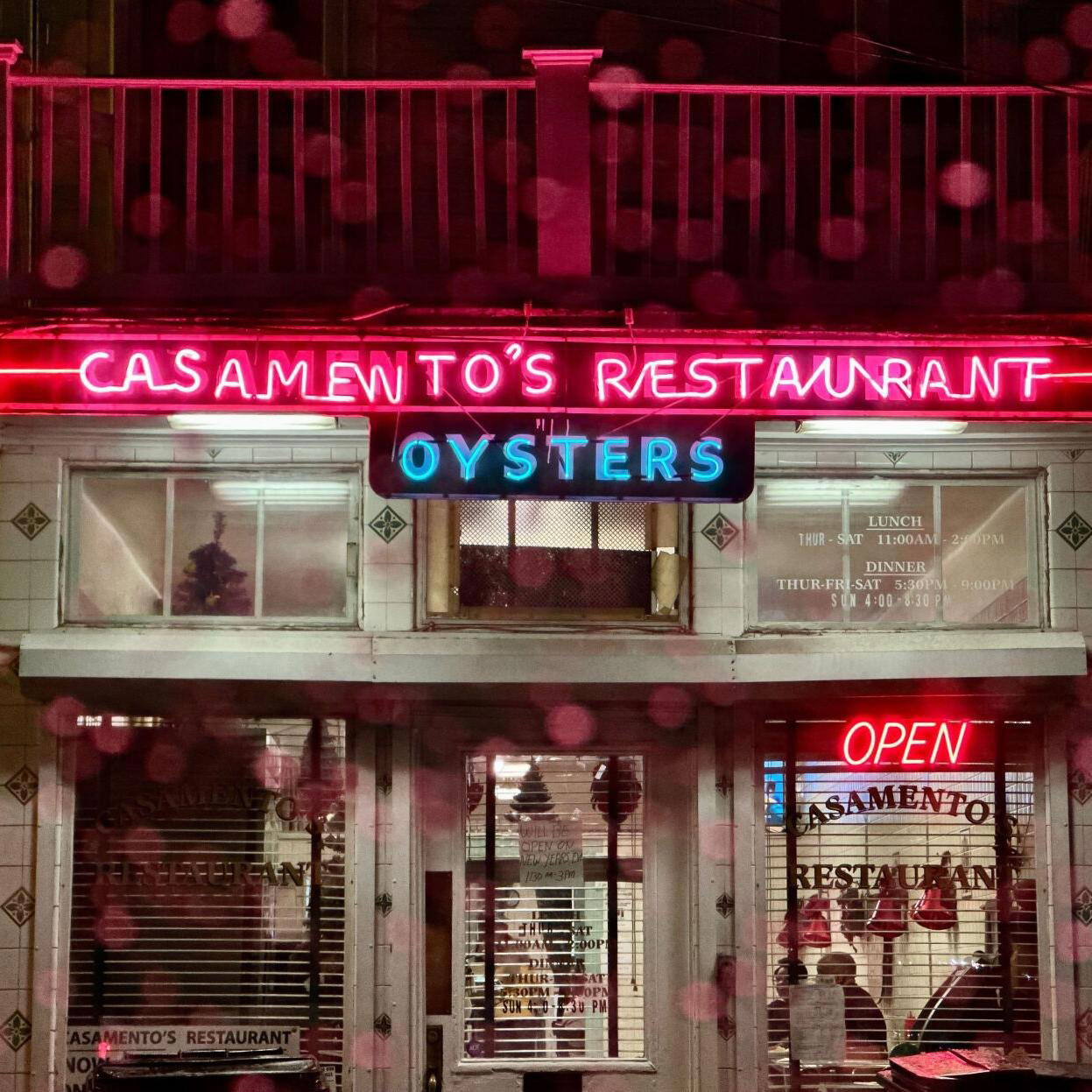
A Room That Makes Its Point Immediately
Magazine Street in Uptown New Orleans runs through one of the city's more residential stretches before it opens into clusters of corner businesses and low-slung storefronts. Casamento's Restaurant at 4330 Magazine sits inside that rhythm: a narrow facade, white tile that extends from the floor up the walls, and a dining room compact enough that conversations from neighbouring tables arrive uninvited. There is no design ambiguity here. The space communicates its purpose before a menu appears, and everything else is secondary.
That kind of physical legibility is increasingly rare in American dining. Restaurants in the upper tiers of cities like New York, San Francisco, and Chicago, Le Bernardin, Lazy Bear, Smyth, operate with layered design intent, rooms calibrated to signal ambition. Casamento's operates in the opposite register: no signal except the food itself. The tile is functional, easy to clean after a heavy service. The ceiling fans move warm air. The room is precisely what it needs to be.
What the Menu Actually Argues
The editorial logic of a menu reveals more about a kitchen's philosophy than any press release can. At Casamento's, the menu is built as a focused argument for the Gulf Coast oyster in its several honest forms, raw, fried, as a loaf, with supporting items that exist to give the main subject room rather than to accumulate into a broader statement. This is menu architecture by subtraction: the kitchen has decided what it does and held that position across decades.
That approach places Casamento's in a distinct tier within New Orleans dining. The city carries a deep seafood tradition running from Creole-influenced rooms like Commander's Palace through to the wood-fired Gulf fish at Emeril's and the contemporary formats at Saint-Germain and Re Santi e Leoni. Casamento's occupies none of those tiers. It sits in a smaller category: the specialist house that has identified a single ingredient and constructed an entire operation around serving it without distraction.
Elsewhere in American dining, this kind of disciplined narrowness tends to appear at the highest price points, at The French Laundry in Napa or Providence in Los Angeles, where a narrow focus signals luxury and control. At Casamento's, the narrowness signals something different: a resistance to the kind of menu sprawl that often accompanies expansion, attention to press cycles, or pressure to diversify revenue. The kitchen is not chasing anything.
The Oyster Loaf as Local Form
New Orleans has its own canon of regional dishes that don't travel well in description, things that require the specific intersection of local ingredients, local technique, and local eating culture to make full sense. The oyster loaf belongs to that canon. In its most direct form, it is fried Gulf oysters served inside hollowed-out bread, dressed simply, the bread absorbing the oil and the brine from the shellfish as you eat. It is a construction that rewards speed and informality, and it reads poorly as a refined plated dish because it was never designed to be one.
Casamento's treatment of this format is consistent with its broader menu logic: no elaboration, no recontextualisation into a finer-dining register, no hedging toward a more nationally legible style. The loaf is what it is. This places the restaurant in useful contrast with the direction that Gulf Coast seafood has taken at more design-led New Orleans addresses like Zasu or the broader New American frame of Bayona, where regional ingredients are absorbed into a more contemporary structural vocabulary. Neither approach is wrong, they serve different purposes and different readers. But the distinction matters for calibrating expectations.
New Orleans Seafood as a Competitive Category
Gulf Coast seafood occupies a specific and largely non-transferable position in American regional cooking. The shrimp, oysters, and crabs that define the New Orleans table are drawn from a shallow, brackish ecosystem that produces shellfish with a flavour profile distinct from the Pacific Northwest or the New England coast. That specificity is the resource Casamento's is drawing on, and the reason why the narrowness of the menu reads as a strength rather than a limitation. When the ingredient is this place-specific, the kitchen's job is not to transform it but to present it at the point of maximum integrity.
In the broader American fine-dining conversation, this philosophy has parallels at farm-anchored operations like Blue Hill at Stone Barns in Tarrytown or Single Thread Farm in Healdsburg, where the sourcing argument structures everything else. At Casamento's, the argument is simpler and more compressed: the Gulf is close, the oysters are good, the kitchen's job is not to get in the way. It is a position that requires confidence to hold across decades of dining trend cycles, and the room at 4330 Magazine Street appears to have held it.
Where It Sits in the New Orleans Dining Map
Casamento's functions as a counterweight to the more formally structured dining rooms in the French Quarter and Central Business District. Uptown's Magazine Street corridor supports a more neighbourhood-oriented dining culture, lower ceilings, faster turnover, a local clientele that returns by habit rather than occasion. Casamento's fits that pattern precisely. It is not a destination restaurant in the sense that Atomix in New York or Addison in San Diego are destination restaurants, properties built for pilgrimage from outside the city. It is a neighbourhood specialist that has accumulated a wider reputation without adjusting its operating model to accommodate that reputation.
Casamento's current hours are limited, so check before visiting. The address at 4330 Magazine St puts it solidly in the Uptown corridor. Its walk-in-friendly policy and current operating days should be confirmed before visiting.
Recognition Snapshot
Comparable venues nearby, for context on price, style, and recognition.
| Venue | Cuisine | Price | Notes |
|---|---|---|---|
| Casamento's RestaurantThis venue — the venue you are viewing | New Orleans Seafood Oyster Bar | $$ | Not listed |
| Grand Isle Restaurant | Louisiana Seafood & Cajun | $$ | Central Business District |
| Deanie's Sea Food Kitchen | New Orleans Seafood | $$ | Lower Garden District |
| Bourbon House | New Orleans Seafood and Oyster Bar | $$$ | Central Business District |
| Central City BBQ | New Orleans-Style Wood-Smoked BBQ | $$ | Central Business District |
| Rosie's On The Roof | American Small Plates & Bar Bites | $$ | Arts District |
Recognition history
Dated appearances from independent guides and award organizations, with the underlying list record or original source where available.
Diners, Drive-Ins and Dives Featured Restaurant
Diners, Drive-Ins and Dives · 2026 Diners, Drive-Ins and Dives Featured Restaurants
Continue exploring
More in New Orleans
Restaurants in New Orleans
Browse all →
Bars in New Orleans
Browse all →

At a Glance
- Classic
- Well Known
- Cozy
- Casual Hangout
- Historic Building
- Local Sourcing
Current opening hours
- Monday
- Closed
- Tuesday
- Closed
- Wednesday
- Closed
- Thursday
- 11 AM–2 PM, 5:30–8:45 PM
- Friday
- 11 AM–2 PM, 5:30–8:45 PM
- Saturday
- 11 AM–2 PM, 5:30–8:45 PM
- Sunday
- 4:30–8:15 PM
Hours can change for holidays and private events. Last verified .
Retro tiled interior with old-school charm and spotless, timeless design.