Cap't Loui
Cap't Loui occupies a slip of West 32nd Street in Koreatown, a block that moves fast and eats faster. The menu architecture here rewards closer reading than the address might suggest, sitting in a New York dining tier where the surrounding neighbourhood context shapes the offer as much as any kitchen philosophy does. Worth understanding before you book.
Pearl is the En Primeur Club membership app — saves, bookings, and concierge access live there. Same editors, same standards.
- Address
- 34 W 32nd St, New York, NY 10001
- Phone
- +12123818354
- Website
- captloui.com
- Directions
- Get directions
 Saves & bookings on Pearl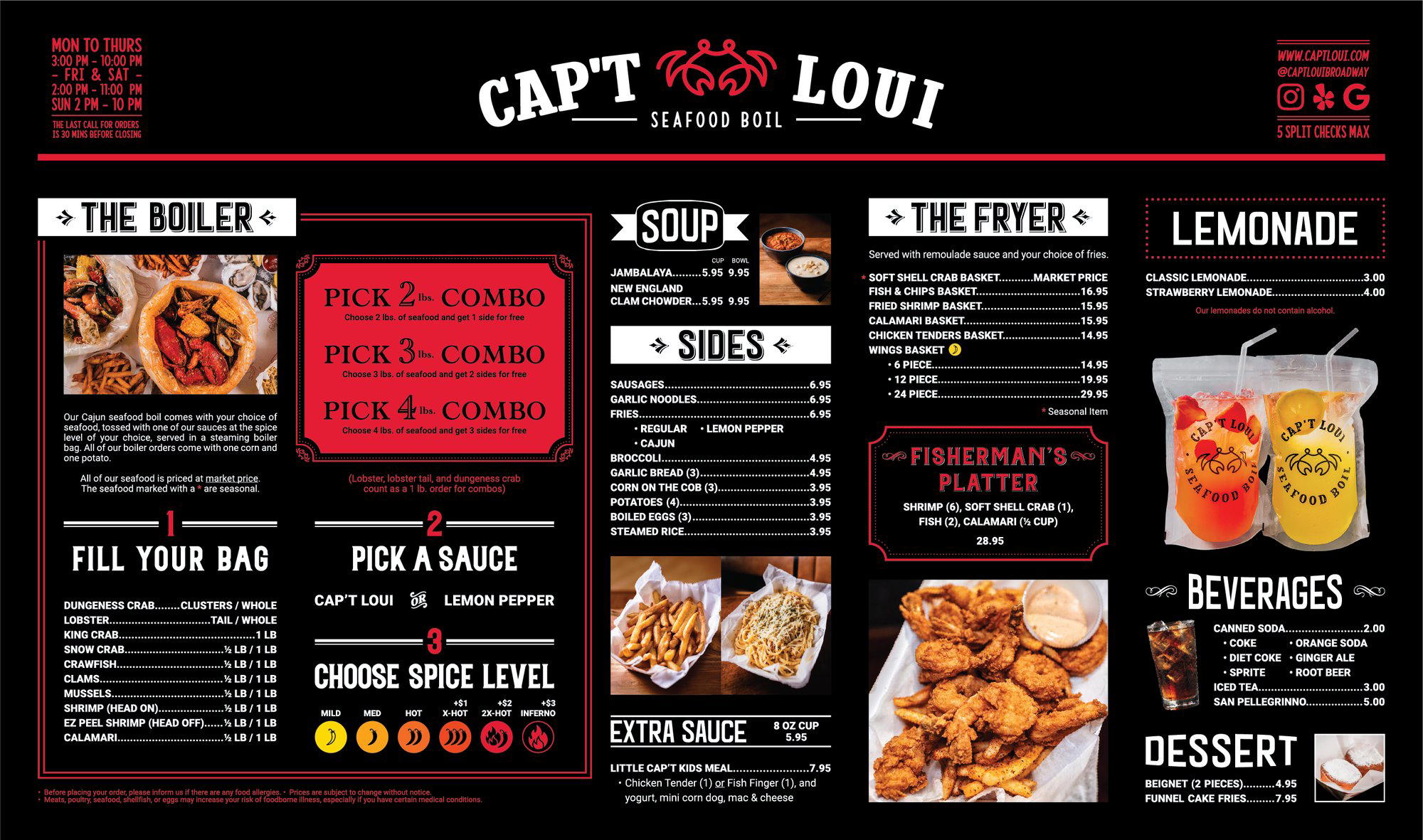
32nd Street and the Logic of What's on the Menu
West 32nd Street in Manhattan runs a tight gauntlet between Herald Square and Fifth Avenue, anchored on both sides by Korean restaurants, barbecue halls, and late-night spots that keep going long after the rest of Midtown has locked up. It is one of the few blocks in New York where the dining clock operates on a different schedule from the neighbourhood around it, and where the menu conventions of a specific regional tradition compete with the pressure to feed a mixed, transient crowd. Cap't Loui sits at number 34, inside that particular tension. Cap't Loui is a Cajun Seafood Boil restaurant in Manhattan, with a casual dress code, walk-in friendly service, and an average price of about $25 per person.
In cities like New York, address does a lot of editorial work before a dish arrives. The $$$$ tasting counters of the Upper West Side or the Flatiron district, places like Le Bernardin, Atomix, or Per Se, operate on reservation lead times measured in months and price points that signal their comparable set immediately. Koreatown operates differently. The density here produces its own hierarchy, one where menu structure, format, and the logic of what appears alongside what tells you more about a restaurant's actual ambition than the neighbourhood's general reputation does.
Reading the Menu as an Argument
A menu structured around shareable plates signals one set of priorities. A single prix-fixe path signals another. A hybrid format, where a core structure accommodates both solo diners and groups, signals a third, and it's one common format in high-turnover Midtown corridors, because it trades some editorial clarity for operational flexibility.
Cap't Loui's address in the 32nd Street corridor places it in a neighbourhood where that operational flexibility is not a compromise but a baseline condition. The restaurants that last on this block tend to be those whose menu architecture is coherent enough to hold a point of view while remaining readable to someone arriving without a reservation and without a preconception. That's a harder design problem than it looks. Across the United States, restaurants in analogous high-density corridors, from the French Quarter blocks around Emeril's in New Orleans to the Gaslamp Quarter near Addison in San Diego, solve it with varying degrees of success.
Where Cap't Loui Sits in the New York Tier System
New York's restaurant tier system is unusually legible once you understand that price bracket, booking friction, and menu format each carry independent signals. A restaurant can be expensive without being hard to book. It can be hard to book without being decorated. And it can carry a coherent culinary identity without either. Stronger examples from the New York dining pyramid, Masa, Eleven Madison Park, competes on all three axes simultaneously. The broader mid-tier, which includes most of what operates in Koreatown's immediate orbit, competes primarily on value coherence: does the menu make sense at its price point, and does the experience justify the format?
With an average price of about $25 per person and a Cajun Seafood Boil format, the restaurant sits in the value-driven end of West 32nd Street, where speed, volume, and clarity of service matter as much as menu breadth. That is not a diminishment. Particularly technically interesting food in American cities exists in exactly this format tier, where the absence of Michelin overhead and tasting-menu prices forces a different kind of discipline onto the kitchen.
For comparison, the farm-to-table precision of Blue Hill at Stone Barns in Tarrytown or the controlled ingredient sourcing at Single Thread Farm in Healdsburg represent one pole of American dining ambition. The dense urban corridor format represents another, and it has its own internal standards worth taking seriously.
The Koreatown Context
Manhattan's Koreatown is one of the smallest Koreatowns by geographic footprint of any major American city, compressed almost entirely onto a single block. That compression produces a dining environment with almost no redundancy tolerance: restaurants that can't differentiate themselves clearly don't survive the lease cycle. The result, counterintuitively, is a strip where menu identity and format clarity matter more than they might in a larger, more sprawling ethnic dining district.
This is the same dynamic that operates in other high-density urban dining corridors across the country. The precision cooking at Smyth in Chicago, or the sourcing-driven menu logic at Lazy Bear in San Francisco, emerged from markets that reward clarity of identity. Koreatown's pressure is different in character but similar in effect: the restaurants that hold an audience tend to be those with a legible, repeatable format that gives diners a reason to return rather than simply try once.
The restaurant's position at 34 W 32nd Street puts it in the centre of that pressure. What the address alone confirms is that the competitive environment is serious, and that the restaurants surviving on this block are doing something right in operational terms.
Planning Your Visit
The restaurant is located at 34 W 32nd Street in Manhattan, walkable from the 34th Street-Herald Square subway stop on the B, D, F, M, N, Q, and R lines. The 32nd Street corridor runs at high volume through lunch and dinner, with the block tending to peak in the evening hours when the Koreatown restaurant cluster draws both neighbourhood regulars and visitors from across the city. Current hours are Monday through Thursday and Sunday from 11:30 AM to 12 AM, Friday and Saturday from 11:30 AM to 2 AM, and the restaurant is walk-in friendly.
For readers planning around a wider dining trip, the city's fine dining anchors at Le Bernardin and Atomix require substantially longer lead times and higher price commitments. The 32nd Street corridor, by contrast, tends to offer more flexible access, which makes it a practical option for diners who want to eat well in Midtown without the planning infrastructure that the upper-tier tasting menus require. Beyond New York, the editorial context extends to destination restaurants like The French Laundry in Napa, Providence in Los Angeles, Frasca Food and Wine in Boulder, The Inn at Little Washington, and internationally to Atelier Moessmer Norbert Niederkofler in Brunico and Dal Pescatore in Runate, each representing a different answer to the question of what menu architecture and format discipline can achieve at the upper end of the dining spectrum.
Cuisine and Credentials
Comparable venues nearby, for context on price, style, and recognition.
| Venue | Cuisine | Price | Notes |
|---|---|---|---|
| Cap't LouiThis venue — the venue you are viewing | Cajun Seafood Boil | $$ | Not listed |
| Randazzo's Clam Bar | Classic Italian-American Seafood | $$ | Sheepshead Bay-Manhattan Beach-Gerritsen Beach |
| The Yacht Club | Seafood-Focused Coastal American | $$$ | Chelsea-Hudson Yards |
| Seamore's | Sustainable Seafood | $$ | Downtown Brooklyn-DUMBO-Boerum Hill |
| Skips Fish and Chicken | Fish and Chicken | $ | Brownsville |
| Amo | Neapolitan Seafood | $$$ | Greenwich Village |
Continue exploring
More in New York City
Restaurants in New York City
Browse all →
Bars in New York City
Browse all →


Hotels in New York City
Browse all →
Wineries in New York City
Browse all →


At a Glance
- Lively
- Energetic
- Group Dining
- Casual Hangout
Current opening hours
- Monday
- 11:30 AM–12 AM
- Tuesday
- 11:30 AM–12 AM
- Wednesday
- 11:30 AM–12 AM
- Thursday
- 11:30 AM–12 AM
- Friday
- 11:30 AM–2 AM
- Saturday
- 11:30 AM–2 AM
- Sunday
- 11:30 AM–12 AM
Hours can change for holidays and private events. Last verified .
Lively and bustling atmosphere that gets crowded quickly during peak hours with a casual, energetic feel.