
CAN CUN is a Sapporo soup curry specialist with Tabelog 100 Curry EAST 2024 recognition and a compact 25-seat format. It sits in the city’s everyday curry bracket rather than the luxury dining tier, with approachable pricing, counter seating, take-out, English menu support, and a reputation that travels beyond its immediate Bus Center Mae neighbourhood.
Pearl is the En Primeur Club membership app — saves, bookings, and concierge access live there. Same editors, same standards.
- Address
- Japan, 〒060-0052 Hokkaido, Sapporo, Chuo Ward, Minami 2 Johigashi, 6 Chome−5 1F
- Phone
- +81 11-261-7099
- Website
- hotpepper.jp
 Saves & bookings on Pearl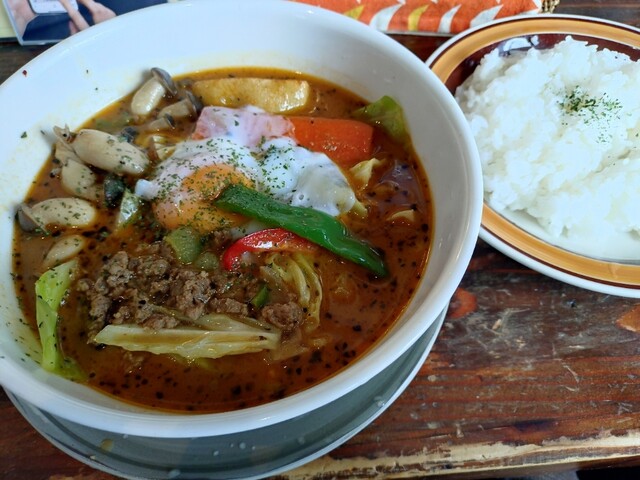
Approaching Sapporo’s east-side curry rooms, the cue is rarely ceremony. The signal is smaller: a short queue, a counter seat turning over, the smell of spice moving faster than the snow outside. Soup curry is one of Sapporo’s defining urban food forms, not a polished export category but a local habit built around broth, heat, vegetables, and the kind of casual precision that rewards repeat eating. CAN CUN belongs to that practical tradition, and its Tabelog 100 Curry EAST 2024 selection places it inside a national conversation about regional curry rather than a tourist-only checklist.
Sapporo’s curry culture has always sat apart from the thicker Japanese curry-rice mainstream. Soup curry is looser, more modular, and more personal: diners read spice levels, toppings, broth style, and rice portions as decisions rather than decoration. That makes critical recognition more useful here than in many casual categories, because the difference between a merely busy curry shop and a serious one often lies in consistency over hundreds of daily bowls. Tabelog’s Curry EAST list functions as a reputation filter across eastern Japan; inclusion matters because it compares shops that operate at similar price points, not only restaurants with formal tasting-menu infrastructure.
Soup curry in Sapporo is judged by rhythm, not ceremony
The city’s stronger curry addresses tend to work within narrow margins: fast service, compact rooms, repeatable spice structures, and enough personality to avoid becoming interchangeable. CAN CUN’s 25-seat scale fits that model. Counter seating points to a meal built for solo diners as much as pairs, while the family-friendly listing and kids-menu note show how soup curry in Sapporo crosses age and occasion in a way that higher-form Japanese dining rarely does.
That breadth is part of the category’s appeal. A sushi counter such as Kin Zushi operates in a different economic universe, with prices that move the meal into occasion dining. Soup Curry Garaku and Hige Danshaku sit closer to the curry lane, while Hot Spice Shop Hood Dog signals the same approachable bracket from another angle. CAN CUN’s recognition within that field is not about luxury. It is about how a low-friction, everyday format earns enough critical traction to be selected among curry specialists across the region.
The neighbourhood context also matters. Bus Center Mae sits close enough to central Sapporo for visitors, but it does not have the same concentrated dining theatre as Susukino. Curry shops in this part of the city depend less on late-night spectacle and more on daytime and early-evening usefulness. That makes the award signal more persuasive: reputation has to travel through repeat custom, local recommendation, and category credibility rather than through a dramatic room or a famous chef narrative.
The award signal places a casual room in a serious curry set
Japan’s dining awards can sometimes blur categories, but curry lists are helpful because they keep the comparison tight. A Tabelog 100 Curry EAST 2024 selection says the restaurant is being read against curry peers, not against kaiseki counters, ramen institutions, or hotel dining rooms. The restaurant’s Tabelog score of 3.60 reinforces that positioning: respected, category-specific, and grounded in a high-volume public review culture rather than a small panel of luxury inspectors.
For Sapporo visitors building a food itinerary, this is the smarter way to use recognition. A city trip should not treat every meal as a splurge. The better rhythm is contrast: a soup curry lunch, a ramen stop, a seafood or sushi dinner, then drinks if the night allows. In that sequence, the restaurant gives the curry slot a credible anchor without forcing the day around a formal reservation. For a wider map of the city, Our full Sapporo restaurants guide is the useful starting point, with separate planning lenses in Our full Sapporo hotels guide, Our full Sapporo bars guide, Our full Sapporo wineries guide, and Our full Sapporo experiences guide.
Curry also reads well beside Sapporo’s other casual specialists. 175°DENO Tantanmen Sapporo kitaguchi ten covers the chilli-and-sesame noodle lane, while [Curry Senmon Ten] Maruyama Kyoju., Ajanta Indo Curry Ten, and Ajanta Sohonke show how many curry dialects the city can sustain. Aigues Vives belongs to a different bakery-led appetite, but it fits the same Sapporo habit of treating specialist shops as destinations in their own right.
Who should put it on a Sapporo food route
The strongest case for the restaurant is for travellers who want Sapporo specificity without turning every meal into a production. The room’s format suits solo dining, small groups, and families, and the availability of take-out and an English menu lowers the friction for visitors who may be fitting curry between market walks, museums, or a train departure. Payment flexibility also aligns with how many contemporary Japanese casual restaurants now serve both local regulars and international diners.
The better editorial read is not that this is a grand occasion restaurant. It is a category specialist with enough recognition to justify choosing it over an anonymous curry stop nearby. That distinction matters in Sapporo, where the city’s food identity is built as much from bowls and counters as from formal dining rooms. For travellers continuing through Japan or comparing casual specialist formats elsewhere, the same logic applies to venues as varied as -Grilled beef Sukiyaki- KAMAKURA TANUKIAN 鎌倉 たぬき庵 in Kamakura. 鮪と炭火焼き うお炭 秋葉原店 in Tokyo.cafe in Osaka.know in Kumamoto, (Shoku) Vietnam in Kawasaki, [ki:] in Kyoto, Jōdo Saké Bar in Los Angeles, and Onigiri Time in Pasadena: narrow focus, clear format, and a reason to exist beyond convenience.
In a city where soup curry can be both lunch and local marker, the restaurant is a credible pick because the praise matches the format. It does not need ceremony to make its point. The point is Sapporo curry as an everyday craft, sharpened enough to earn notice beyond the neighbourhood.
- Seafood & Vegetable Soup Curry
- Torori Egg & Cheese with Thick-cut Bacon Soup Curry
- Spicy Lamb Keema Vegetable Curry
- Pork & Vegetable Soup Curry
- Garam Masala Fried Chicken Wings
- Curry Zangi Fried Chicken
Cost Snapshot
Comparable venues by category and price.
| Venue | Cuisine | Price |
|---|---|---|
| CAN CUNThis venue — the venue you are viewing | Not listed | $$ |
| sapporo soup curry dip | Kita, Sapporo Soup Curry | $$ |
| Magic Spice Sapporo honten | Shiroishi, Sapporo soup curry | $$ |
| Rakkyo | Nishi, Sapporo Soup Curry | $$ |
| Picante | Kita, Sapporo soup curry | $$ |
| Yoshoku Konoyoshi Kiyotaku kitano ten | Kiyota, Japanese Yoshoku | $$ |
Recognition history
Dated appearances from independent guides and award organizations, with the underlying list record or original source where available.
Tabelog 100 #55 · No. 55
Tabelog · Tabelog 100 - Curry - EAST - 2024




At a Glance
- Cozy
- Lively
- Trendy
- Intimate
- Solo
- Family
- Group Dining
- Casual Hangout
- Date Night
- After Work
- Standalone
- Design Destination
- Beer Program
Current opening hours
- Monday
- 11:30 AM–2:45 PM
- Tuesday
- 11:30 AM–2:45 PM, 5:30–7:45 PM
- Wednesday
- 11:30 AM–2:45 PM, 5:30–7:45 PM
- Thursday
- 11:30 AM–2:45 PM, 5:30–7:45 PM
- Friday
- 11:30 AM–2:45 PM, 5:30–7:45 PM
- Saturday
- 11:30 AM–2:45 PM, 5:30–7:45 PM
- Sunday
- 11:30 AM–2:45 PM, 5:30–7:45 PM
Hours can change for holidays and private events. Last verified .
Casual and cozy soup curry bar with an exotic Mexican resort theme, colorful walls and illustrations, relaxed seating for solo diners and small groups, and a generally lively but comfortable atmosphere.