
Our verdict
One of Florence's most storied trattorias, Buca Lapi has occupied a vaulted cellar beneath Palazzo Antinori since 1880, making it among the oldest continuously operating restaurants in the city. Ranked in Opinionated About Dining's Casual Europe list three consecutive years (including #54 in 2024), it anchors the traditional end of Florentine dining with a kitchen rooted in Tuscan inheritance rather than contemporary reinvention.

Pearl is the En Primeur Club membership app, where members save venues, book tables and use the concierge.
The menu
What to order
- Bistecca alla Fiorentina
- Pappardelle al Cinghiale
- Cannelloni Gratinati alla Buca Lapi
- Ribollita
A Cellar Older Than the Republic
Florence's dining scene fractures cleanly between two poles: the Michelin-chasing contemporary kitchens Osteria Francescana in Modena set that aspirational template, and locally, Enoteca Pinchiorri holds the three-star standard, and, on the other side, a smaller, quieter category of trattorias that have been feeding the city in essentially the same register for generations. Buca Lapi belongs to the second group, and it does so without apology. The restaurant has operated in the vaulted cellar beneath Palazzo Antinori, on Via del Trebbio, since 1880. That address alone frames almost everything: you are eating in a medieval wine cellar, under one of Florence's most significant Renaissance palaces, in a room that predates the Italian state in its current form.
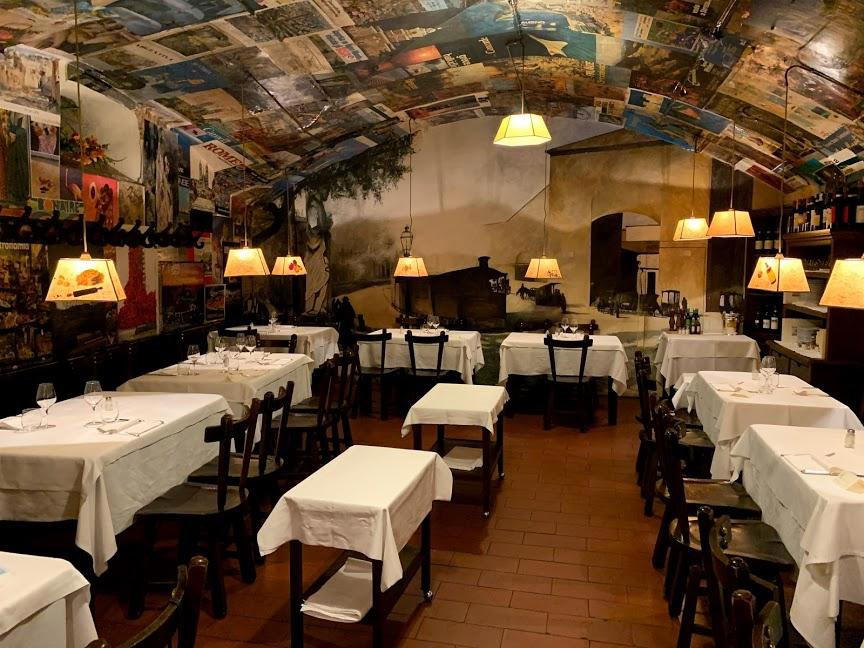
The physical approach matters here. You descend from street level into low, frescoed ceilings, walls covered in vintage travel posters and maps accumulated across more than a century, and a room that communicates continuity before a single dish arrives. This is not a calculated atmosphere, assembled for effect. It is the residue of real time. In a city where hospitality operators regularly invoke tradition while serving food that has little connection to it, that distinction carries weight.
What Generational Kitchens Actually Look Like
The concept of a kitchen passed between generations sounds romantic until you consider what it demands in practice: consistency across decades, restraint in the face of trend cycles, and a willingness to serve dishes that no longer photograph well for social media. Florentine trattoria cooking, bistecca alla Fiorentina carved tableside, ribollita ladled from wide bowls, pappardelle under wild boar ragu, is not a cuisine of visual theatre. It is a cuisine of calibration, where the margin between correct and overcooked is measured in minutes, and where the sourcing of the base ingredient determines almost everything.
At this end of the Florence trattoria tier, the kitchen functions less as a site of authorial expression and more as a custodian of a canon. The comparison venues in the premium bracket, Santa Elisabetta, Borgo San Jacopo, Gucci Osteria da Massimo Bottura, operate with chef-driven menus where individual creative identity is the selling point. Buca Lapi operates in a different mode entirely, one closer to Cammillo, Alla Vecchia Bettola, or Da Ruggero in its commitment to the received repertoire.
This is a meaningful distinction for anyone building an itinerary around Florence's dining. The city's fine-dining tier, from Enoteca Pinchiorri downward, is covered extensively elsewhere. The trattoria tier is harder to read from the outside, because the differences between a room coasting on historical reputation and one genuinely maintaining craft are not visible from a facade or a menu. That is where external recognition becomes useful.
Three Consecutive Years on Opinionated About Dining
Buca Lapi has appeared on the Opinionated About Dining Casual Europe list for three consecutive years: ranked #90 in 2023, climbing to #54 in 2024, and listed at #76 in 2025. OAD's methodology relies on votes from food professionals and experienced diners rather than anonymous inspection, which makes it a different signal than Michelin. For traditional trattorias specifically, OAD recognition often carries more information than a Michelin Bib Gourmand: it indicates that informed, regular visitors are returning and recommending, which for a restaurant in this price and format tier is a more demanding test than a single inspector visit.
The trajectory from #90 to #54 between 2023 and 2024 suggests a kitchen that improved or received broader recognition during that window, not one resting on legacy alone. The slight retreat to #76 in 2025 places it comfortably within the leading hundred casual restaurants across all of Europe in that assessment. For context, that ranking sits it alongside trattorias and bistros operating in the same traditional-register across France, Spain, and the broader Italian peninsula. Within Florence's casual dining category specifically, that consistency of recognition over three years is a substantive data point.
High-volume tourist restaurants in Florence's centre often accumulate ratings through foot traffic rather than repeat visits; a 4.5 across nearly a thousand responses at a destination-specific address like Via del Trebbio suggests a different pattern.
Positioning and Peer Context
Placing Buca Lapi correctly within Florence's restaurant ecosystem matters for making the right choice. It is not the city's most experimental kitchen: Cibrèo Trattoria and Club Culinario Toscano da Osvaldo occupy adjacent positions with slightly different editorial identities. It is not competing with the city's contemporary fine-dining tier, where restaurants like those referenced above, or comparable national benchmarks including Le Calandre in Rubano, Piazza Duomo in Alba, Enrico Bartolini in Milan, or Atelier Moessmer Norbert Niederkofler in Brunico, operate in a different mode and at a different price point.
What Buca Lapi offers is more specific: a direct line to the traditional Florentine kitchen, in a physical setting that no amount of interior design budget can replicate, with OAD-verified consistency over a three-year run. For visitors who would otherwise spend an evening at a technically proficient but generically contemporary Italian restaurant, this represents a meaningfully different option. The equivalent calculation applies to someone choosing between a neighbourhood bistro and a three-star in Paris, or between a classic kaiseki room and a contemporary omakase in Tokyo: the category difference matters as much as the quality signal.
For those building a broader Italy itinerary around traditional kitchens, the lineage of Florentine trattoria cooking connects directly to what Dal Pescatore in Runate represents in Lombardy: a kitchen where the generational transfer of a regional recipe tradition is the entire project.
Planning Your Visit
Buca Lapi opens for dinner Tuesday through Saturday from 7 to 11 pm, with Monday service also running on the same evening-only schedule. The kitchen is closed on Sundays. The evening-only format is consistent with how the serious end of the Florentine trattoria tier operates: lunch is frequently a more abbreviated, tourist-facing service, while dinner attracts the considered booking. Via del Trebbio sits immediately off Via della Vigna Nuova, a short walk from the Arno and within easy reach of both the Duomo and the Oltrarno. Advance reservations are advisable, particularly for weekends and during peak travel periods in spring and autumn. For anyone structuring a full Florence visit across dining, accommodation, and cultural programming, EP Club's complete resources cover the broader picture: see our full Florence restaurants guide, our full Florence hotels guide, our full Florence bars guide, our full Florence wineries guide, and our full Florence experiences guide.
Frequently asked questions
Who's behind the kitchen at Buca Lapi?
The chef associated with Buca Lapi is Various.
Accolades, Compared
| Venue | Cuisine | Price | Awards | Notes |
|---|---|---|---|---|
| Buca LapiThis venue (the venue you are viewing) | Traditional Tuscan Trattoria | $50–100 | Not listed | Not listed |
| Enoteca Pinchiorri | Contemporary Italian Fine Dining | $200–300 | 3 Michelin Stars · World's 50 Best #32 | Italian - French, Italian Contemporary |
| Santa Elisabetta | Modern Italian Fine Dining with Seafood Focus | $200–300 | 2 Michelin Stars · La Liste Top Restaurants | Italian, Creative |
| Borgo San Jacopo | Michelin-starred Modern Tuscan & Italian Fine Dining | $150–200 | 1 Michelin Star · Falstaff Restaurant - 94 Falstaff Points | Italian, Modern Cuisine |
| Gucci Osteria da Massimo Bottura | Contemporary Italian with Japanese and Mexican Influences | $200–300 | 1 Michelin Star · Wine Spectator Best of Award of Excellence | Modern Italian, Italian Contemporary |
| Il Palagio | Modern Tuscan Fine Dining | $100–150 | 1 Michelin Star · Star Wine List | Italian Contemporary |
Recognition history
Dated appearances from independent guides and award organizations, with the underlying list record or original source where available.
Opinionated About Dining Casual in Europe Ranked #107
Opinionated About Dining
Full recognition history (4 entries)
Opinionated About Dining Casual in Europe Ranked #76
Opinionated About Dining
Opinionated About Dining Casual in Europe Ranked #54
Opinionated About Dining
Opinionated About Dining Casual in Europe Ranked #90
Opinionated About Dining
Continue exploring
More in Florence
Restaurants in Florence
All restaurants in Florence →
Bars in Florence
All bars in Florence →
Hotels in Florence
All hotels in Florence →

Details
- Classic
- Rustic
- Well Known
- Intimate
- Date Night
- Special Occasion
- Celebration
- Wine Cellar
- Open Kitchen
- Historic Building
- Extensive Wine List
- Local Sourcing
- A La Carte
- Wine
- Gluten Free Options
Current opening hours
- Monday
- 7–11 PM
- Tuesday
- 7–11 PM
- Wednesday
- 7–11 PM
- Thursday
- 7–11 PM
- Friday
- 7–11 PM
- Saturday
- 7–11 PM
- Sunday
- Closed
Hours can change for holidays and private events. Hours as of .
Subterranean Renaissance wine cellar with vaulted ceilings carpeted in vintage travel posters, open kitchen visible upon entry, warm candlelit atmosphere with refined yet casual charm.