Boyoma Falls
Boyoma Falls, on the Congo River in Tshopo province, is one of central Africa's most significant natural landmarks: a series of seven cataracts stretching across roughly 100 kilometres of river. The surrounding region draws those interested in the ecology and food culture of the Congo Basin, where the river itself has long defined what communities eat and how they eat it.
 Discover on Pearl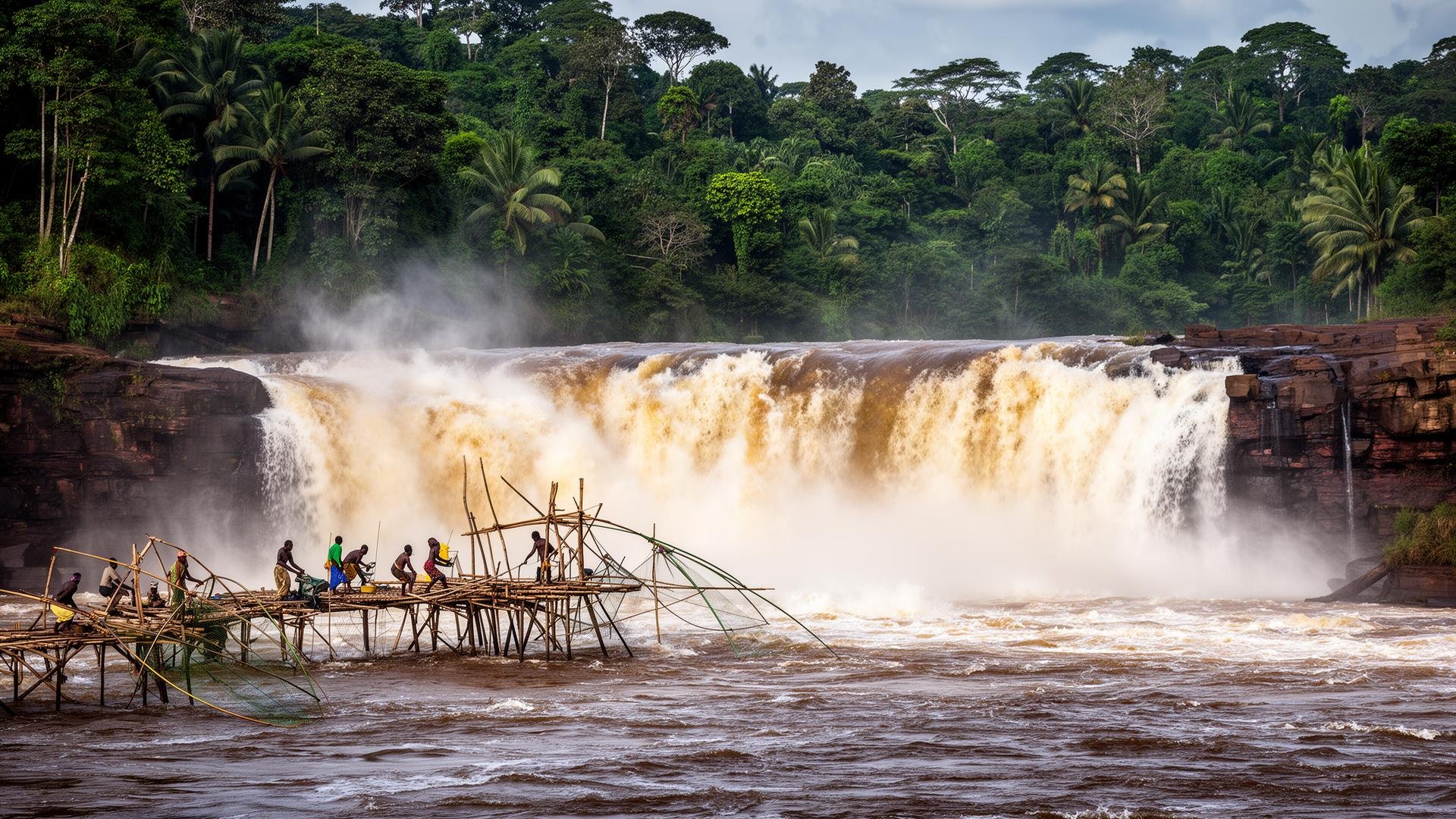
Where the River Sets the Table
The Congo River does not merely pass through Tshopo — it organises life there. At Boyoma Falls, a sequence of seven cataracts spread across roughly 100 kilometres of the upper Congo near Kisangani, the river transitions from navigable waterway to something more elemental: a physical boundary, a fishing ground, and the primary source of protein for communities that have worked these waters for generations. Visitors who arrive expecting a conventional dining or hospitality destination will need to recalibrate. What Boyoma Falls offers instead is a direct encounter with one of central Africa's most consequential food geographies.
The falls themselves — known historically as Stanley Falls , mark the point where the Congo River descends through a series of drops that make upstream navigation impossible by boat. That geographical fact has shaped the regional food economy for centuries. Communities on both banks developed fishing traditions calibrated to fast-moving, oxygen-rich water, landing species that do not appear in slower stretches of the river downstream. The ingredient story here begins with the river and radiates outward.
The shortlist, unlocked.
Hard-to-book tables, cellar releases, and concierge-planned trips.
Get Exclusive Access →The Ecology of the Congo Basin Table
Central African river fishing operates on a logic quite different from coastal or lacustrine traditions. The Congo Basin holds one of the highest concentrations of endemic freshwater fish species on earth , estimates from ichthyological research put the number of species in the broader basin at over 700, many found nowhere else. At a cataract system like Boyoma, where oxygenation is high and water temperatures relatively stable, specific species congregate and are targeted with precision gear: basket traps, woven from local materials and positioned to exploit current patterns, have been in use here in some form for centuries.
This is ingredient sourcing in its most direct form. There are no cold chains, no distribution networks in the European or North American sense. Fish caught at the falls reach local preparation within hours. The result is a freshness standard that high-investment restaurant programmes in cities from New York to Osaka work hard to approximate: Le Bernardin in New York City, for instance, has built its international reputation partly on the rigour of its fish sourcing and handling. At Boyoma, that rigour is simply the local condition rather than a considered programme.
Regional Context: Tshopo's Food Culture
Tshopo province sits in the northeast of the Democratic Republic of Congo, with Kisangani as its administrative centre. The city is the largest in the eastern Congo and the furthest navigable point on the river from the Atlantic , a position that historically made it a commercial crossroads and, more recently, a point of resilience through decades of political disruption. The food culture of the region reflects that history: it is practical, river-centred, and shaped by the rhythms of what the water and the surrounding forest provide rather than by external culinary influence.
Smoked and dried fish preparation is common across the province, developed as a preservation method in a region where refrigeration infrastructure is limited. Plantain, cassava, and palm oil appear across most local preparations, with the river fish providing the primary protein. These are not fusion ingredients or curated combinations , they are the cooking of necessity and geography, which gives them a coherence that more deliberately constructed menus often lack. For a point of comparison closer to this approach in spirit (if not in geography), the farm-to-table discipline at Atelier Moessmer Norbert Niederkofler in Brunico or the hyper-regional sourcing philosophy behind Reale in Castel di Sangro pursue a similar logic , that geography should determine the plate , but through entirely different institutional frameworks.
Other perspectives from EP Club's coverage of place-driven cooking include Uliassi in Senigallia, Dal Pescatore in Runate, Piazza Duomo in Alba, Le Calandre in Rubano, Quattro Passi in Marina del Cantone, and Waterside Inn in Bray , all operating within established culinary infrastructures that reward what Tshopo's food culture produces through raw circumstance.
Planning a Visit: What This Requires
Boyoma Falls is not a venue in any conventional hospitality sense. There is no booking method, no dress code, and no structured dining format on record. A visit to the falls falls under expedition or independent travel planning, and the practical requirements are substantial. Kisangani is reachable by air from Kinshasa, and ground transport into Tshopo province demands local knowledge and current security guidance , the region has experienced periods of instability, and any travel plan should be verified against up-to-date foreign ministry advisories from your country of residence before commitment.
The wider Tshopo dining scene, including options in and around Kisangani, is covered in our full Tshopo restaurants guide. Closer to a conventional restaurant experience in this part of the Congo is Fatimata Restaurant in Kindu, which provides a reference point for the regional dining format. Independent travellers exploring the broader Congo dining context may also find value in the editorial range EP Club maintains across international markets, from the tasting menu discipline of Atomix in New York City and Lazy Bear in San Francisco to the Gulf of Cadiz sourcing logic of Quique Dacosta in Dénia, Jordnær in Gentofte, Arzak in San Sebastián, HAJIME in Osaka, and Emeril's in New Orleans , all of which, in their own ways, articulate the relationship between place and plate that the Congo Basin embodies without institutional framing.
Frequently Asked Questions
- What kind of setting is Boyoma Falls?
- Boyoma Falls is a natural landmark rather than a hospitality venue: a series of seven river cataracts on the upper Congo in Tshopo province, eastern DRC. The setting is remote and demands serious logistical preparation. There are no awards, formal dining formats, or fixed price structures attached to the site itself.
- What should I order at Boyoma Falls?
- There is no menu or chef-driven dining format at Boyoma Falls. The food culture of the surrounding Tshopo region centres on freshwater river fish , caught from the Congo and prepared locally , alongside cassava, plantain, and palm oil preparations. Engaging with that food culture means eating where local communities eat, not at a structured restaurant.
- Is Boyoma Falls suitable for children?
- The suitability of a visit depends entirely on the logistics involved, which are demanding for any traveller. Reaching the falls requires long-distance travel to Kisangani and onward ground transport, with conditions that vary by season and current local circumstances. Families with children should assess the full logistical picture , including security advisories for Tshopo province , before planning.
- How far ahead should I plan for Boyoma Falls?
- Given the absence of any formal booking infrastructure and the complexity of reaching Tshopo province, planning timelines should be measured in months, not weeks. Flights into Kisangani are limited, ground arrangements require local contacts or a specialist operator, and current security guidance for eastern DRC should be confirmed well in advance.
- What makes Boyoma Falls worth seeking out?
- The falls represent one of the Congo Basin's most geographically significant cataract systems, and the food culture that has developed around them , centred on endemic freshwater species caught in fast-moving, oxygen-rich water , is found nowhere else in this form. For travellers whose interest in food extends to understanding where ingredients originate before any culinary intervention, this is as close to a primary source as it is possible to visit.
- How does the fishing tradition at Boyoma Falls differ from other Congo River communities?
- Cataract-adjacent fishing in a system like Boyoma targets species and uses gear configurations adapted to fast, well-oxygenated water , a distinct micro-ecology within the broader Congo Basin. Communities downstream on slower stretches of the river work with different species assemblages and different techniques. That specificity makes the Boyoma stretch a reference point for understanding how geography, not just culture, shapes what central African river communities eat. Tshopo province as a whole has limited coverage in international food writing, which makes ground-level engagement with its fishing traditions proportionally more informative.
At-a-Glance Comparison
These are the closest comparables we have in our database for quick context.
| Venue | Cuisine | Price | Awards | Notes |
|---|---|---|---|---|
| Boyoma Falls | This venue | |||
| Fatimata Restaurant |
Need a table?
Our members enjoy priority alerts and concierge-led booking support for the world's most difficult tables.
Get Exclusive AccessThe shortlist, unlocked.
Hard-to-book tables, cellar releases, and concierge-planned trips.
Get Exclusive Access →